Table of Contents
Imagine this: you’re cruising down the highway, scenic views blurring past the windows, but the backseat soundtrack has shifted from excited chatter to the dreaded “Are we there yet?” chorus. Every parent knows that magical transition from adventure to anxiety when road trip energy dips. Suddenly, snacks lose their appeal, tablets glitch, and the quiet that follows isn’t peaceful—it’s the calm before the meltdown storm. You need a lifeline, something that transforms cramped car seats into hubs of laughter, focus, and maybe even a little healthy competition. That’s where the humble travel board game becomes your secret weapon against restlessness.
Forget bulky boxes or fiddly pieces that vanish into seat crevices. The right travel game isn’t just a distraction; it’s a portable playground that sparks imagination, builds critical thinking, and turns miles into memorable moments. But with so many options flooding the market, how do you choose games that actually survive the chaos of motion sickness, limited space, and varying ages? It’s not about chasing the shiniest new toy—it’s about finding clever designs that prioritize durability, simplicity, and genuine engagement. Let’s unpack what truly makes a board game road trip royalty, focusing on features that deliver joy mile after mile, not just on the shelf.
Top 10 Travel Board Games for Kids
Detailed Product Reviews
1. Hasbro Games Grab and Go! Bundle (4 Pack) | Kids Travel Board Games | Battleship, Connect 4, Guess Who?, Hungry Hungry Hippos Games | 2 Players I Ages 7+

Overview: This compact bundle delivers four iconic Hasbro board games scaled for travel, designed specifically for screen-free entertainment during trips or downtime for children aged 7 and up. Each game retains its classic rules but in a portable, two-player format. What Makes It Stand Out: The standout feature is the clever built-in storage for all game pieces within each unit, drastically reducing the risk of lost components—a common pain point for travel games. Offering four distinct, universally loved games (Battleship, Connect 4, Guess Who?, Hungry Hungry Hippos) in one package provides exceptional variety, catering to different play styles from strategy to fast-paced action. Value for Money: Priced competitively for a 4-game bundle, it offers significant value over buying individual travel editions. The durable construction and comprehensive piece storage justify the cost, especially compared to flimsier single-game alternatives that often lose parts. It’s a smarter investment than disposable travel activities. Strengths and Weaknesses: Strengths: Excellent variety of proven, engaging games; highly effective built-in storage; easy setup; ideal size for bags; perfect non-screen gift. Weaknesses: Limited to two players per game; smaller boards/pieces may frustrate very young children; Hungry Hungry Hippos mechanism can feel less robust than the full version. Bottom Line: An outstanding travel essential offering diverse, reliable fun with smart design. Highly recommended for families seeking durable, screen-free entertainment that survives constant movement and keeps kids engaged anywhere.
2. Magnetic Game Travel Set for Kids - Bundle with 2 Travel Games in Tin Featuring Sorry, Guess Who Plus Stickers, More | Hasbro Travel Games for Kids 8-12
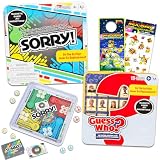
Overview: This set presents two classic Hasbro games—Sorry! and Guess Who?—in compact, magnetic tin formats, targeting children aged 8-12 for travel or waiting-area entertainment. The magnetic pieces and included extras aim to enhance portability and appeal. What Makes It Stand Out: The magnetic game boards are the key innovation, securely holding pieces during movement—crucial for car or plane travel. Including two distinct strategy games (Sorry!’s luck-based race and Guess Who?’s deduction) in durable, pocket-sized tins provides solid variety. Bonus Rex-Man stickers and a door hanger add novelty value for the target age group. Value for Money: Good value for two high-quality, officially licensed magnetic games in one purchase. The tins ensure longevity and piece retention, outperforming non-magnetic travel sets that often lose components. While not the cheapest option, the build quality and included extras justify the price for frequent travelers. Strengths and Weaknesses: Strengths: Magnets prevent piece loss effectively; tins are sturdy and portable; classic gameplay retains kid appeal; bonus stickers enhance unboxing; suitable for ages 8-12. Weaknesses: Limited to two games (less variety than larger bundles); magnetic pieces can occasionally stick awkwardly; stickers/door hanger offer minimal long-term play value. Bottom Line: A reliable, well-executed duo of magnetic travel games. Best for families needing compact, piece-secure entertainment for occasional trips; recommended if prioritizing durability over sheer game quantity.
3. Hasbro Gaming Magnetic Game Travel Set for Kids - Bundle with 4 Travel Games in Tin Featuring Connect 4, Sorry, Trouble, Guess Who Plus Stickers | Travel Games for Kids 8-12

Overview: This expanded bundle doubles the fun, packing four magnetic-travel classics—Connect 4, Sorry!, Trouble, and Guess Who?—into individual tins, plus stickers, targeting kids 8-12 seeking versatile on-the-go entertainment. What Makes It Stand Out: Quadrupling the game variety within the magnetic-tin format is its major advantage. It covers diverse mechanics: Connect 4 (strategy), Trouble (dice luck), Sorry! (racing), and Guess Who? (deduction). The magnetic pieces stay firmly in place during transit, while the tins enable effortless storage and portability—ideal for lengthy journeys where novelty is key. Value for Money: Excellent value given four premium magnetic games in one set. It costs less per game than buying them individually and surpasses single-game travel sets in replayability. The inclusion of Rex-Man stickers, while minor, sweetens the deal. Beats larger non-magnetic bundles prone to lost pieces. Strengths and Weaknesses: Strengths: Unmatched variety in a compact format; superior magnetic piece retention; durable tin storage; classic games appeal broadly; great for group travel with multiple kids. Weaknesses: Individual tins add bulk compared to consolidated bundles; magnetic pegs in Connect 4/Trouble can be fiddly; stickers are disposable extras. Bottom Line: The top choice for families wanting maximum game diversity in a secure, travel-ready package. Highly recommended for road trips or flights where sustained engagement is essential—justifies its price with robust utility.
4. Regal Games Card Games for Kids - Go Fish, Crazy 8’s, Old Maid, Slap Jack, Garbage Monster, War - Simple & Fun Classic Family Table Games - Games May Vary (6 Set)

Overview: This set delivers six distinct, kid-optimized card games (including Go Fish, Crazy 8’s, and War) in oversized decks, designed for 2-6 players aged 4+. It emphasizes simplicity, education, and portability for family play anywhere. What Makes It Stand Out: The extra-large cards (perfect for small hands) and vibrant, intuitive designs make it exceptionally child-friendly. Beyond fun, it subtly builds cognitive skills—memory, color/number recognition, and reading—through gameplay. The compact size and six-game variety offer immense replayability in a near-weightless package. Value for Money: Exceptional value; six thematic decks surpass most single-deck card sets. The durable cards withstand rough handling, and the educational angle justifies the cost versus purely entertainment-focused alternatives. It’s cheaper per game than comparable specialty sets while serving ages 4+. Strengths and Weaknesses: Strengths: Oversized, durable cards ideal for young children; strong educational benefits; huge variety for group play; ultra-portable; great for 2-6 players. Weaknesses: Card-only format lacks tactile board-game engagement; “Garbage Monster” theme may not resonate with all; minimal strategy depth for older kids (10+). Bottom Line: A superb, budget-friendly starter set for young children that blends learning with fun. Highly recommended for preschoolers and early elementary kids needing accessible, screen-free group activities on the move.
5. Gamie Magnetic Board Travel Games for Kids, Includes 12 Retro Fun Games - 5" Compact Design, Individually Boxed Travel Essentials for Kids Road Trip/Airplane/Camping, Stocking Stuffers for All Ages

Overview: This premium collection features twelve magnetic board games (Chess, Checkers, Backgammon, etc.) in compact 5-inch formats, individually boxed, targeting versatile family entertainment for ages 6+ during travel or at home. What Makes It Stand Out: The sheer breadth—twelve distinct strategy games—is unmatched, including complex options like Chess and Backgammon alongside kid-friendly choices like Snakes & Ladders. High-quality magnetic boards and individually boxed storage within a sturdy master case ensure longevity and organization, while printed instructions support independent play. Value for Money: Outstanding long-term value due to the extensive game library. The durable construction and comprehensive scope far exceed single-game sets, making it cost-effective per game. Ideal for families seeking to replace multiple purchases with one heirloom-quality kit for diverse ages. Strengths and Weaknesses: Strengths: Unrivaled variety covering all skill levels; robust magnetic play and storage; excellent for cognitive development; suitable for 6+ to adults; sturdy master box. Weaknesses: Smaller board size (5") may challenge players with limited dexterity; complex games like Chess require prior knowledge; premium price point. Bottom Line: The ultimate investment for families prioritizing educational depth and game diversity. Highly recommended for frequent travelers or households wanting a single, comprehensive solution for sustained, screen-free engagement across ages.
6. Pedolini 4 in a Row Connect Game Travel Board Game (Small) Mini 7x4.8 Inch

Overview: This ultra-compact plastic Connect 4 variant delivers the classic strategy game in a pocket-sized format perfect for on-the-go play. Designed for two players to race to align four discs vertically, horizontally, or diagonally, it targets families and kids seeking portable entertainment during travel or downtime.
What Makes It Stand Out: Its standout feature is the genuinely portable 7x4.8-inch size, fitting effortlessly in bags for cars, planes, or picnics. High-quality, smooth plastic ensures durability uncommon in mini-games, while the simple, educational gameplay sharpens strategic thinking for children without screens.
Value for Money: Priced modestly higher than paper travel games but significantly cheaper than full-sized sets, it offers excellent longevity. The sturdy construction justifies the cost compared to flimsy alternatives, making it a smarter investment for frequent travelers than disposable options.
Strengths and Weaknesses: Strengths: Exceptional portability; robust plastic build; quick setup; genuinely educational for spatial reasoning. Weaknesses: Very small discs risk loss; limited replay depth for adults; narrow grid (5x4) shortens game duration versus standard versions.
Bottom Line: An ideal travel companion for families with young kids, offering reliable, screen-free fun. While too simplistic for older players, its durability and true portability make it a worthwhile buy for car rides or waiting rooms.
7. Educational Insights Kanoodle - 3D Brain Teaser Puzzles for Kids, Spatial Puzzle Games for Adults, Teens and Kids, Problem Solving Toys and Logic Puzzles, Single Player Games

Overview: Kanoodle is a best-selling, single-player logic puzzle challenging users to arrange colorful, interconnected pieces into 2D grids or 3D pyramids across 200+ increasingly difficult levels. Marketed as screen-free brain training, it appeals to ages 7-107 seeking portable cognitive challenges.
What Makes It Stand Out: Its viral popularity (“9 million sold”) underscores its addictive, progressive difficulty curve. The compact, self-contained case with locking tray prevents piece loss, while the blend of 2D and 3D puzzles uniquely develops spatial reasoning beyond typical flat puzzles, fostering serious “just one more” engagement.
Value for Money: Competitively priced for the puzzle count and durability, it outperforms cheaper, flimsy alternatives. Given its years-long replayability and cross-generational appeal, it offers superior cost-per-hour value compared to disposable travel games or digital subscriptions.
Strengths and Weaknesses: Strengths: Massive puzzle variety; exceptional portability; builds critical STEM skills; satisfying tactile feedback; durable case. Weaknesses: Purely solo play limits social interaction; advanced puzzles may frustrate younger kids; small pieces pose a choking hazard for under-3s.
Bottom Line: A must-have for puzzle lovers seeking substantive, screen-free mental exercise. Its educational depth and travel-ready design justify the price, making it a top-tier gift for thinkers of almost any age.
8. Hasbro Gaming Guess Who? Card Game for Kids, 2 Player Guessing Game, Fun Summer Activities, Vacation Travel Essentials, Ages 5+

Overview: This travel-focused card adaptation distills the iconic Guess Who? board game into a compact deck, where two players race to deduce each other’s hidden character by asking strategic yes/no questions about traits like hair color or accessories.
What Makes It Stand Out: It brilliantly miniaturizes the classic deduction experience without sacrificing core gameplay. The card-only format eliminates bulky plastic components, making it featherlight for suitcases or pockets, while retaining the quick, engaging question-and-answer dynamic perfect for short attention spans.
Value for Money: Slightly pricier than generic card games but justified by Hasbro’s reliable branding and faithful adaptation. It costs less than the full board game yet delivers 80% of the fun in a fraction of the space, offering solid value for frequent travelers needing instant entertainment.
Strengths and Weaknesses: Strengths: True portability; simple rules ideal for ages 5+; quick rounds (5-10 mins); durable cards resist wear; authentic Guess Who? charm. Weaknesses: Only for two players; limited character variety reduces replayability; small cards easily bent or lost if not stored carefully.
Bottom Line: An excellent travel essential for parents wanting classic game fun without bulk. While constrained by player count, its ease of play and compactness make it a smart, reliable choice for road trips or waiting areas.
9. PlayMonster Spoons in a Case, Card Games for Kids - Spoons Game, Fun Family Games for Kids and Adults, Game Night, Travel Games, 3-6 Players, Ages 7+

Overview: This fast-paced party game challenges 3-6 players to rapidly collect four-of-a-kind cards and snatch a physical spoon from the center, triggering chaotic scrambles. Housed in a durable case with included spoons, it’s engineered for explosive group fun anywhere.
What Makes It Stand Out: The integrated travel case is a game-changer—keeping spoons and cards securely contained prevents constant loss during trips. Its brilliance lies in the perfect storm of simplicity (learn in 60 seconds), high-energy interaction, and universal appeal that sparks laughter across generations in minutes.
Value for Money: Excellent value given the included spoons and rugged case, which eliminate the need for makeshift solutions. Priced comparably to standard card decks but delivering vastly more replayability and physical engagement, it outshines generic travel games for group settings.
Strengths and Weaknesses: Strengths: Unbeatable group energy; brilliantly portable case; scales perfectly for 3-6 players; endless replayability; easy to learn. Weaknesses: Requires minimum 3 players; spoons can bend; not suitable for calm environments due to noise/scrambles.
Bottom Line: The ultimate travel game for lively groups. Its thoughtful packaging and infectious fun make it indispensable for family vacations, parties, or game nights—just ensure you have enough players.
10. Melissa & Doug On The Go Game On! Reusable Games Wipe-Off Activity Pad Reusable Travel Toy with 2 Dry-Erase Markers - FSC Certified

Overview: This spiral-bound activity pad features 10 double-sided, wipe-clean pages with 17 reusable games (like mazes, word searches, and spot-the-difference), paired with two dry-erase markers. Designed for solo or partner play, it’s a sustainable travel essential for ages 6+.
What Makes It Stand Out: Its standout feature is true reusability—unlike single-sheet activity books, kids can play games repeatedly, reducing waste. The sturdy FSC-certified construction, built-in marker storage, and compact 6"x10" size make it exceptionally practical for extended trips without constant repurchasing.
Value for Money: Higher initial cost than disposable books, but the endless play value offers massive long-term savings. The included markers and durable pages prevent the need for replacements, justifying the price for eco-conscious families facing frequent travel.
Strengths and Weaknesses: Strengths: Eco-friendly and waste-free; diverse game types; secure marker storage; FSC-certified sustainability; ideal for quiet trips. Weaknesses: Limited social interaction; marker smudging can occur; less engaging for kids preferring tactile/3D play.
Bottom Line: A top-tier, planet-friendly solution for keeping kids occupied on long journeys. While not interactive, its reusability and thoughtful design make it a cost-effective, responsible choice for patient travelers.
Why Portability Isn’t Just About Size
The Critical Weight Factor
It’s not just about fitting in the glove compartment. A game that feels substantial in your bag adds unnecessary strain on already overburdened luggage. Lightweight materials like durable cardboard, thin but sturdy plastic, or even fabric components make a huge difference when every ounce counts during constant packing and unpacking. Consider how the game feels after hours of travel—bulky, heavy sets become forgotten burdens, while featherlight options stay accessible and inviting.
Magnetic Magic: More Than Just a Gimmick
True road trip heroes often feature strong, reliable magnets. This isn’t just a neat trick; it’s essential physics for moving vehicles. Magnets keep boards stable on laps, prevent pieces from scattering during sudden stops, and allow play on metal surfaces (like tray tables or even the car door itself). Weak magnets lead to constant frustration and lost pieces—prioritize sets where the magnetic connection feels secure and positive, even with small hands manipulating pieces.
The Snap-Close Imperative
Games that snap shut securely are non-negotiable. Flimsy clasps or loose drawstrings mean pieces spill the moment the bag shifts. Look for rigid boxes with positive-locking mechanisms or durable fabric rolls with secure fastenings. This simple feature saves countless minutes (and tempers) spent retrieving tiny components from under seats. A truly travel-ready game should survive being tossed in a backpack without compromising its integrity.
Matching Games to Developmental Stages
Toddler Tactics: Simplicity and Sensory Engagement
For the youngest travelers (ages 2-4), games must prioritize ultra-simple rules, large, easy-to-grasp pieces, and sensory elements. Think matching games with chunky tiles, basic color or shape recognition, or even tactile games with different textures. The goal isn’t complex strategy but short bursts of focused play that develop motor skills and cognitive recognition without overwhelming their developing attention spans. Avoid anything requiring fine dexterity or multi-step rules.
School-Age Strategy: Building Cognitive Muscle
Children aged 5-8 thrive on games introducing light strategy, memory, and pattern recognition. Look for mechanics like set collection, simple resource management, or cooperative play where everyone works towards a common goal. Games at this level should offer clear cause-and-effect, opportunities for planning one or two moves ahead, and a satisfying sense of accomplishment. Avoid overly punishing mechanics; the focus should be on learning through play, not intense competition that leads to tears.
Pre-Teen Prowess: Depth Within Constraints
Older kids (9-12+) crave more strategic depth and replayability, but space limitations still apply. Seek compact games offering meaningful decisions, variable setups, or modular boards that change each playthrough. Cooperative challenges, light deduction, or strategic tile-laying can be excellent. The key is balancing complexity—enough to be engaging and mentally stimulating, but not so much that rules explanations eat up precious travel time or cause frustration in confined spaces. Games should spark discussion and negotiation.
Essential Features for In-Car Success
Noise Level: The Quiet Game Advantage
Road trips are already noisy environments. Games requiring loud dice rolls, shouting, or excessive shuffling can quickly become irritating for everyone, including the driver. Prioritize silent play mechanics: card drafting, tile placement, magnetic movement, or dexterity games using gentle flicks instead of loud throws. Consider the sound of the pieces themselves—plastic that clicks loudly versus softer cardboard or fabric.
Playtime Perfection: Micro-Sessions Rule
Forced marathon sessions rarely work in a car. The ideal travel game excels in short, 5-15 minute bursts. Look for games with quick setup, simple turns, and natural stopping points. Can you play a meaningful round while waiting for gas? Finish a mini-challenge before the next rest stop? Games designed for longer sessions often lead to frustration when inevitably interrupted by traffic or a necessary pit stop. Brevity is a feature, not a limitation.
One-Handed Operation: The Lap Desk Reality
Playing on a moving lap demands games that can be managed with one hand while the other stabilizes the playing surface (or clutches a seatbelt!). Avoid games requiring constant two-handed manipulation, heavy shuffling, or precise stacking that crumbles with every bump. Magnetic boards, cards that lay flat without shuffling, and pieces that snap securely are key. Test how easily a game functions when your dominant hand is busy holding it steady.
Beyond the Game: The Hidden Travel Factors
The All-Ages Inclusion Factor
Trips often involve siblings of vastly different ages. Games that offer scalable difficulty—like adjustable rule variants or cooperative play where everyone contributes meaningfully—are golden. Avoid games where younger kids feel lost or older kids are bored; seek mechanics where participation feels valuable regardless of skill level. Cooperative games often excel here, fostering teamwork instead of highlighting skill gaps.
The Cleanup Speed Test
When the driver announces “We’re stopping in 2 minutes!” panic sets in. Games with minimal pieces, clear organization within the box, or self-contained playing areas (like a single board with slots) win the cleanup race. Complex games with dozens of tiny components are a recipe for disaster and lost pieces. Ask yourself: Can this be packed away blindfolded in under 30 seconds? If not, it’s probably not car-ready.
Spill-Proof Design Philosophy
Beyond magnets, consider how pieces naturally behave. Do they have flat bases that resist rolling? Are they large enough not to vanish instantly? Are cards oversized for small hands? Games designed with travel in mind anticipate spills—they use pieces that nest securely, avoid perfect spheres, and ensure critical components (like the board itself) are the first thing secured when packing. It’s about anticipating chaos, not just hoping for calm.
Maximizing the Experience: Pro Tips for Parents
The Pre-Trip Preview Strategy
Introduce the game at home before the trip. Let kids learn the rules, handle the pieces, and play a full round in a calm environment. This reduces frustration on the road when attention spans are shorter. It also helps identify if a game is truly a good fit—some look great online but confuse kids in practice. Home testing reveals rule ambiguities or pieces that are too fiddly.
The Cooperative Shift: Reducing Backseat Rivalry
Competitive games can escalate tension quickly in confined spaces. Whenever possible, choose or adapt games to be cooperative. Working together towards a common goal (like escaping a maze or collecting all the treasures) minimizes arguments, builds teamwork, and creates shared positive memories. Even competitive games can sometimes be reframed as “us vs. the timer” or “can we beat our last score?”
Integrating the Journey: Thematic Travel Connections
Choose games that subtly connect to the travel experience itself. A route-building game mirrors the journey you’re on; a resource management game echoes packing snacks and supplies; a memory game about landmarks seen out the window reinforces observation skills. This transforms play from a distraction into an engaging part of the adventure, making the trip itself more interactive and meaningful.
Frequently Asked Questions
How do I stop small game pieces from getting lost in the car?
Prioritize games with larger components, magnetic pieces, or integrated storage slots. Always play on a dedicated lap tray or the game board itself—not loose on seats. Do a quick piece count and secure the game before stopping the car.
What’s better for road trips: cards or board games?
Both work well, but compact card games (especially those in tuck boxes) often have the edge for extreme portability and noise reduction. However, magnetic board games offer a more stable, shared focal point. Consider your space and noise tolerance.
Can travel games actually be educational?
Absolutely. Look for games reinforcing math (counting, simple arithmetic), literacy (word formation, storytelling), spatial reasoning (pattern building, mazes), logic (deduction, sequencing), and social skills (taking turns, cooperation). The best blend fun with subtle learning.
How do I handle games that require reading for non-readers?
Seek games relying on symbols, colors, or pictures instead of text. Many modern games use intuitive iconography. For family games, have an adult read cards initially, or choose cooperative options where older kids/adults can assist younger players with rules.
Are electronic travel games a good alternative?
They have a place, but non-electronic games offer crucial screen-free time, reduce eye strain, avoid battery anxiety, and encourage direct social interaction. They’re also unaffected by poor signal or device glitches—critical when you need a reliable distraction.
What’s the ideal number of players for a car game?
Games designed for 2-4 players are most versatile. Consider your typical passenger count. Games playable solo (for independent play) or cooperatively (for group play) offer maximum flexibility across different trip scenarios.
How do I keep the game from sliding off laps?
Use a small, rigid lap desk or even a sturdy book as a base. Magnetic games inherently resist sliding. Play on the center console if safe and accessible. Avoid placing games directly on slippery car seats without a stable underlayer.
Should I prioritize durability over complexity?
Generally, yes. A slightly simpler game that survives repeated travel and rough handling is far more valuable than a complex one that breaks or loses pieces quickly. Durability ensures the game remains usable trip after trip.
How can I make game time fair with kids of different ages?
Use cooperative play, assign handicaps (e.g., younger kids get extra moves), choose games with adjustable difficulty levels, or have older kids mentor younger ones. Focus on participation and fun, not strict competition.
What’s the most overlooked feature in travel games?
Ease of setup and teardown. Games that pop open ready-to-play and snap shut in seconds minimize frustration during short travel windows. If setup takes longer than the play session, it’s not road-trip friendly.
See Also
- Stop Boredom on Road Trips with the 10 Best Travel Board Games for Kids This Year
- How to Choose the 10 Best Travel Board Games for Kids in 2026
- 10 Top-Rated Travel Board Games for Kids According to Experts in 2026
- 10 Most Durable Travel Board Games for Kids Based on Real User Reviews in 2026
- How to Choose the Best Travel Board Games for Stress-Free Family Vacations