Table of Contents
Imagine staring down the barrel of a long car ride or flight with restless kids, the dreaded “Are we there yet?” echoing before you’ve even left the driveway. Portable entertainment becomes your lifeline, but sticky fingers, limited space, and the constant threat of tiny pieces vanishing into seat crevices turn simple fun into a logistical nightmare. Parents know the struggle: balancing engagement with sanity, education with entertainment, and durability with portability feels like solving a puzzle blindfolded. The right travel game isn’t just a distraction; it’s a peace treaty for the journey, transforming potential meltdowns into moments of shared laughter and quiet concentration.
Beyond mere survival tactics, thoughtfully chosen travel games offer remarkable developmental benefits disguised as play. Research consistently shows that strategic board games enhance cognitive flexibility, improve problem-solving skills, and foster emotional resilience in children—skills that shine brightest when routines are disrupted. Unlike screen-based options, physical games encourage face-to-face interaction, building communication and social bonds without the zombie-eyed aftermath of digital overstimulation. Investing time in selecting the right compact game means nurturing your child’s growth while reclaiming precious moments of calm during travel chaos. Let’s explore how to pinpoint the perfect portable playmates for your next adventure.
Top 10 Travel Board Games for Kids
Detailed Product Reviews
1. Hasbro Games Grab and Go! Bundle (4 Pack) | Kids Travel Board Games | Battleship, Connect 4, Guess Who?, Hungry Hungry Hippos Games | 2 Players I Ages 7+

Overview:
This compact 4-pack delivers iconic Hasbro board games in travel-ready formats. Designed for ages 7+, each game—Battleship, Connect 4, Guess Who?, and Hungry Hungry Hippos—is miniaturized for portability while retaining core gameplay. Ideal for two players during travel or downtime, it champions screen-free engagement with built-in storage to prevent lost pieces.
What Makes It Stand Out:
The bundle excels in practicality: all four classics fit neatly into pocket-sized cases, each with secure compartments for components. Hungry Hungry Hippos’ mini mechanical plungers and Battleship’s peg storage are thoughtful adaptations. Its universal appeal as non-candy gifts (Easter baskets, stocking stuffers) and versatility across settings—planes, restaurants, or waiting rooms—cements its standout travel utility.
Value for Money:
Priced competitively against single full-sized games, this set offers exceptional value. Buying four portable classics separately would cost significantly more, making it economical for parents seeking durable, reusable entertainment. While slightly pricier than basic card decks, the physical interactivity justifies the cost for frequent travelers.
Strengths and Weaknesses:
Strengths: Streamlined setup; robust cases prevent piece loss; timeless gameplay fosters strategy and deduction; perfect for impromptu play. Weaknesses: Strictly limited to two players; miniaturization slightly reduces tactile satisfaction (e.g., smaller Hippos); not ideal for children under 7 due to complexity.
Bottom Line:
A near-flawless travel essential for families. Its smart design, nostalgic appeal, and multi-scenario usability make it a top-tier investment for keeping kids engaged offline—highly recommended for road trips or waiting periods.
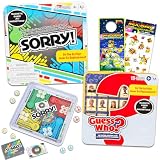
2. Magnetic Game Travel Set for Kids - Bundle with 2 Travel Games in Tin Featuring Sorry, Guess Who Plus Stickers, More | Hasbro Travel Games for Kids 8-12
Overview:
This dual-game tin bundle offers magnetic versions of Sorry! and Guess Who? tailored for kids 8–12. Housed in sturdy, portable tins, both games feature magnetic pieces that stay securely in place during travel—eliminating frustration from shifting boards on planes or cars. Includes bonus Rex-Man stickers and a door hanger for added appeal.
What Makes It Stand Out:
The magnetic mechanism is the hero here, ensuring pieces never slide during gameplay—a critical upgrade for moving vehicles. The tin cases double as storage and play surfaces, maximizing convenience. Bonus stickers provide instant gratification, while the gender-neutral design broadens its audience. It’s ideal for sustained focus during long journeys.
Value for Money:
At a mid-range price point, it delivers solid value for two high-engagement games. Though fewer titles than larger bundles, the magnetic reliability justifies the cost compared to non-magnetic alternatives prone to piece loss. The included extras (stickers, hanger) enhance perceived worth without inflating price.
Strengths and Weaknesses:
Strengths: Magnets prevent mid-game chaos; tins are durable and space-efficient; easy rule comprehension; stickers extend play value. Weaknesses: Only two games limit replay variety; stickers/hanger feel like filler; Guess Who?’s smaller scale may frustrate younger kids; strictly for 2 players.
Bottom Line:
A reliable, no-fuss travel solution for short trips. Best for families prioritizing piece security over quantity—recommended if you seek frustration-free gameplay but want more variety than this offers.
3. Hasbro Gaming Magnetic Game Travel Set for Kids - Bundle with 4 Travel Games in Tin Featuring Connect 4, Sorry, Trouble, Guess Who Plus Stickers | Travel Games for Kids 8-12

Overview:
This comprehensive set expands on Hasbro’s magnetic travel concept with four classics: Connect 4, Sorry!, Trouble, and Guess Who? Each game arrives in its own compact tin, featuring secure magnetic pieces and printed instructions. Targeted at ages 8–12, it promises hours of screen-free fun during commutes or vacations.
What Makes It Stand Out:
Quadrupling the game variety over smaller bundles, it includes Trouble’s iconic “Pop-O-Matic” dice roller in mini form—a standout feature. All tins nest neatly for storage, and magnets ensure pieces stay put even mid-shake. The inclusion of Rex-Man stickers maintains kid appeal, while diverse gameplay (strategy, luck, deduction) caters to varied interests.
Value for Money:
Exceptional value for four premium magnetic games. Competing single-game tins often match this bundle’s price, making it a smarter buy. The durability of tins versus flimsy boxes justifies a slight premium over non-magnetic sets. Ideal for cost-conscious parents wanting maximum replayability.
Strengths and Weaknesses:
Strengths: Four distinct, high-quality games; magnetic security; Trouble’s functional dome adds novelty; tins protect components long-term. Weaknesses: Guess Who?’s tiny pegs may frustrate; stickers feel superfluous; all games support only 2 players; tin edges can snag fabric.
Bottom Line:
The definitive magnetic travel bundle for versatility and durability. A must-buy for frequent travelers—it outperforms smaller sets in replay value and reliability. Highly recommended for ages 8+.
4. Regal Games Card Games for Kids - Go Fish, Crazy 8’s, Old Maid, Slap Jack, Garbage Monster, War - Simple & Fun Classic Family Table Games - Games May Vary (6 Set)

Overview:
This 6-deck set delivers timeless card games—Go Fish, Crazy 8’s, Old Maid, Slap Jack, War, and Silly Monster Memory Match—in child-optimized formats. Designed for 2–6 players aged 4+, it features oversized cards with vibrant illustrations, prioritizing accessibility and educational play over complex rules.
What Makes It Stand Out:
The extra-large cards (3.5"x2.5") are perfect for small hands, reducing fumbling. Bright, thematic artwork (e.g., “Garbage Monster”) boosts engagement, while simplified rules lower entry barriers. Unlike electronic alternatives, it encourages social interaction and adaptability—slap-based games like Slap Jack add energetic physical play.
Value for Money:
Outstanding value under $15. Six themed decks surpass typical single-game packs in variety and longevity. The focus on skill-building (memory, numeracy) elevates it beyond pure entertainment, making it cheaper per hour of play than most digital subscriptions or physical games.
Strengths and Weaknesses:
Strengths: Large, durable cards; inclusive player count (2–6); stealthy educational benefits; portable for all outings. Weaknesses: Minimal strategy depth for older kids; “Garbage Monster” theme feels gimmicky; no storage box included; paper quality prone to bending if mishandled.
Bottom Line:
A brilliant starter kit for preschoolers and early readers. Its simplicity, inclusivity, and learning potential make it essential for developing social and cognitive skills—highly recommended as a first card game set.
5. Gamie Magnetic Board Travel Games for Kids, Includes 12 Retro Fun Games - 5" Compact Design, Individually Boxed Travel Essentials for Kids Road Trip/Airplane/Camping, Stocking Stuffers for All Ages

Overview:
This expansive collection packs 12 magnetic board games—Chess, Checkers, Backgammon, and more—into palm-sized 5" sets. Each game comes in its own rigid box with magnetic pieces, targeting ages 6+ for travel or home play. It emphasizes educational strategy while fitting neatly into bags or glove compartments.
What Makes It Stand Out:
The sheer variety (12 games) is unmatched, spanning strategy (Chess), luck (Snakes & Ladders), and logic (Solitaire). Magnetic pieces stay fixed during turbulence, and individual boxes prevent game mixing. Printed instructions simplify setup, while the retro assortment appeals to multiple generations—unlike kid-focused bundles.
Value for Money:
Exceptional for the quantity. Buying 12 standalone magnetic travel games would cost 3x more. Though some titles (e.g., Nine Men’s Morris) are niche, the breadth justifies the price for families seeking long-term engagement. Durable construction ensures years of use, outperforming flimsy alternatives.
Strengths and Weaknesses:
Strengths: Unrivaled game diversity; sturdy individual boxes; strong educational focus; compact yet readable boards. Weaknesses: Tiny pieces in Chess/Checkers risk loss; complex games like Backgammon may overwhelm young kids; no carrying case for all 12 boxes; inconsistent instruction clarity.
Bottom Line:
A powerhouse bundle for strategy-loving families. Despite minor age-fit issues, its educational depth and replayability make it a top-tier investment—highly recommended for road trips or gifting to curious minds.
6. Pedolini 4 in a Row Connect Game Travel Board Game (Small) Mini 7x4.8 Inch

Overview: The Pedolini 4 in a Row is a compact travel adaptation of the classic strategy game, designed for on-the-go play. Its miniature size (7x4.8 inches) caters to children and adults seeking portable entertainment during commutes, flights, or outdoor activities. Crafted for quick setup and easy storage, it prioritizes convenience without sacrificing core gameplay.
What Makes It Stand Out: Its standout feature is the seamless portability—small enough for pockets or bags yet robust enough for repeated use. The high-quality plastic ensures smooth disc insertion and durability, while the timeless “4-in-a-row” objective offers educational value by sharpening kids’ strategic thinking. Unlike flimsy travel games, it maintains sturdiness during movement, making it ideal for cars or planes.
Value for Money: Priced modestly for a durable, ready-to-play set, it outperforms single-use travel kits. While larger standard editions cost more, this mini version delivers identical gameplay at a fraction of the size and price, justifying its cost for frequent travelers or parents needing screen-free distractions.
Strengths and Weaknesses:
Strengths: Exceptional portability; premium, non-brittle plastic; quick setup; educational for ages 6+; versatile for schools or picnics.
Weaknesses: Smaller grid (7x6 vs. standard 7x6) slightly reduces strategic depth; tiny discs risk loss if not stored carefully.
Bottom Line: A near-flawless travel essential for strategy fans, offering reliable fun and educational benefits. Highly recommended for families prioritizing compact, high-quality entertainment over traditional board game scale.
7. Educational Insights Kanoodle - 3D Brain Teaser Puzzles for Kids, Spatial Puzzle Games for Adults, Teens and Kids, Problem Solving Toys and Logic Puzzles, Single Player Games

Overview: Kanoodle is a bestselling single-player puzzle game challenging users to solve 200+ 2D and 3D spatial logic puzzles using colorful interconnected beads. Marketed as “TikTok-made,” it targets ages 7–107 with progressively difficult challenges stored in a compact, self-contained case.
What Makes It Stand Out: Its viral success (9M+ sold) stems from addictive, screen-free problem-solving that bridges generations. The dual 2D/3D puzzle modes and portable design—keeping all 12 puzzle pieces secure—make it exceptional for travel. Unlike multiplayer games, it fosters independent critical thinking with “just one more” replayability.
Value for Money: At mid-range pricing, it offers extraordinary longevity with hundreds of puzzles, outlasting cheaper alternatives that lack complexity. While expansion packs cost extra, the base game’s depth justifies the investment for educators or families seeking sustained cognitive engagement.
Strengths and Weaknesses:
Strengths: Massive puzzle variety; sturdy travel case; boosts spatial reasoning; screen-free focus; suitable for wide age range.
Weaknesses: 3D puzzles may frustrate younger kids (under 9); no competitive element limits group play.
Bottom Line: An outstanding brain-training tool for solo players, Kanoodle earns its hype with educational depth and portability. Ideal for travelers, students, or anyone craving challenging, device-free fun—highly recommended.
8. Hasbro Gaming Guess Who? Card Game for Kids, 2 Player Guessing Game, Fun Summer Activities, Vacation Travel Essentials, Ages 5+

Overview: This portable adaptation of the iconic Guess Who? board game condenses the classic mystery-character guessing into a compact card format. Designed for two players ages 5+, it uses face-up character cards and a draw deck to facilitate quick yes/no questioning sessions anywhere.
What Makes It Stand Out: Its travel-friendly card-only design eliminates bulky stands or trays, making it uniquely suited for planes or restaurants. The simplified rules retain the original’s deductive fun while speeding up gameplay—perfect for short attention spans. As an official Hasbro product, it leverages nostalgic branding with modern convenience.
Value for Money: Slightly pricier than generic card games but justified by Hasbro’s quality and recognizable IP. It costs less than the full board game yet delivers comparable core mechanics, offering solid value for parents seeking reliable, brand-trusted travel entertainment.
Strengths and Weaknesses:
Strengths: Ultra-portable; easy setup/rules for young kids; authentic Guess Who? experience; durable cards.
Weaknesses: Lacks tactile engagement of original stand-up game; two-player limit reduces group appeal.
Bottom Line: A clever, well-executed travel companion that captures Guess Who?’s spirit efficiently. Best for parents needing quick, educational downtime—recommended for ages 5–10, though purists may miss the classic board.
9. PlayMonster Spoons in a Case, Card Games for Kids - Spoons Game, Fun Family Games for Kids and Adults, Game Night, Travel Games, 3-6 Players, Ages 7+

Overview: PlayMonster’s Spoons packages the chaotic, fast-paced card game—where players race to collect four-of-a-kind and snatch a spoon—into a travel-ready case. Including 52 cards and 4 plastic spoons, it supports 3–6 players in high-energy rounds ideal for game nights or road trips.
What Makes It Stand Out: The integrated storage case is revolutionary for Spoons, solving the perennial issue of lost spoons or scattered cards. Gameplay remains gloriously simple and social, sparking instant laughter with its blend of speed, bluffing, and spoon-grabbing panic—perfect for breaking the ice at gatherings.
Value for Money: Competitively priced for a complete, durable set. Cheaper travel versions often omit spoons or use flimsy materials, but this includes robust components and reusability, making it a smarter long-term buy for frequent players.
Strengths and Weaknesses:
Strengths: Brilliant case organization; lightning-fast setup; inclusive for mixed ages; encourages social interaction; replayable.
Weaknesses: Plastic spoons feel less premium than metal; noise may disrupt quiet environments.
Bottom Line: The definitive travel edition of Spoons, transforming a classic into a tidy, ready-to-play package. Highly recommended for families or groups craving lively, no-fuss fun—just add players and chaos.
10. Melissa & Doug On The Go Game On! Reusable Games Wipe-Off Activity Pad Reusable Travel Toy with 2 Dry-Erase Markers - FSC Certified

Overview: This spiral-bound activity pad features 10 double-sided, wipe-clean pages with 17 reusable games (like mazes and word puzzles) and two dry-erase markers. Designed for travel, it offers screen-free engagement for one or two players ages 6+, emphasizing eco-friendly FSC-certified materials.
What Makes It Stand Out: Its reusability eliminates waste—players solve, erase, and replay endlessly—setting it apart from disposable travel kits. The sturdy construction, built-in marker storage, and compact 6"x10" size make it exceptionally practical for cars or waiting rooms, while FSC certification appeals to eco-conscious buyers.
Value for Money: Priced higher than single-use activity books but justified by infinite playtime. The included markers (with eraser caps) and durable pages ensure cost efficiency over trips, outperforming cheaper pads that smudge or tear.
Strengths and Weaknesses:
Strengths: Truly reusable; eco-certified; diverse game types; portable with secure storage; great for solo or paired play.
Weaknesses: Marker ink may fade over time; younger kids might struggle with complex puzzles.
Bottom Line: A sustainable, versatile travel essential that pays for itself through endless use. Highly recommended for parents seeking mess-free, educational downtime—just wipe and replay for years.
Understanding the Unique Demands of Travel Games
Travel board games face challenges regular tabletop games never encounter. They must withstand the rigors of transit while remaining instantly accessible and endlessly engaging in cramped spaces. This unique environment demands specific considerations beyond standard gameplay.
Durability Under Pressure
Games destined for backpacks, carry-ons, and car trunks need rugged construction. Flimsy boxes crack, thin cards bend, and loose components shatter easily. Prioritize materials like thick, laminated cards, sturdy plastic tokens, and reinforced storage compartments that survive drops, temperature shifts, and the inevitable jostling of transit. A game that arrives intact is a game that actually gets played.
Compact Size and True Portability
“Travel-sized” can be misleading. True portability means fitting effortlessly into a plane seat pocket, a small backpack, or even a large jacket. Measure dimensions realistically—games exceeding 6x6 inches often become cumbersome. Consider weight too; heavy wooden pieces add unnecessary bulk. Opt for designs that nest components efficiently within a slim profile, avoiding awkward shapes that snag or won’t stow.
Effortless Setup and Takedown
When space is limited to a tray table or your lap, complex setups are impractical. Ideal travel games deploy in seconds with minimal components. Look for integrated boards, magnetic pieces, or fold-out play areas that eliminate separate mats. Similarly, takedown should be a one-motion process—no hunting for stray tokens under seats. Games with self-contained storage systems shine here.
Minimalist Component Count
Fewer pieces mean less stress and fewer losses. Games relying on a single deck of cards, a few durable tokens, or a small board with fixed slots drastically reduce the risk of losing critical elements mid-journey. Avoid games with dozens of tiny, identical pieces; even a secure box can’t prevent one rogue meeple from escaping during frantic play. Simplicity equals longevity on the road.
Decoding Age Appropriateness and Skill Development
Choosing a game mismatched for your child’s developmental stage leads to frustration, not fun. Understanding cognitive and motor skills at different ages ensures the game remains engaging without causing tears.
Matching Complexity to Cognitive Milestones
Preschoolers thrive on simple matching, color recognition, and short turns—games with clear, immediate feedback work best. Early elementary kids handle basic strategy, memory challenges, and cooperative play. Tweens and older children can manage deeper tactics, resource management, and nuanced rules. Ignoring these milestones results in either boredom (too simple) or overwhelm (too complex), killing replay value instantly.
Fine Motor Skill Considerations
Small hands struggle with fiddly pieces. Younger children need larger tokens, chunky cards, and components easy to grasp and manipulate in bumpy vehicles. Games requiring precise dexterity—like stacking tiny blocks—often end in scattered pieces and frustration during travel. Ensure components align with your child’s current motor abilities to keep play smooth and enjoyable.
Balancing Competition and Cooperation
While healthy competition has its place, travel often heightens emotions. Cooperative games, where players work together against the game itself, minimize sibling rivalry and foster teamwork—especially valuable in confined spaces. For competitive games, prioritize those with short playtimes, luck elements to soften losses, and clear paths to bounce back after setbacks, preventing one bad turn from ruining the trip.
Maximizing Educational Value On the Go
Travel time shouldn’t mean educational downtime. The best portable games seamlessly weave learning into play, turning transit hours into stealthy skill-building sessions without feeling like homework.
Strengthening Core Cognitive Abilities
Look for games that naturally develop memory (through matching or recall mechanics), spatial reasoning (via pattern placement or route planning), and logical deduction (in clue-gathering or prediction scenarios). These aren’t just “fun”—they reinforce neural pathways critical for academic success, all while kids are focused on winning the next round.
Fostering Language and Social Skills
Games requiring players to explain choices, negotiate trades, or describe strategies boost vocabulary and communication. Turn-taking, active listening, and graceful winning/losing are social muscles exercised through gameplay. Cooperative travel games are particularly potent for teaching empathy and collaborative problem-solving in real-time.
Encouraging Creativity and Adaptability
Open-ended games or those with variable setups spark improvisation. Can players invent new rules? Adapt to changing “travel conditions” within the game? This flexibility mirrors real-world problem-solving, teaching kids to pivot when plans shift—a crucial skill whether navigating a delayed flight or a tricky level in their favorite game.
Essential Features for Real-World Travel Success
Beyond core gameplay, specific practical features determine whether a game survives repeated journeys or gets abandoned after the first trip. These often-overlooked details make the difference between a trusted companion and travel trash.
Secure, Integrated Storage Solutions
The holy grail is a game where every component locks securely in place. Magnetic closures, snug-fitting trays, or compartments with raised edges prevent pieces from migrating or spilling during transit. Avoid boxes relying solely on rubber bands or flimsy lids—they fail under pressure. Test storage by shaking the box gently; if you hear rattling, it’s a disaster waiting to happen.
Visual Clarity and Low-Light Playability
Glowing screens aren’t the only option for dim cabins or evening road trips. Prioritize high-contrast visuals, large fonts, and uncluttered boards. Matte finishes reduce glare from windows, while bold colors and distinct symbols help kids with visual processing differences stay engaged. Some games even feature glow-in-the-dark elements—ideal for night flights.
Minimal Noise and Tactile Engagement
Crinkly cards, loud dice rolls, or clattering pieces annoy fellow travelers and disrupt focus. Seek quiet components like soft dice, smooth-card shuffling, or silent token placement. Conversely, subtle tactile elements (textured cards, satisfyingly weighty pieces) provide sensory feedback that enhances focus without disturbing others, keeping kids absorbed.
Replayability Through Variation
A game played 20 times on a single trip needs built-in variety. Look for modular boards, multiple rule variants, solo modes, or expandable challenges. Games relying solely on luck often lose appeal quickly; those blending luck with meaningful player choices maintain interest across countless journeys, offering fresh experiences without new purchases.
Maintaining Games and Managing Expectations
Even the best travel game fails if it’s constantly lost, broken, or met with resistance. Smart maintenance and realistic expectations ensure longevity and consistent use.
Establishing a Pre- and Post-Travel Ritual
Make game care part of your travel routine. Before packing, do a quick component count together. After playing, involve kids in the takedown—turn it into a “mission” to find every piece. This builds responsibility and prevents the dreaded “missing token” panic mid-game. A dedicated pouch within your travel bag signals this game is only for journeys.
Managing Screen-Time Transitions Smoothly
Don’t expect an instant switch from tablets to tabletops. Introduce travel games during calm home sessions first, framing them as “special trip adventures.” Start with short playtimes on journeys, gradually increasing as engagement grows. Position games as exciting alternatives, not punishments—enthusiasm is contagious.
Repairing and Refreshing Your Collection
Accidents happen. Keep a small travel kit with double-sided tape, mini zip bags for loose pieces, and a marker for touch-ups. If a game becomes stale, “refresh” it: invent a house rule, play sitting on the floor of a rest stop, or challenge kids to teach it to a new friend. Sometimes, taking a break and reintroducing it months later reignites interest.
Frequently Asked Questions
How do I stop small game pieces from getting lost during travel?
Use games with integrated storage where pieces snap or magnetize into place. Before packing, do a piece count with your child and store the game in a dedicated, padded pouch within your main bag. Avoid games with numerous tiny, identical components.
Can travel board games replace screen time effectively?
Absolutely. Well-chosen games offer focused engagement without blue light exposure. Start with short sessions during calm moments at home to build familiarity, making the transition smoother during actual travel. The social interaction and tactile feedback often prove more satisfying than passive screen use.
What’s the ideal playtime length for a travel game?
Aim for 10-20 minutes per session. Games ending within this window prevent restlessness in confined spaces and allow for multiple plays or switching activities. Avoid games exceeding 30 minutes unless suitable for older kids or breaks during long layovers.
Are cooperative games better than competitive ones for traveling?
Cooperative games often reduce in-car arguments since players work as a team against the game. They’re excellent for mixed-age groups. However, well-designed competitive games with quick turns and luck elements can also work—just prioritize those minimizing “winner takes all” frustration.
How do I choose a game for kids of different ages?
Look for games with adjustable rules or multiple play modes targeting different skill levels. Cooperative games frequently accommodate wider age ranges naturally. Avoid games where younger kids feel constantly “outplayed” by older siblings; shared goals or team play often bridge the gap.
What materials should I avoid in travel games?
Steer clear of games with thin cardboard, flimsy plastic, or small wooden pieces prone to snapping. Also avoid those relying on complex setups with many loose elements. Prioritize laminated cards, thick chipboard, and secure plastic or silicone components.
How can I test a game’s portability before buying?
Check the box dimensions against your intended storage spot (e.g., plane seat pocket). Mentally visualize setting it up on a tray table. Read reviews specifically mentioning “easy setup” or “compact storage.” If possible, watch unboxing videos focusing on component organization.
Do travel games really support learning?
Yes, robustly. They enhance memory, spatial reasoning, strategic thinking, and social skills like turn-taking and communication. The focused, interactive nature of physical play provides cognitive benefits screens often lack, turning downtime into valuable developmental time.
How often should I rotate travel games to keep kids interested?
Introduce one “new” game per major trip after testing it at home. Rotate 2-3 core games in your travel kit seasonally. Taking a game on a months-long break can make it feel fresh again when reintroduced, extending its useful life significantly.
What’s the biggest mistake parents make with travel board games?
Choosing games based solely on home play appeal without testing their travel-specific functionality. A great living room game often fails in transit due to size, setup time, or fragile pieces. Always prioritize portability, durability, and ease of use over complex mechanics for journeys.
See Also
- How to Choose the 10 Best Travel Board Games for Kids in 2026
- The 10 Ultimate Best Travel Board Games for Kids for Road Trips in 2026
- 10 Most Durable Travel Board Games for Kids Based on Real User Reviews in 2026
- Stop Boredom on Road Trips with the 10 Best Travel Board Games for Kids This Year
- How to Choose the Best Travel Board Games for Stress-Free Family Vacations