Table of Contents
Ever feel like your brain needs a workout as much as your body does? In our fast-paced world overflowing with information overload and snap judgments, the ability to cut through the noise, connect subtle clues, and arrive at sound conclusions isn’t just handy—it’s essential. Deduction strategy games offer a uniquely engaging mental gym, transforming the abstract skill of logical reasoning into a thrilling puzzle where every move sharpens your cognitive edge. Forget passive scrolling; these games demand active engagement, forcing you to observe meticulously, hypothesize rigorously, and adapt dynamically—skills that translate directly to better decision-making at work, in relationships, and navigating everyday complexities.
Looking ahead to 2026, the landscape for developing logical prowess through play is more vibrant and accessible than ever. Advances in game design are creating deeper, more intuitive experiences that cater to diverse learning styles and age groups, while research continues to underscore the profound impact structured deductive play has on cognitive development. Whether you’re a parent seeking tools to nurture a child’s critical thinking, an educator building classroom resources, or simply an adult committed to lifelong brain health, understanding how to choose and leverage these powerful games is key. This guide cuts through the hype to focus on the core principles and features that truly matter for building unshakeable logical reasoning skills through the timeless art of deduction.
Top 10 Deduction Strategy Games
Detailed Product Reviews
1. ENTHRONE – Abstract Deduction Strategy Game for 2 Players by Smirk & Dagger | Ages 10+ | 20–30 Min Playtime

Overview: ENTHRONE is a sleek, two-player deduction game where opponents duel to uncover each other’s hidden pawn identity while maneuvering on a striking stained-glass board. It blends tactical movement with psychological insight in short, intense sessions. What Makes It Stand Out: Its exceptional physical design—featuring eight 3-inch sculpted fantasy busts and a vibrant puzzle-board—creates an unmatched table presence. Unlike many deduction games, it avoids chaos through tight, turn-based strategy, emphasizing calculated risk over luck. The absence of player elimination ensures constant engagement. Value for Money: Priced mid-to-high for a niche two-player game, it justifies cost through heirloom-quality components and infinite replayability. Few abstract strategy games offer this blend of aesthetic beauty and cerebral depth, making it a standout investment for dueling enthusiasts. Strengths and Weaknesses: Strengths: Gorgeous premium materials; deeply strategic yet easy to learn; perfect for focused 1v1 challenges; no downtime. Weaknesses: Limited to two players; higher price point may deter casual gamers; thematic depth takes a backseat to mechanics. Bottom Line: ENTHRONE excels as a visually stunning, intellectually satisfying duel. Ideal for strategy purists seeking a refined head-to-head experience, it’s worth the investment despite its niche focus.
2. The Resistance Card Game by Indie Boards & Cards | Social Deduction Strategy Game of Bluffing, Deception, Negotiation | Party Game for 5–10 Players Ages 13+ | 30 Minute Rounds

Overview: The Resistance plunges 5–10 players into a sci-fi spy thriller where hidden “Spies” sabotage missions while the “Resistance” fights to complete them. Trust is fleeting as players debate, bluff, and expose traitors through rapid-fire rounds. What Makes It Stand Out: Its genius lies in continuous player involvement—no one sits out when missions fail, maintaining tension until the final vote. The streamlined rules prioritize social manipulation over complex mechanics, fostering explosive group dynamics and organic storytelling within tight 30-minute sessions. Value for Money: An exceptional bargain for large groups, offering robust replayability at a modest price. It outshines pricier alternatives by delivering pure social deduction without filler, making it indispensable for regular game nights with 5+ attendees. Strengths and Weaknesses: Strengths: Zero player elimination; scales perfectly for big groups; easy setup; encourages intense negotiation; highly replayable. Weaknesses: Can devolve into arguments; weaker with shy players; minimal theme integration; requires a balanced player count (7+ ideal). Bottom Line: A masterclass in accessible, high-stakes social deduction. Essential for groups craving dramatic, interactive gameplay—just ensure your friends enjoy heated debates.
3. Coup Card Game by Indie Boards & Cards | Fast Bluffing and Social Deduction Strategy | Hidden Roles, Deception, and Player Interaction | Quick 15-Minute Game for 2–6 Players | Adults, Teens, Families

Overview: Coup is a lightning-fast card game where 2–6 players wield hidden roles (like Duke or Assassin) to accumulate influence, bluff actions, and challenge opponents. With rounds under 15 minutes, it’s a whirlwind of deception and split-second decisions. What Makes It Stand Out: Its minimalist design—just 15 cards and a rulebook—delivers maximum chaos. The elegant “call the bluff” mechanic creates constant tension, while the tiny footprint makes it perfect for travel or as a palate cleanser between heavier games. Accessibility meets strategic depth seamlessly. Value for Money: Unbeatable for its price; the ultra-portable box offers endless re-play value. It competes with games costing twice as much by focusing purely on player-driven drama, ideal for casual and seasoned gamers alike. Strengths and Weaknesses: Strengths: Blazing setup/play speed; simple rules, deep mind games; highly portable; thrives with mixed-skill groups; minimal components. Weaknesses: Short rounds may feel shallow to hardcore strategists; luck influences early games; player count below 4 reduces intrigue. Bottom Line: Coup is the quintessential social deduction gateway game—affordable, addictive, and universally engaging. A must-own for any game library.
4. Asmodee The Werewolves of Miller’s Hollow Party Game - Social Deduction and Strategy Game, Fun Family Game for Kids and Adults, Ages 10+, 8-18 Players, 30 Minute Playtime, Made by Zygomatic

Overview: In Werewolves of Miller’s Hollow, players wake each night to find villagers torn apart by hidden werewolves. By day, the town debates accusations in a race to eliminate the pack before they outnumber the living—a chaotic social battle for 8–18 participants. What Makes It Stand Out: Its magic is scalability; whether with 8 or 18 players, the game dynamically adjusts roles to maintain balance. The accessible “day/night” cycle creates cinematic moments of paranoia, while simple rules let kids and adults participate equally in the drama. Value for Money: A powerhouse for large gatherings, justifying its cost through sheer versatility. Few games handle massive groups this smoothly, making it cost-effective for schools, parties, or community events compared to buying multiple smaller games. Strengths and Weaknesses: Strengths: Effortless scaling for huge groups; quick setup; family-friendly tension; encourages creative storytelling; inclusive for all ages. Weaknesses: Can become noisy/unruly with rowdy groups; moderator required; limited strategy depth; less engaging below 8 players. Bottom Line: The go-to solution for big-group social deduction—ideal for parties where inclusivity and lively fun trump complex strategy.
5. Spy Alley - Mensa Award-Winning Strategy Game - Social Deduction & Bluffing Board Game - Family Game Night Fun - Ages 8+ for 2-6 Players

Overview: Spy Alley tasks players with collecting secret agent gear while deducing rivals’ nationalities. Moving around a central board, competitors bluff about their identity, creating a family-friendly blend of deduction and light strategy for 2–6 players. What Makes It Stand Out: Decades of refinement shine through its elegant balance: simple enough for kids (age 8+), yet layered with bluffing depth that appeals to adults. The Mensa award underscores its clever design, where observation trumps luck, and every move feels intentional. Value for Money: A timeless investment. Priced accessibly, its durable components and multi-generational appeal ensure years of use—outlasting flashier games. The included historical spy lore (tying to designer William Stephenson) adds charming personality. Strengths and Weaknesses: Strengths: Truly cross-generational; promotes critical thinking; high replayability; rich thematic immersion; award-winning depth. Weaknesses: Board layout can feel dated; slower than card-only games; less chaotic than modern social deducers; niche appeal for hardcore gamers. Bottom Line: Spy Alley remains a gold standard for thoughtful family deduction—a worthy heirloom game that educates as it entertains. Highly recommended for inclusive game nights.
6. There’s Been A Murder - A Collaborative Card Game of Death and Deduction (Packaging May Vary) by Pressman, for Ages 14 and up

Overview: This cooperative card game casts players as detectives racing against time to identify the hidden Murderer among them before they escape. Designed for 3-8 players aged 14+, it emphasizes teamwork and communication under pressure in a social deduction framework where failure means a collective loss.
What Makes It Stand Out: Unlike competitive deduction games, its fully collaborative nature forces players to strategically share and interpret card-based clues without direct accusations, fostering intense group dynamics. The variable card effects ensure high replayability, as each session unfolds differently based on player interactions and hidden roles.
Value for Money: Priced accessibly for a niche strategy game, it delivers exceptional replay value through its cooperative tension and minimal setup. It outshines pricier alternatives by focusing purely on player-driven deduction without board components, making it ideal for groups prioritizing social engagement over physical production.
Strengths and Weaknesses:
Strengths: Highly engaging group collaboration; simple rules with deep strategic communication; scales well across player counts; zero player elimination.
Weaknesses: Can devolve into groupthink; relies heavily on extroverted players to drive discussion; limited theme integration beyond card effects.
Bottom Line: A compelling, affordable choice for cooperative deduction fans seeking dynamic group interaction; best for experienced players who enjoy verbal strategy over solo puzzle-solving.
7. Asmodee Love Letter Card Game (2025 Refresh) - Deduction & Player Elimination Strategy Game for Kids & Adults, Ages 10+, 2-6 Players, 20 Minute Playtime

Overview: This refreshed classic is a lightning-fast deduction game where players compete to deliver their love letter to the Princess through bluffing and strategic card play. With a 15-minute runtime for 2-6 players aged 10+, it distills social deduction into an accessible, portable package.
What Makes It Stand Out: Its brilliance lies in elegant simplicity: just 16 cards drive tense mind games where player elimination fuels urgency. The 2025 edition’s eco-friendly packaging and included acrylic tokens enhance sustainability without compromising the core loop of risk assessment and calculated gambles.
Value for Money: An outstanding budget-friendly staple. At its price point, it surpasses newer deduction games in sheer replayability and ease of teaching, serving as a near-perfect gateway game. The durable components justify the cost for frequent use in casual or educational settings.
Strengths and Weaknesses:
Strengths: Effortless to learn; incredibly portable; high replayability; fosters quick critical thinking; eco-conscious redesign.
Weaknesses: Light strategy depth for hardcore gamers; luck can override skill in small groups; player elimination may frustrate younger audiences.
Bottom Line: An essential, polished entry in any game library—ideal for beginners, families, or as a quick warm-up; the eco-refresh cements its status as a timeless value leader.
8. Hasbro Gaming Clue Conspiracy Board Game for Adults and Teens, Secret Role Strategy Games, Ages 14+, 4-10 Players, 45 Minutes, Mystery & Party Games
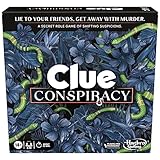
Overview: A bold reimagining of Clue, this game pits players in secret teams—Friends protecting Mr. Coral or Conspiracy members plotting his murder—at a tropical resort. For 4-10 players aged 14+, it merges hidden roles, sabotage, and deduction within a vibrant party-game framework.
What Makes It Stand Out: The innovative Friends vs. Conspiracy dynamic replaces Clue’s solo sleuthing with team-based deception, allowing lies, hidden alliances, and trap-setting. Its 10-player capacity is rare for deduction games, while the shifting suspicions and multiple win conditions create unpredictable, high-energy sessions.
Value for Money: Priced mid-range, it justifies cost through exceptional scalability and thematic depth. Unlike smaller card games, its board and tokens support larger groups effectively, offering more varied interactions than similar party-deduction titles in its class.
Strengths and Weaknesses:
Strengths: Excels with large groups; dynamic team-based bluffing; immersive theme; high player interaction; flexible win conditions.
Weaknesses: Setup is more complex than card-only games; balance can falter below 6 players; theme may feel disjointed for Clue purists.
Bottom Line: A thrilling, social upgrade to classic deduction—best for groups seeking theatrical deception at parties; a worthy investment for fans of Werewolf or Secret Hitler.
9. BFF Games Hidden Leaders Board Game - Deduction and Strategy Game, Fantasy Game for Kids and Adults, Ages 10+, 2-6 Players, 20-40 Minute Playtime, Made by

Overview: Set in the fractured realm of Oshra, this game tasks players with deducing secret faction allegiances while building influence through card play. For 2-6 players aged 10+, it blends tableau-building with deduction in a compact, art-driven experience emphasizing constant player interaction.
What Makes It Stand Out: Its unique “influence” mechanic lets players indirectly sway outcomes by aligning with hidden leaders, avoiding elimination and downtime. Charming fantasy art and intuitive role-reveal system make complex deduction approachable, while the tableau element adds strategic layering uncommon in pure deduction games.
Value for Money: Offers remarkable depth for its price, with components that punch above its weight. Though niche, it provides more strategic nuance than simpler card games like Love Letter, justifying cost for families or casual gamers seeking progression without complexity.
Strengths and Weaknesses:
Strengths: Zero downtime; engaging tableau-building; accessible yet strategic; beautiful art; scales smoothly across player counts.
Weaknesses: Theme feels generic; limited replayability compared to role-varied games; influence mechanic can confuse new players.
Bottom Line: A polished, family-friendly deduction gem—highly recommended for groups wanting meaningful interaction without cutthroat competition or lengthy sessions.
10. Gamewright - Deduckto - A Quacking Deduction Game - Card Game for Kids Ages 8 and Up - Great for Family Game Night!

Overview: A lighthearted deduction game where players quack their way to victory by guessing their secret animal identity (duck, disguise, and location). Tailored for 2-4 players aged 8+, it uses simple clue-giving to teach logical reasoning in a 15-minute burst perfect for young families.
What Makes It Stand Out: Its adorable animal theme and “quacking” hook make deduction playful for kids, while the rotating clue-giver role ensures constant engagement. The triple-layer guessing (animal/disguise/location) adds surprising depth without overwhelming rules, distinguishing it from oversimplified children’s games.
Value for Money: An exceptional entry-point investment. At its low price, it outperforms many kids’ games with durable cards and genuine strategic thinking—ideal for repeated use during family nights or classroom play, where its educational value shines.
Strengths and Weaknesses:
Strengths: Perfect for young players; genuinely educational; quick setup/play; hilarious theme; highly replayable.
Weaknesses: Too simplistic for teens/adults; limited strategic depth; player count capped at 4.
Bottom Line: The definitive deduction starter game for kids—unbeatable for fostering logic skills in a joyful, accessible package; essential for family game nights with elementary-schoolers.
Understanding Deduction Games and Logical Reasoning
Deduction strategy games are distinct from pure luck-based or reflex-driven activities. They center on the process of using given information, observing patterns, eliminating impossibilities, and drawing valid conclusions through structured reasoning. Players start with incomplete data and must systematically gather clues, test hypotheses, and refine their understanding to solve a central mystery or achieve a specific objective. This mirrors real-world problem-solving where definitive answers aren’t handed over; they must be logically constructed.
The Core Mechanics of Deductive Play
True deduction games rely on mechanisms like clue gathering, process of elimination, inference chains, and hypothesis testing. Players often work with hidden information—either concealed from them or known only to certain players—and must use logic to uncover truths. Unlike games focused solely on memory or calculation, the emphasis here is on the reasoning pathway itself: why a conclusion follows from the evidence, not just what the conclusion is. This builds the foundational skill of constructing sound arguments.
How Deduction Translates to Real-World Reasoning
The cognitive muscles flexed during deduction gameplay—pattern recognition, identifying logical fallacies, evaluating evidence strength, and managing uncertainty—are directly transferable. Navigating a complex work project, analyzing news sources critically, troubleshooting technical issues, or even resolving interpersonal conflicts all require the same structured thought processes honed by strategically eliminating possibilities and building evidence-based conclusions step by step.
Distinguishing Deduction from Related Skills
It’s crucial to differentiate deduction from induction and abduction. Deduction moves from general rules to specific conclusions (if A and B are true, then C must be true). Induction infers general rules from specific observations (observing many swans are white, concluding all swans are white—potentially flawed). Abduction seeks the best explanation for an observation (the grass is wet, so it probably rained). Deduction games primarily train rigorous deductive logic, though elements of the others often play supporting roles, making the skill development more holistic.
The Tangible Cognitive Benefits of Deductive Gaming
Engaging regularly with well-designed deduction strategy games delivers measurable improvements in specific cognitive domains. Research consistently shows that structured logical play enhances fluid intelligence—the ability to solve novel problems independently of prior knowledge. This isn’t about memorizing facts; it’s about developing adaptable mental frameworks for tackling unfamiliar challenges, a skill increasingly vital in our rapidly evolving world.
Strengthening Working Memory and Attention
Deduction inherently requires holding multiple pieces of information (clues, rules, past moves) in mind simultaneously while filtering out irrelevant details. Tracking evolving states, remembering eliminated possibilities, and linking disparate clues all place a healthy demand on working memory capacity and sustained, focused attention—core executive functions critical for academic and professional success.
Developing Systematic Problem-Solving Frameworks
These games teach players to move beyond guesswork. They foster the habit of breaking down complex problems into manageable steps, formulating clear hypotheses, testing them methodically against available evidence, and adjusting strategies based on outcomes. This systematic approach replaces impulsive reactions with deliberate, evidence-based decision-making processes applicable far beyond the game board.
Enhancing Metacognition and Error Analysis
A powerful aspect is the development of metacognition—thinking about one’s own thinking. Players learn to recognize why they made a wrong deduction (e.g., overlooking a clue, making an unwarranted assumption) and adjust their reasoning strategies accordingly. This ability to analyze errors constructively is fundamental to true learning and intellectual growth.
Key Features to Evaluate in Deduction Games for 2026
Not all games labeled as “deductive” offer equal value for developing deep logical reasoning. As the market evolves, discerning the features that provide the richest cognitive workout is essential. Prioritize games where the deduction is the core challenge, not merely a superficial layer. Look for mechanics that necessitate multi-step logical chains and reward careful analysis over speed or luck.
Depth of Pattern Recognition Required
Superficial pattern matching won’t cut it. Seek games demanding the identification of complex, often non-obvious relationships between elements. Does the game require recognizing patterns across different dimensions (e.g., color, shape, position, sequence) simultaneously? Can patterns shift or have conditional rules? Deeper pattern recognition directly correlates with stronger abstract reasoning abilities.
Robustness of the Elimination Process
The heart of deduction is elimination. Evaluate how the game structures this: Is it a simple binary (yes/no), or does it involve nuanced elimination of possibilities within categories? Does it allow for and encourage tracking partial eliminations? Games with sophisticated elimination mechanics (e.g., marking degrees of certainty, handling interconnected categories) provide a more rigorous logical workout than those with overly simplistic “guess and check” approaches.
Clarity and Consistency of Game Logic
For deduction to be effective learning, the underlying logic must be sound and consistent. Ambiguous rules or hidden mechanics that contradict stated information frustrate logical reasoning and teach players to rely on luck or meta-knowledge rather than pure deduction. A well-designed game ensures that every solution is theoretically reachable through flawless application of the given rules and clues—no “gotchas” allowed.
Designing for Different Skill Levels and Ages
Effective deduction games cater to a spectrum of logical reasoning abilities without sacrificing core principles. Entry-level experiences should introduce foundational concepts gently, using concrete themes and limited variables, while advanced games layer complexity through interconnected systems, hidden agendas, or time pressure, demanding sophisticated multi-threaded reasoning. The progression should feel challenging yet achievable.
Foundational Games for Beginners
Ideal starting points feature a very limited set of variables (e.g., 3-4 categories with 3-4 options each), highly visual clues, and immediate feedback on deductions. Themes should be concrete and relatable (e.g., identifying animals, matching simple attributes). The focus is on mastering the basic loop: observe clue, eliminate possibilities, confirm conclusion. Avoid overwhelming beginners with abstract symbols or complex rule interactions initially.
Intermediate Challenges for Developing Reasoners
These games introduce more variables (e.g., 5-6 categories), require holding multiple inference chains in mind, and incorporate clues that have conditional meanings (“If A is true, then B must be false”). Players must learn to manage uncertainty, track partially solved information, and recognize when deductions from one area impact another. Themes can become slightly more abstract, but clarity remains paramount.
Advanced Puzzles for Seasoned Logicians
At the highest level, expect intricate networks of interdependent clues, hidden player roles with conflicting information, time constraints, or the need to deduce information about other players’ knowledge states. These demand exceptional working memory, the ability to construct and deconstruct complex logical trees rapidly, and resilience when initial hypotheses collapse. The satisfaction comes from navigating profound complexity through pure reason.
Solo Play vs. Social Deduction Dynamics
The context of play significantly shapes the deduction experience and the specific reasoning skills emphasized. Solo puzzle games offer a controlled environment for focused, self-paced logical development, while social deduction games introduce the fascinating (and often messy) element of human psychology, bluffing, and interpreting verbal/non-verbal cues alongside pure logic.
The Precision of Solo Deductive Puzzles
Solo experiences excel at honing pure analytical skills. Without the distraction of other players, you can focus entirely on the internal logic of the puzzle, meticulously testing hypotheses and refining your deductive process. They are ideal for building foundational speed and accuracy in logical operations, providing immediate feedback, and allowing deep concentration on pattern recognition and elimination strategies. Think of them as targeted logic drills.
Navigating the Human Element in Social Deduction
Social deduction games (like hidden role or traitor mechanics) add a thrilling layer: you must deduce not only the game state but also the intentions and potential deceptions of other players. This trains critical skills in evaluating credibility, interpreting ambiguous social signals, constructing logical arguments to persuade others, and adapting reasoning based on observed behavior. It blends cold logic with emotional intelligence, reflecting real-world negotiation and collaboration challenges.
Choosing the Right Context for Your Goals
Consider your primary objective. For pure, undiluted logical speed and accuracy training, solo puzzles are unmatched. For developing reasoning skills within social dynamics, persuasion, and handling deception—skills crucial in leadership and teamwork—social deduction is invaluable. Many enthusiasts benefit from engaging with both types, as they develop complementary facets of practical reasoning.
Physical Board Games vs. Digital Platforms in 2026
The medium significantly influences the deduction experience. Physical board games offer tangible interaction, spatial reasoning benefits, and a screen-free social environment, while digital platforms provide dynamic puzzle generation, sophisticated hint systems, seamless progress tracking, and accessibility features. The “best” choice depends on learning preferences, context, and desired cognitive engagement.
The Tactile Advantage of Physical Games
Manipulating physical components—moving tokens, flipping cards, marking sheets—creates a stronger sensory connection to the deduction process. This kinesthetic element can enhance memory encoding and spatial reasoning. The shared physical space also fosters natural conversation and immediate social interaction in group play, making the reasoning process more collaborative and visible. Setup and storage are considerations, but the immersive, distraction-free nature is a major plus.
The Adaptive Power of Digital Deduction
Digital platforms shine in personalization and scalability. They can generate near-infinite unique puzzles, dynamically adjust difficulty based on performance, offer tiered hints that guide without spoiling, and provide detailed analytics on reasoning patterns (e.g., common error types, time per deduction step). Features like undo buttons reduce frustration, allowing fearless hypothesis testing. Accessibility options (text size, color contrast, audio cues) also make digital more inclusive.
Hybrid Experiences: The Emerging Frontier
Look for innovative hybrids in 2026: physical games integrating companion apps for dynamic scenarios or enhanced clue delivery, or digital platforms using AR to overlay puzzles onto the real world. These aim to capture the best of both worlds—tactile engagement with adaptive, personalized digital logic challenges—potentially offering the most comprehensive reasoning workout by engaging multiple cognitive pathways simultaneously.
Integrating Deduction Games into Learning and Development
Maximizing the cognitive benefits requires moving beyond casual play. Intentional integration—whether in educational settings, professional development, or personal growth routines—transforms these games from entertainment into powerful pedagogical tools. The key is structuring play to encourage reflection on the process of reasoning, not just the outcome.
Creating Structured Learning Sessions
Dedicate specific time for focused play with clear objectives. Before starting, define what logical skill you’re targeting (e.g., “Today, I’ll focus on tracking eliminations across two categories simultaneously”). After playing, spend 5 minutes reflecting: What deduction strategy worked best? Where did I get stuck, and why logically? Jotting down these insights reinforces the learning. For groups, facilitated debriefs discussing different reasoning paths are incredibly valuable.
Balancing Challenge and Frustration
The optimal difficulty level is just beyond current ability—challenging enough to require effortful thinking, but not so hard it induces shutdown. Use the game’s built-in difficulty scaling or start with core mechanics before adding complexity. If stuck for more than a reasonable time (e.g., 10-15 minutes on a puzzle), utilize hint systems strategically to understand the reasoning leap needed, not just to get the answer. The struggle is where growth happens, but productive struggle requires the right support.
Tracking Progress and Skill Development
Notice subtle improvements: Are you solving puzzles faster? Making fewer assumptions? Catching your own logical errors more quickly? Do complex inferences feel more intuitive? Keeping a simple log of game types played, time taken, and self-rated confidence in deductions can reveal progress over weeks and months. Celebrate milestones in reasoning fluency, not just winning the game.
Future Trends Shaping Deduction Games in 2026
The field is evolving rapidly, driven by cognitive science research and technological innovation. Expect deeper personalization, where AI tailors puzzle complexity and clue types to an individual’s specific reasoning strengths and weaknesses in real-time. Integration with broader cognitive training platforms, providing holistic brain health feedback, is also on the rise.
AI-Powered Adaptive Difficulty
Beyond simple easy/medium/hard settings, sophisticated algorithms will analyze how you solve puzzles—your common error patterns, speed on specific deduction types, reliance on hints—to dynamically adjust not just the puzzle’s overall difficulty, but the nature of the challenges presented. This ensures constant, optimal cognitive engagement, pushing your reasoning skills precisely where growth is possible.
Cross-Disciplinary Logical Challenges
Look for games blending deduction with other cognitive domains more seamlessly. Puzzles might require logical reasoning to interpret musical patterns, decode simple cryptographic elements, or navigate spatial logic mazes. This mirrors real-world problem-solving, where logic rarely operates in isolation, fostering more flexible and applicable reasoning skills.
Enhanced Accessibility for Diverse Thinkers
Design is increasingly prioritizing neurodiversity. Expect more games offering customizable interfaces (reducing visual clutter, adjusting color schemes for色觉 deficiency), alternative input methods, adjustable time pressures, and clear explanations of logical structures. This ensures the cognitive benefits of deduction are accessible to a wider range of learners and thinkers.
Getting Started: Building Your Deduction Practice
Embarking on a deduction journey doesn’t require expensive gear or prior expertise. Start small, focus on consistency, and prioritize enjoyment. The goal is sustainable habit formation where logical reasoning becomes a rewarding part of your routine, not a chore. Choose an entry point that aligns with your current interests and schedule.
Assessing Your Current Reasoning Baseline
Before diving deep, take stock. What kinds of logical puzzles do you already enjoy (crosswords, sudoku, escape rooms)? Where do you feel stuck in daily decisions? Try a few simple, free online logic grids or basic deduction puzzles. Notice where your mind resists systematic elimination or jumps to conclusions. Honest self-assessment helps target your practice effectively.
Establishing a Sustainable Routine
Consistency trumps duration. Aim for short, regular sessions (e.g., 15-20 minutes, 3-4 times a week) rather than infrequent marathons. Tie it to an existing habit (e.g., “after my morning coffee, I do one logic puzzle”). Use reminders initially. The key is making it a non-negotiable part of your cognitive hygiene, like brushing your teeth for your brain.
Cultivating the Right Mindset for Growth
Approach deduction with curiosity, not just a desire to “win.” Embrace being wrong—it’s data, not failure. Ask “What can this mistake teach me about my reasoning process?” Celebrate the aha! moment of a correct deduction, not just finishing the puzzle. This growth mindset, focused on the process of thinking, is where profound and lasting cognitive improvements take root.
Frequently Asked Questions
How much time should I dedicate daily to see cognitive benefits from deduction games?
Consistent short sessions (15-20 minutes most days) yield better results than sporadic long sessions. Quality of focused engagement matters more than sheer time; actively reflecting on your reasoning during play accelerates benefits far more than passive completion.
Are deduction games suitable for very young children, like under age 8?
Yes, but choose age-appropriate versions. Start with highly visual, concrete themes (matching animals, simple attribute sorting) with very few variables. Focus on the process (“How did you figure that out?”) rather than speed or correctness. Games designed for early logic development often use physical manipulation which is ideal.
Can playing these games help with conditions like ADHD or anxiety?
They can be a valuable complementary tool. The structured focus required can improve attention regulation, while the predictable logic provides a sense of control that may reduce anxiety for some. However, they are not a replacement for professional treatment; consult a specialist for personalized strategies.
Do I need strong math skills to excel at deduction strategy games?
Not necessarily. While some games involve numerical logic, most core deduction relies on pattern recognition, process of elimination, and verbal/symbolic reasoning. Strong math often correlates with logical thinking, but deduction skills can be developed independently through practice with non-mathematical puzzles.
How can I tell if a game is truly building logic skills versus just relying on memory?
Focus on the process. If success depends primarily on remembering past moves or hidden info (like Memory), it’s memory-based. True deduction requires using current clues and rules to logically eliminate possibilities and infer unknowns, even if you forget specific details. Look for games where the solution path is reconstructible from the evidence.
Is it better to play alone or with others for developing reasoning?
Both offer unique benefits. Solo play builds pure analytical speed and accuracy in a distraction-free zone. Social play develops reasoning within dynamic human contexts, teaching persuasion, reading cues, and handling deception—skills vital for real-world application. Ideally, incorporate both for comprehensive development.
What if I get stuck constantly and feel frustrated?
Frustration is normal! First, ensure the difficulty level matches your current skill—start simpler. Use hint systems strategically to understand the logical step you missed, not just the answer. Take breaks; stepping away often allows subconscious processing. Remember, the struggle is the growth phase for your reasoning muscles.
Can digital deduction games be as effective as physical board games?
Absolutely, and they offer unique advantages. Digital platforms provide adaptive difficulty, personalized feedback, vast puzzle variety, and accessibility features. The key is choosing well-designed apps focused on core deduction mechanics, not those prioritizing flashy graphics or random elements over logical depth. Effectiveness depends on the game’s design, not the medium.
How long before I notice improvements in my everyday logical thinking?
Subtle improvements (e.g., noticing flawed arguments faster, organizing thoughts more clearly) can emerge within weeks of consistent practice. More significant shifts in complex problem-solving confidence often take 2-3 months. Track small wins—like catching your own assumption quicker—and be patient; cognitive rewiring is a gradual process.
Are there specific deduction game mechanics proven most effective for adults?
Research suggests logic grids, complex elimination puzzles with interconnected variables, and social deduction games requiring inference of others’ knowledge states offer particularly robust challenges for adult brains. Games demanding multi-step inference chains and adaptation to new rule layers provide the deepest cognitive engagement for mature reasoning skills.
See Also
- How to Choose the 10 Best Deduction Strategy Games for Game Night in 2026
- 10 Tips for Finding the Perfect Deduction Strategy Games in 2026
- We Tested 50 Deduction Strategy Games - Here are the 10 Best for 2026
- The 10 Ultimate Best Deduction Strategy Games for Adult Thinkers in 2026
- The 10 Most Revolutionary Deduction Board Games of 2026