Table of Contents
Traveling with kids used to mean bracing for the inevitable “Are we there yet?” chorus and frantic screen-swiping to stave off meltdowns. But imagine this: instead of digital glare and passive scrolling, you’re met with the satisfying click of game pieces, bursts of laughter over a clever move, and genuine connection as your family navigates a miniature adventure together – all within the cramped quarters of a plane, train, or minivan. The magic of the right travel board game transforms tedious transit into shared storytelling, quiet concentration, and joyful competition, turning travel time into some of the most memorable moments of your trip. It’s not just about killing time; it’s about creating it.
Choosing the perfect game, however, feels like solving a puzzle blindfolded. With endless options promising fun, how do you avoid the bulky box that eats your suitcase space, the game that frustrates your preschooler, or the one that bores your pre-teen into oblivion? The landscape shifts constantly, and by 2026, new materials, smarter designs, and evolving developmental insights will reshape what makes a game truly travel-worthy. Forget chasing fleeting “best of” lists; the real power lies in understanding the timeless principles that separate a game that gathers dust from one that becomes your family’s secret weapon for stress-free journeys. Let’s crack the code together.
Top 10 Travel Board Games for Kids
Detailed Product Reviews
1. Hasbro Games Grab and Go! Bundle (4 Pack) | Kids Travel Board Games | Battleship, Connect 4, Guess Who?, Hungry Hungry Hippos Games | 2 Players I Ages 7+

Overview:
This compact bundle delivers four beloved Hasbro classics—Battleship, Connect 4, Guess Who?, and Hungry Hungry Hippos—in travel-sized editions designed for on-the-go play. Tailored for two players aged 7+, it transforms road trips, flights, or waiting rooms into engaging screen-free zones with familiar, easy-to-learn gameplay.
What Makes It Stand Out:
The standout feature is its thoughtful portability: each game includes built-in storage compartments to secure pieces, eliminating lost parts. Unlike bulkier board games, these slim cases slip into backpacks effortlessly. The inclusion of Hungry Hungry Hippos—a rare travel adaptation—adds kinetic fun absent in most compact sets, while maintaining authentic mechanics.
Value for Money:
Priced competitively against buying individual travel games, this bundle offers exceptional value. You get four distinct experiences (strategy, deduction, dexterity) for roughly the cost of two standalone sets. It outperforms generic alternatives with Hasbro’s quality control and brand recognition, making it ideal for gift-giving without breaking the bank.
Strengths and Weaknesses:
Strengths: Durable construction; intuitive setup; perfect size for cars/planes; built-in storage; diverse gameplay styles.
Weaknesses: Limited to two players per game; Hungry Hungry Hippos’ smaller scale slightly reduces tactile satisfaction; not ideal for under-7s due to complexity.
Bottom Line:
A near-flawless travel essential for families seeking reliable, screen-free entertainment. Its versatility, durability, and smart design justify the price, making it a top recommendation for vacations or daily commutes with school-aged kids.
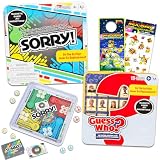
2. Magnetic Game Travel Set for Kids - Bundle with 2 Travel Games in Tin Featuring Sorry, Guess Who Plus Stickers, More | Hasbro Travel Games for Kids 8-12
Overview:
This magnetic travel set packs two Hasbro classics—Sorry! and Guess Who?—into compact tins with magnetic boards, targeting kids aged 8–12. Designed for travel chaos, it ensures pieces stay put during car rides or flights, supplemented by Rex-Man stickers for added appeal.
What Makes It Stand Out:
The magnetic components are the hero here, preventing pieces from scattering mid-journey—a common flaw in non-magnetic travel games. The sturdy tin cases double as storage and play surfaces, while the inclusion of exclusive stickers and a door hanger elevates it beyond basic bundles. Guess Who?’s magnetic flaps work seamlessly despite the reduced size.
Value for Money:
While pricier per game than non-magnetic sets, the magnetic functionality justifies the cost for frequent travelers. It’s more affordable than purchasing two separate magnetic editions but offers fewer games than larger bundles (e.g., Product 3). Best for those prioritizing piece security over variety.
Strengths and Weaknesses:
Strengths: Magnets prevent piece loss; tins are durable and portable; easy game resets; stickers add novelty; intuitive for older kids.
Weaknesses: Only two games limit replay value; stickers/door hanger feel like minor extras; Guess Who? character art is slightly pixelated at small scale.
Bottom Line:
A solid choice for parents needing reliable, spill-proof entertainment for longer trips. Though the game count is modest, the magnetic innovation makes it worthwhile for kids 8+—opt for this if piece security trumps quantity.
3. Hasbro Gaming Magnetic Game Travel Set for Kids - Bundle with 4 Travel Games in Tin Featuring Connect 4, Sorry, Trouble, Guess Who Plus Stickers | Travel Games for Kids 8-12

Overview:
This expanded magnetic bundle includes four Hasbro staples—Connect 4, Sorry!, Trouble, and Guess Who?—housed in portable tins with magnetic boards. Aimed at ages 8–12, it promises mess-free travel fun with built-in storage and bonus Rex-Man stickers.
What Makes It Stand Out:
Doubling the game count of Product 2, it delivers exceptional variety: strategy (Connect 4), luck-based racing (Trouble), and deduction (Guess Who?). The magnets reliably secure pieces—even Trouble’s iconic “pop-o-matic” dome adapts well. Tins stack neatly, and printed rules eliminate app dependency, a rare plus in modern travel games.
Value for Money:
Outshines Product 2 by offering twice the games for a marginal price increase, making it the best value in Hasbro’s magnetic line. It’s costlier than non-magnetic bundles (e.g., Product 1) but justifies it with superior piece retention. Ideal for gifting, as the diverse styles cater to varied preferences.
Strengths and Weaknesses:
Strengths: Four high-quality magnetic games; tins protect pieces flawlessly; broad gameplay appeal; includes stickers; durable construction.
Weaknesses: Tins are slightly bulky for tiny pockets; younger kids may struggle with Connect 4 strategy; no storage for stickers/door hanger.
Bottom Line:
The definitive magnetic travel bundle for families. Its unbeatable mix of variety, reliability, and Hasbro polish makes it a worthy splurge for road trips—highly recommended for households with multiple children.
4. Regal Games Card Games for Kids - Go Fish, Crazy 8’s, Old Maid, Slap Jack, Garbage Monster, War - Simple & Fun Classic Family Table Games - Games May Vary (6 Set)

Overview:
This 6-deck set delivers classic card games—Go Fish, Crazy 8’s, Old Maid, Slap Jack, War, and Silly Monster Memory Match—in vibrant, oversized cards. Designed for ages 4+, it focuses on simplicity, education, and portability for 2–6 players.
What Makes It Stand Out:
The jumbo-sized cards (3.5"x2.5") are perfect for small hands, reducing frustration during gameplay. Bright, engaging artwork sustains attention, while the variety covers memory (Old Maid), speed (Slap Jack), and counting (War). Unlike board-based sets, it’s ultra-lightweight—ideal for impromptu play anywhere.
Value for Money:
An affordable powerhouse: six themed decks beat buying singles, and the educational focus (colors, numbers, matching) adds long-term value. Though less durable than laminated cards, it’s competitively priced against premium brands. Best for preschoolers needing foundational skill practice.
Strengths and Weaknesses:
Strengths: Oversized cards ease handling; vibrant designs captivate kids; builds cognitive skills; pocket-sized; great for mixed-age groups.
Weaknesses: Cards lack lamination (may warp); “Garbage Monster” rules vary confusingly; not suited for older kids seeking strategy.
Bottom Line:
A stellar starter kit for young children, blending fun and learning seamlessly. Its portability and skill-building make it a smart buy for parents of 4–7-year-olds—skip if you need advanced gameplay.
5. Gamie Magnetic Board Travel Games for Kids, Includes 12 Retro Fun Games - 5" Compact Design, Individually Boxed Travel Essentials for Kids Road Trip/Airplane/Camping, Stocking Stuffers for All Ages

Overview:
This expansive kit features 12 magnetic mini-games (Chess, Checkers, Backgammon, etc.) in 5" portable boxes. Marketed for all ages, it emphasizes educational benefits and travel readiness with durable, self-contained sets.
What Makes It Stand Out:
The sheer variety—12 games including niche picks like Nine Men’s Morris—caters to diverse interests, from logic (Chess) to luck (Snakes & Ladders). Each magnetic board is individually boxed with printed instructions, enabling solo or group play. The compact size and strong magnets withstand turbulence exceptionally well.
Value for Money:
Unbeatable for breadth: 12 games rival a full board-game library at a fraction of the cost. Though pricier than smaller bundles, it outperforms single-game purchases for families with multiple kids. The sturdy storage box enhances longevity, making it ideal for frequent travelers.
Strengths and Weaknesses:
Strengths: Unmatched game diversity; robust magnetic hold; excellent educational depth; compact yet clear boards; adult-friendly options.
Weaknesses: Overwhelming for preschoolers; some games require prior knowledge; boxes add bulk versus tins.
Bottom Line:
A must-have for road-trip veterans or educators. Its blend of education, portability, and variety justifies the investment—highly recommended for ages 6+ seeking timeless, screen-free challenges.
6. Pedolini 4 in a Row Connect Game Travel Board Game (Small) Mini 7x4.8 Inch

Overview: This ultra-compact travel version of the classic Connect 4 game offers portable strategy fun. Measuring just 7x4.8 inches, it fits easily into bags for play during commutes, flights, or picnics, targeting families and kids seeking screen-free entertainment on the go. What Makes It Stand Out: Its standout feature is the genuinely pocket-sized design without sacrificing core gameplay. Crafted from smooth, sturdy plastic, it maintains durability despite its miniaturization. The focus on portability for diverse settings—from cars to classrooms—makes it uniquely convenient for spontaneous play. Value for Money: Priced affordably (typically under $15), it delivers excellent value for a dedicated travel game. While cheaper knockoffs exist, the premium plastic construction justifies a slight premium over flimsy alternatives, ensuring longevity for frequent use. Strengths and Weaknesses: Strengths: Exceptionally portable, durable plastic build, true to the original game’s strategy, highly engaging for kids’ critical thinking. Weaknesses: Very small pieces pose a choking hazard for toddlers, limited replay novelty compared to digital versions, and the tiny grid may frustrate players accustomed to larger boards. Bottom Line: An ideal, well-executed travel essential for Connect 4 fans. Its compact reliability and quality make it a top choice for parents wanting classic strategy fun anywhere, despite minor limitations for very young children.
7. Educational Insights Kanoodle - 3D Brain Teaser Puzzles for Kids, Spatial Puzzle Games for Adults, Teens and Kids, Problem Solving Toys and Logic Puzzles, Single Player Games

Overview: Kanoodle is a viral-hit, single-player logic puzzle game challenging users to solve over 200 2D and 3D spatial puzzles using colorful, interlocking pieces. Housed in a compact case, it’s designed for ages 7+, offering screen-free brain training anywhere. What Makes It Stand Out: Its massive popularity (9M+ sold) stems from the clever blend of escalating difficulty (beginner to expert) and true portability. The self-contained case securely stores all pieces, while the satisfying “aha!” moments across diverse puzzles create addictive, focused play ideal for travel or downtime. Value for Money: At $12-$15, Kanoodle offers exceptional value. The sheer volume of puzzles (200+) and durable construction provide hours of engagement, far surpassing cheaper, less substantial puzzle books or apps requiring screens. It’s a worthy investment in cognitive development. Strengths and Weaknesses: Strengths: Massive replayability, excellent spatial reasoning development, perfectly travel-sized, screen-free focus, appeals broadly across ages. Weaknesses: Strictly single-player (limiting social interaction), 3D puzzles can be overly frustrating for younger kids, and pieces are small enough to lose if not careful. Bottom Line: A must-have for puzzle lovers seeking portable brain exercise. Kanoodle’s addictive challenges and robust design make it outstanding value for solo cognitive fun, highly recommended for students, commuters, and families wanting educational travel games.
8. Hasbro Gaming Guess Who? Card Game for Kids, 2 Player Guessing Game, Fun Summer Activities, Vacation Travel Essentials, Ages 5+

Overview: This streamlined card adaptation of the iconic Guess Who? board game condenses the classic character-guessing fun into a compact, travel-ready format. Designed for two players ages 5+, it uses character cards and simple yes/no questions to deduce the opponent’s mystery person. What Makes It Stand Out: It brilliantly captures the essence of the original board game in a highly portable, quick-play card format. The elimination of the bulky board and flimsy stands makes it uniquely suited for travel, while maintaining the core deductive reasoning gameplay kids love. Value for Money: Priced competitively (around $10), it offers solid value as a dedicated travel game. It’s significantly cheaper than the full board game yet retains the core experience, though it lacks the physical novelty of the original’s flip-down stands. Strengths and Weaknesses: Strengths: Extremely portable and lightweight, retains core Guess Who? logic, very quick setup/play (5-10 mins), durable cards, excellent for car rides or waiting rooms. Weaknesses: Limited to only two players, lacks the tactile satisfaction of the board game’s stands, and the card-only format feels less immersive for some fans. Bottom Line: A smart, highly practical travel solution for Guess Who? fans. While it sacrifices some charm of the original, its portability, ease of play, and faithful adaptation make it a valuable stocking stuffer or vacation essential for families seeking quick, brain-teasing fun.
9. PlayMonster Spoons in a Case, Card Games for Kids - Spoons Game, Fun Family Games for Kids and Adults, Game Night, Travel Games, 3-6 Players, Ages 7+

Overview: This travel edition packages the chaotic, fast-paced Spoons card game—where players race to collect four-of-a-kind and grab a spoon—into a neat, self-contained case. Designed for 3-6 players ages 7+, it promises portable, high-energy fun. What Makes It Stand Out: The integrated case is the game-changer, solving the perennial problem of storing loose spoons and cards. This makes it uniquely travel-friendly without compromising the game’s signature speed, laughter, and frantic spoon-grabbing action, perfect for game nights or group trips. Value for Money: Priced around $12-$15, it delivers superb value for a group travel game. The durable case and included spoons/cards eliminate the need for makeshift solutions, offering reliable, repeated fun that justifies its cost compared to generic card decks lacking organization. Strengths and Weaknesses: Strengths: Ingenious portable case design, incredibly easy to learn, fosters hilarious group interaction, high replayability, ideal for parties or family gatherings. Weaknesses: Can get noisy (unsuitable for quiet travel like flights), requires 3+ players to shine, and the plastic spoons, while functional, feel less substantial than real ones. Bottom Line: The definitive travel version of Spoons. Its clever case design, infectious energy, and group appeal make it an exceptional value and a top recommendation for families or friends seeking portable, laugh-out-loud party fun on the road.
10. Melissa & Doug On The Go Game On! Reusable Games Wipe-Off Activity Pad Reusable Travel Toy with 2 Dry-Erase Markers - FSC Certified

Overview: This spiral-bound activity pad features 10 double-sided, reusable pages (17 games total) like mazes, word searches, and picture puzzles, designed for travel. Includes two dry-erase markers with erasers, targeting kids ages 6+ needing quiet, screen-free entertainment. What Makes It Stand Out: Its key innovation is the truly reusable, wipe-clean format combined with sturdy construction and FSC-certified materials. The built-in marker storage and compact size (6"x10") make it uniquely mess-free and organized for travel, eliminating single-use printouts or app dependency. Value for Money: At $10-$12, it offers outstanding long-term value. The endless replayability (unlike disposable books) and included markers provide hours of quiet activity, far exceeding the cost-per-use of single puzzle books or constant screen time, especially for frequent travelers. Strengths and Weaknesses: Strengths: Eco-friendly reusable design, exceptional portability with storage, diverse game types, promotes independent play, FSC-certified materials. Weaknesses: Marker tips can wear down over time, some games may feel repetitive after heavy use, and spiral binding, while sturdy, isn’t as durable as hardcover. Bottom Line: An essential, eco-conscious travel companion for parents. The Game On! pad’s convenience, reusability, and quiet play make it unbeatable value for car rides or restaurants, highly recommended for reducing travel chaos without screens.
Core Considerations for Any Travel Game
Portability is Non-Negotiable
The absolute first filter is physical practicality. A game that’s too large, too heavy, or too cumbersome simply won’t get used. Prioritize compactness above all else – think pocket-sized tins, foldable boards, or games that nest neatly into a single small pouch. Every extra ounce or inch matters when space is at a premium. Bulky boxes are instant disqualifiers for modern travel.
Component Durability for Real-World Chaos
Travel is inherently rough on games. Dropping pieces, spills, temperature swings, and eager little hands demand resilience. Seek out games made with sturdy materials: thick cardboard, durable plastic tokens, or even silicone components that won’t crack. Avoid flimsy cards, tiny wooden pieces easily lost in seat crevices, or anything requiring fragile setups. If it can’t withstand being tossed in a backpack and jostled for hours, it’s not travel-ready.
Effortless Setup and Takedown
The golden rule of travel gaming: setup should take less time than ordering snacks. Games requiring complex board assembly, intricate rule explanations, or lengthy preparation are destined for frustration. Ideal travel games unfold in seconds – a single board or mat, minimal sorting, and intuitive placement. Takedown must be equally swift; a game that takes five minutes to pack away defeats the purpose of a quick distraction.
Age and Skill Range Precision
Mistaking a game’s actual complexity for its labeled age range is a common pitfall. A game marketed for “6+” might involve strategic depth better suited for 8+, while a “family game” could overwhelm a young child. Scrutinize the realistic cognitive demands: Does it require reading? Complex counting? Long-term strategy? Short attention spans demand quick turns and immediate feedback. The best travel games often have adaptable rules or multiple difficulty levels built-in.
Gameplay Mechanics That Shine On the Go
Turn Length and Pacing Perfection
Long, drawn-out turns are the enemy of travel peace. Games where players wait minutes between actions will lead to boredom, fidgeting, and disruptive behavior. Prioritize games with snappy turns – ideally under 30 seconds – where everyone stays actively engaged. Simultaneous play mechanics (where players act at the same time) are particularly golden for keeping the energy high and the waiting low, even with larger groups.
Minimalist Rules for Maximum Fun
Complex rulebooks belong at home, not at 30,000 feet. The ideal travel game has core rules explainable in under two minutes, with few exceptions or edge cases. Look for intuitive mechanics that feel familiar (like matching, simple dice rolling, or light deduction) and avoid games reliant on obscure terminology or convoluted special powers. If you can’t teach it quickly while managing luggage, it’s not the right pick.
Noise Level and Physical Restraint
Consider the environment. Is shouting “BINGO!” appropriate on a quiet flight? Probably not. Games requiring loud dice rattling, vigorous shaking, or large physical movements (like flicking discs) can be disruptive and impractical in confined spaces. Opt for quieter, contained play: card drafting, tile placement, gentle dexterity, or silent observation games. The best travel games let kids focus without disturbing others.
Solo and Cooperative Options
Sometimes siblings clash, or one child loses interest faster. Games offering solo play variants or strong cooperative mechanics (where players work together against the game) can be lifesavers. Cooperative play reduces direct competition that might flare tempers in close quarters, while solo modes give a child a focused, independent activity during particularly long stretches, preventing boredom-induced chaos.
Educational Value Disguised as Fun
Cognitive Skill Development
The best travel games subtly build crucial skills without feeling like homework. Look for mechanics that enhance spatial reasoning (like tile-laying or pattern recognition), logical deduction (simple “process of elimination” games), numerical fluency (using dice or counting in novel ways), or even visual perception (spotting matches or sequences quickly). The key is seamless integration – the learning happens through the fun, not as a separate lesson.
Language and Social Growth
Games are microcosms for social interaction. Travel games that encourage negotiation (“Would you trade this card?”), clear communication (“Describe this picture without saying the word”), turn-taking practice, or collaborative problem-solving foster essential social-emotional skills. Even simple games requiring players to state their move aloud strengthen verbal expression and active listening in a low-pressure setting.
Patience and Emotional Regulation
Travel tests everyone’s patience. Games that inherently require waiting (even with short turns), handling minor setbacks (like a bad dice roll), or managing competitive feelings provide safe, structured practice in emotional control. Choosing games with low “sting” from losing (e.g., cooperative wins, or games where scores are close) helps kids learn resilience without major meltdowns in transit.
Real-World Testing and Practical Tips
The “Backpack Test” Before You Buy
Never judge a travel game solely by its box description. Mentally (or physically, if possible) subject it to real travel stress: Can it survive being at the bottom of a stuffed backpack? How easily do pieces get lost if the box tips? Is the box itself sturdy enough, or will it crush? Does the lid stay securely closed? Visualize the game in action during turbulence or on a bumpy bus ride – if it seems precarious, skip it.
Involve Your Kids in the Selection (Appropriately)
While the final call rests with the adult, giving kids limited, guided choices builds buy-in. Show them 2-3 options that you pre-vetted for portability and age-appropriateness and let them pick the theme or artwork they like best. This simple step dramatically increases their willingness to engage with the game later. Avoid overwhelming them with too many choices or options that don’t meet your core criteria.
Rule Adaptation is Key
Don’t feel bound by the official rules, especially in the unique context of travel. Shorten playtime by reducing the winning score. Simplify complex actions for younger players. Allow “take-backs” to reduce frustration. The goal is engagement and enjoyment in that moment, not strict adherence to the rulebook. Flexibility prevents the game from becoming another stress point.
Storage and Organization Hacks
Even the best game fails if pieces vanish. Prioritize games with built-in storage solutions: compartments, elastic straps, or secure tuck boxes. For games lacking this, immediately add a small, labeled zipper pouch or sectioned container to your travel kit. Teach kids the “one and done” rule: pieces go back immediately after the game ends, before moving to the next activity. A dedicated spot in your carry-on prevents frantic searches later.
Future-Proofing for 2026 and Beyond
Sustainable Materials Gaining Traction
By 2026, eco-consciousness will be deeply embedded in travel gaming. Expect wider adoption of recycled cardboard, plant-based plastics for tokens, and soy-based inks. While not impacting gameplay directly, choosing games made with sustainable materials aligns with responsible travel values and often correlates with higher durability standards as manufacturers invest in quality for longevity.
Digital Integration as Optional Enhancement
Don’t expect screens to replace physical games, but subtle digital aids might emerge. Think QR codes linking to quick video rule summaries (for when you forgot the specifics) or optional companion apps that handle scoring or provide ambient soundscapes – not core gameplay. The physical interaction must remain central; digital elements should be purely supportive conveniences, easily ignored if preferred.
Focus on Neurodiversity and Inclusivity
Game design is increasingly recognizing diverse needs. Look for 2026 releases with clearer visual distinctions between components, rules written in multiple complexity levels, quieter play options, and themes that resonate across a wider spectrum of interests. Games designed with neurodiverse players in mind often benefit all children by reducing sensory overload and offering flexible engagement.
Frequently Asked Questions
What’s the absolute most important feature for a travel board game with young kids?
Portability and setup speed are paramount. If the game is bulky or takes longer to set up than the flight leg, it won’t get used. Prioritize compact size and instant playability above all else.
How do I know if a game is truly the right age for my child?
Go beyond the box age range. Look for descriptions of the actual cognitive skills needed: Can they handle the turn length? Do rules require reading they don’t have? Is the theme engaging for them? When in doubt, choose slightly simpler – frustration kills fun.
Won’t small game pieces be a choking hazard or get lost easily?
This is critical. Avoid games with numerous tiny components for young children. Seek games with larger, durable pieces, or those where pieces are securely contained (like pegs in a board). Always do a thorough piece count before and after play during travel.
Can travel games actually be educational, or is that just marketing?
Truly well-designed travel games integrate learning seamlessly. Look for mechanics that build spatial reasoning, pattern recognition, simple math, or social skills like turn-taking and communication – the learning happens naturally through engaging play, not forced lessons.
How do I stop my kids from arguing over the rules during travel?
Choose games with exceptionally simple, clear rules. Before starting, have one quick “rule run-through” where each child repeats a key rule back. For younger kids, consider appointing a rotating “rule helper” to reinforce understanding and reduce disputes.
Are cooperative games better than competitive ones for travel?
Cooperative games (where players work together) often reduce sibling rivalry and meltdowns in confined spaces, making them excellent travel choices. However, very young kids might not grasp cooperation; for them, ultra-simple competitive games with quick, low-stakes turns can work well.
How many travel games should I pack for a long trip?
Quality over quantity. One exceptionally well-chosen game that genuinely engages your kids is far better than three that gather dust. Start with one. If they master it quickly, having a second simple option is wise, but avoid overpacking games.
What should I do if the game gets damaged during travel?
Durable materials help, but accidents happen. Carry small, versatile repair items: a tiny tube of strong glue, clear tape, and a mini ziplock for lost pieces. For card games, packing a few blank cards as spares is smart. Focus on quick fixes to keep playing.
Can travel board games replace screens entirely on a trip?
While they won’t eliminate screen time for most families, a great travel game significantly reduces reliance on devices. The goal is balance: use games for active engagement during key travel segments (boarding, takeoff, meal times) to break up screen use and foster interaction.
How do I keep the game pieces organized in a moving vehicle?
Choose games with excellent built-in storage (compartments, secure lids). If not, immediately add a small, dedicated zipper pouch only for that game’s pieces. Implement a strict “pack up before we move” rule to prevent pieces from scattering during transitions.
See Also
- 10 Top-Rated Travel Board Games for Kids According to Experts in 2026
- The 10 Ultimate Best Travel Board Games for Kids for Road Trips in 2026
- 10 Most Durable Travel Board Games for Kids Based on Real User Reviews in 2026
- How to Choose the Best Travel Board Games for Stress-Free Family Vacations
- Stop Boredom on Road Trips with the 10 Best Travel Board Games for Kids This Year