Table of Contents
Picture this: the karaoke machine is humming, the first round of drinks has landed, and your group is buzzing with anticipation. Someone belts out a show-stopping ballad, earning enthusiastic cheers. But then… a lull. The songbook sits open, fingers hovering uncertainly, as the energy dips. You’ve hit the dreaded karaoke plateau. What if you could inject fresh excitement, spark friendly competition, and get everyone – even the shyest singer or most dedicated listener – actively engaged between vocal performances? That’s where the magic of music trivia games comes in, transforming passive pauses into dynamic, laughter-filled interludes that keep the party momentum soaring all night long.
Forget the pressure of hitting those high notes for a moment. Music trivia games offer the perfect counterpoint to karaoke, celebrating the shared love of songs, artists, and eras in a way that’s inclusive and wildly entertaining. They turn obscure knowledge into bragging rights, test collective memory, and create hilarious “remember when” moments that become part of your group’s lore. As karaoke nights evolve beyond just singing, integrating the right trivia element isn’t just a nice add-on; it’s becoming essential for crafting a truly memorable, well-rounded social experience where every guest feels involved. Let’s explore how to choose the perfect music trivia companion for your next sing-along soirée.
Top 10 Music Trivia Games
Detailed Product Reviews
1. SongFest! The New Music Trivia Game | 1000 Questions, 4 Categories and 5+ Decades | QR Song Hints Play The Music You Remember

Overview:
SongFest! is a dynamic music trivia board game designed to evoke nostalgia through 1,000 questions spanning five decades. Players roll dice to select decades and categories (like “Artist Alley” or “Song Snippets”), using QR codes linked to Spotify for audio hints. It accommodates 2–12 players, making it ideal for group gatherings.
What Makes It Stand Out:
Its standout feature is the seamless integration of QR codes that instantly stream song snippets via Spotify, transforming abstract trivia into an immersive auditory experience. The decade-specific customization (e.g., playing only the ’80s) and dual dice system ensure highly replayable, personalized sessions. The focus on sparking personal storytelling about musical memories elevates it beyond standard trivia.
Value for Money:
Priced competitively around $25, SongFest! offers exceptional value with 1,000 questions—double or triple most rivals. The reusable digital hints eliminate app downloads, and the durable components justify the cost versus cheaper sets with fewer questions or flimsy parts. It outperforms budget alternatives in longevity and engagement.
Strengths and Weaknesses:
Strengths: Massive question bank; intuitive QR audio hints; highly adaptable for different group sizes/eras; promotes social interaction.
Weaknesses: Spotify dependency limits accessibility; some obscure questions may frustrate casual fans; dice mechanics slightly slow gameplay.
Bottom Line:
SongFest! is a top-tier music trivia game that brilliantly blends technology with nostalgia. Its rich content and innovative audio features make it a must-have for game nights, easily justifying its price for frequent players despite minor streaming limitations.
2. Jumbo Hitster - The Music Fun Party Quiz Card Game, 2-10 Players - 300 Plus Iconic Music Hits - Great for Adult and Family Game Night

Overview:
Jumbo Hitster delivers fast-paced music trivia for 2–10 players, featuring 300+ iconic hits from the last century. Players scan QR codes on cards using a free app to hear song clips, then answer trivia questions. It includes tokens for strategic gameplay and emphasizes quick, energetic rounds perfect for parties.
What Makes It Stand Out:
The inclusion of physical tokens (“Hitster chips”) adds a tactical layer rarely seen in music trivia games, allowing players to steal points or block opponents. Its streamlined setup—scan, play, answer—ensures near-instant immersion. The diverse playlist spans 100 years, appealing to multigenerational groups without decade-specific limitations.
Value for Money:
At approximately $22, it’s affordably priced for the component count: 300+ cards, 37 tokens, and robust instructions. While question volume is lower than SongFest!, the token system enhances replayability. It’s a smarter investment than single-mechanic trivia decks but less versatile than decade-focused alternatives.
Strengths and Weaknesses:
Strengths: Engaging token-based strategy; rapid setup/play; broad musical coverage; sturdy card quality.
Weaknesses: App required for audio (no direct Spotify link); only 300 questions; token rules may confuse new players.
Bottom Line:
Jumbo Hitster excels as a lively, strategic party game that transforms music trivia into competitive fun. Its token mechanics and ease of use make it ideal for casual gatherings, though audiophiles might prefer deeper question banks.
3. FAFO GAMES The Gen-X Challenge - 80s and 90s Trivia Card Game with 600 Trivia Cards - Pop Culture Trivia Game with Movies, Music, TV Shows - Ideal for Game Night, Christmas, Birthday, or Gift

Overview:
The Gen-X Challenge is a nostalgia-driven trivia game exclusively celebrating 1980s–1990s pop culture. With 600 cards covering movies, music, TV, toys, and events, it targets adults aged 30–50. Housed in a keepsake box, it’s designed for 2+ players seeking lighthearted reminiscence.
What Makes It Stand Out:
Its laser focus on Gen-X culture—think Blockbuster, arcades, and parachute pants—creates an unmatched emotional resonance for its audience. Unlike broader music games, it dives deep into era-specific minutiae (e.g., “What toy advertised ‘molded on a stick’?”). The high-quality, durable cards emphasize collectibility over disposability.
Value for Money:
Priced around $20, it’s a steal for the niche depth: 600 meticulously researched questions targeting a specific demographic. While not a general music game, it outvalues generic trivia sets for Gen-X buyers. As a gift, its thematic precision justifies the cost better than broader alternatives.
Strengths and Weaknesses:
Strengths: Unparalleled 80s/90s depth; premium card quality; evokes strong nostalgia; excellent gift appeal.
Weaknesses: Limited appeal outside Gen-X; no audio components; minimal gameplay variation (Q&A only).
Bottom Line:
For Gen-Xers, this is the ultimate nostalgia trip—a thoughtfully crafted, gift-ready game that sparks vivid memories. Its specificity is both its strength and limitation, making it essential for its target audience but irrelevant to others.
4. Ultimate Music Trivia | 300 Questions

Overview:
Ultimate Music Trivia is a streamlined card game testing knowledge across 300 questions in three categories: Timeless Tunes, Music Legends, and Big Hits. Designed for ages 12+, it suits small groups seeking straightforward trivia without tech dependencies or complex rules.
What Makes It Stand Out:
Its minimalist design—no apps, QR codes, or tokens—sets it apart as a pure, accessible trivia experience. The curated 300 questions span genres and eras (Adele to ZZ Top), avoiding over-reliance on one decade. Its portability and lack of setup make it ideal for casual, on-the-go play.
Value for Money:
At roughly $15, it’s the most affordable option reviewed. While question count is modest, the no-frills approach ensures usability anywhere—no batteries, apps, or streaming needed. It’s excellent value for budget buyers or educators, though less feature-rich than tech-integrated rivals.
Strengths and Weaknesses:
Strengths: Ultra-portable; zero tech requirements; simple rules; broad musical coverage.
Weaknesses: Only 300 questions; no audio elements; limited replayability; basic component quality.
Bottom Line:
Ultimate Music Trivia is a reliable, entry-level game perfect for classrooms or low-key nights. It lacks the flair of premium competitors but delivers solid, accessible trivia at an unbeatable price for casual use.
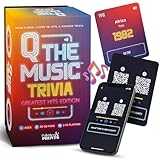
5. Q The Music – Music Lyric Party Trivia Quiz Card Game for Adult and Family Game Nights, 2-10 Players, Scan, Listen to Iconic Hits, and Answer Trivia – Adult Games for Parties
Overview:
Q The Music merges lyric trivia with QR technology, offering 312 songs spanning 100 years. Players scan cards to hear 30-second clips, then answer lyric- or artist-based questions. Suited for 2–10 players, it emphasizes quick, energetic rounds ideal for parties.
What Makes It Stand Out:
The 30-second song previews are its crown jewel, enabling immediate lyric recognition without full-app dependency. Unique “misheard lyrics” questions and flexible team play (solo/pairs) foster inclusive fun. Its century-spanning playlist—from 70s rock to modern pop—caters to diverse age groups seamlessly.
Value for Money:
Priced near $25, it competes strongly with SongFest! by focusing intensely on lyric challenges (312 songs vs. 1,000 Qs). The reusable QR system and high card count offer better longevity than Jumbo Hitster. Best value for lyric-focused groups, though question depth lags behind SongFest!.
Strengths and Weaknesses:
Strengths: Excellent lyric-centric gameplay; 30-second audio clips; versatile team options; durable cards.
Weaknesses: Spotify/app needed; fewer total questions than top rivals; occasional obscure lyric focuses.
Bottom Line:
Q The Music is the premier choice for lyric lovers, blending modern tech with infectious energy. Its precision on song snippets and accessibility make it a party staple, narrowly edging out competitors for pure musical engagement.
6. Lyrically Correct ’90s & 2000s Music Trivia Card Game - Pop Edition - Finish The Lyrics Challenge, Fun for Adults, Party or Family Night

Overview: This card game challenges players to recall lyrics from iconic ’90s and 2000s pop hits. Featuring 140 trivia cards plus 10 challenge cards, it’s designed for fast-paced, head-to-head lyric completion during game nights or social gatherings.
What Makes It Stand Out: Its laser focus on two beloved decades of pop culture—spanning throwback hits and one-hit wonders—creates instant nostalgia. The “Sing, Rap, or Mumble” mechanic encourages expressive participation, making it more dynamic than standard trivia. The challenge cards add unexpected twists to maintain energy.
Value for Money: Priced competitively for a 150-card set, it delivers strong replayability with era-specific content rarely matched by broader music games. While cheaper trivia decks exist, few offer this level of thematic depth for pop enthusiasts, justifying its cost for target audiences.
Strengths and Weaknesses: Strengths: Highly engaging for millennials/Gen X; accessible for 2+ players; perfect for casual parties. Weaknesses: Limited appeal for non-pop fans; no instructions for solo play; challenge cards lack complexity for hardcore trivia buffs.
Bottom Line: An excellent choice for pop-culture devotees seeking lighthearted, interactive fun. Ideal for themed parties or nostalgic gatherings, though less versatile for diverse musical tastes. Highly recommended within its niche.
7. After Dinner Amusements: Name That Tune!: 50 Music Trivia Questions and Challenges (Family Friendly Trivia Card Game, Portable Camping and Holiday Games)

Overview: A compact trivia tin offering 50 music-themed questions spanning eras, designed for quick, family-friendly gameplay. Its pocket-sized metal container makes it ideal for travel, dinner parties, or casual icebreakers.
What Makes It Stand Out: Extreme portability is its hallmark—the petite tin fits in purses or luggage effortlessly. The broad “past and present” music scope ensures multi-generational appeal, while its simplicity (humming/singing answers) lowers barriers to entry for kids and non-gamers.
Value for Money: While the card count is modest, the durable tin packaging and niche as a travel-ready game justify the price. It’s not a standalone game night centerpiece but excels as an affordable stocking stuffer or spontaneous conversation starter.
Strengths and Weaknesses: Strengths: Unbeatable portability; family-inclusive; high-quality tin; integrates seamlessly into existing events. Weaknesses: Too few cards for regular play; questions lack depth; limited replay value without expansions.
Bottom Line: A superb supplemental game for travelers or hosts needing bite-sized entertainment. Prioritize it for vacations or as a gift add-on, but pair it with larger games for dedicated game nights.
8. You Gotta Know Rock - Trivia Game

Overview: This rock-focused trivia set features 125 cards (500 questions) covering artists and music from the 1960s–1990s, packaged in a distinctive metal tin. Gameplay follows a simple “Race to 21” point system.
What Makes It Stand Out: Its deep dive into rock history—from classic to alternative—caters specifically to genre enthusiasts. The metal tin elevates gifting appeal, while the era-specific scope (60s–90s) offers educational value beyond casual play.
Value for Money: The 500-question count provides substantial content at a mid-range price. Though less versatile than pop-focused games, it’s a steal for rock fans seeking depth. The tin doubles as storage, enhancing longevity versus flimsy boxes.
Strengths and Weaknesses: Strengths: Rich historical coverage; durable packaging; straightforward rules; excellent for rock purists. Weaknesses: Narrow audience (excludes non-rock fans); no modern music (post-90s); minimal visual design on cards.
Bottom Line: A must-have for rock aficionados wanting substantive trivia. While limited in breadth, its focused expertise and sturdy build deliver exceptional value for its target market. Buy it for the ultimate rock fan.
9. Lyrically Correct ’90s & 2000s Music Trivia Card Game - Hip Hop and R&B Edition - Finish The Lyrics Challenge, Fun for Adults, Party or Family Night

Overview: Targeting hip-hop and R&B fans, this edition tests knowledge of ’90s/2000s golden-era lyrics through 140 trivia cards and 10 challenge cards. It emphasizes vocal participation with its “Sing It or Rap It” approach.
What Makes It Stand Out: It uniquely celebrates Black music genres often underrepresented in mainstream trivia. The high-energy requirement (“no wallflowers allowed”) fosters inclusivity and excitement, while the challenge cards introduce team dynamics missing in similar games.
Value for Money: Matches Product 6’s card count but with rarer genre specificity, increasing its worth for enthusiasts. The competitive team-play structure extends replayability, making it a robust investment for group entertainment.
Strengths and Weaknesses: Strengths: Vital representation of hip-hop/R&B; dynamic gameplay; ideal for diverse social settings (BBQs, reunions). Weaknesses: Potentially alienating for non-hip-hop listeners; lyrical focus may challenge non-native English speakers.
Bottom Line: The definitive choice for hip-hop/R&B lovers seeking authentic, lively trivia. Its cultural relevance and energetic design justify premium positioning. Essential for genre fans, but verify group preferences first.
10. Lucky Egg The Original Misheard Music – Guess The Song or Artist with 500 Lyrical Nonsense Cards – Hilarious Music Games for Adults & Teens – Fun Family Card Games for Karaoke & Party Entertainment

Overview: This game turns misheard lyrics into comedy gold, featuring 500 cards (350 song titles + 150 artist names) where players race against a 30-second timer to identify real songs from hilarious “lyrical nonsense.”
What Makes It Stand Out: The misheard-lyrics concept is brilliantly original, transforming familiar music into laugh-out-loud puzzles. The timer mechanic injects urgency, while the jukebox card holder and high card count ensure chaotic, replayable fun for all ages.
Value for Money: Unbeatable content volume (500 unique cards) at its price point. The blend of humor, speed, and broad musical eras creates near-limitless replayability, outperforming rivals in longevity and versatility.
Strengths and Weaknesses: Strengths: Hilarious premise; exceptional replay value; inclusive for teens/adults; timer elevates excitement. Weaknesses: Overwhelming for trivia novices; timer may frustrate casual players; requires strong pop-culture base.
Bottom Line: A top-tier party game that guarantees laughter and engagement. Its innovative twist and massive card library make it the most universally appealing pick here—highly recommended for lively groups.
Understanding the Karaoke Trivia Synergy
Why Trivia Elevates the Karaoke Experience
Karaoke thrives on performance, but trivia fuels the conversation and connection around it. Integrating trivia breaks up the singing segments, giving vocalists a rest and non-singers a starring role. It deepens the musical appreciation, turning casual listening into active engagement. Trivia questions about song origins, artist trivia, or chart history can directly reference the songs just performed or queued up, creating a cohesive musical journey rather than isolated performances. This synergy keeps energy high, prevents downtime awkwardness, and ensures the entire evening feels dynamic and thoughtfully paced.
Identifying Your Group’s Trivia Personality
Not all trivia games suit all crowds. Before diving into features, consider your regular crew. Are they music historians who crave deep-cut questions about B-sides and session musicians? Or is your group more about mainstream pop culture, laughing over who dated whom or remembering viral dance trends? Maybe you have a mix of ages, requiring broad appeal across decades. Understanding whether your audience leans towards “serious music nerd” or “lighthearted fun” is crucial. This shapes whether you prioritize encyclopedic depth, humor-focused questions, or a balanced blend that keeps everyone guessing and grinning.
The Crucial Role of Accessibility
The best karaoke trivia games succeed by being accessible to all skill levels. Avoid options that rely solely on obscure knowledge only hardcore fans possess; this alienates casual listeners. Look for games that cleverly layer difficulty – starting with recognizable hooks or famous lyrics everyone might know, then offering progressively harder clues or follow-up questions. Features like visual aids (album covers, artist photos), audio snippets, or multiple-choice formats significantly lower the barrier to entry, ensuring that someone who can’t name the drummer for a 90s band can still confidently identify a massive #1 hit from the chorus alone.
Key Features to Evaluate in Music Trivia Games
Music Library Depth and Breadth
The heart of any music trivia game is its song database. Scrutinize the scope: Does it cover the essential eras your group loves (70s rock, 80s pop, contemporary hits)? More importantly, does it offer meaningful depth within those eras? A game with 500 songs spread thinly across decades might feel shallow, while one with 200 meticulously curated tracks from specific golden ages could be far more engaging for your crowd. Prioritize breadth relevant to your audience over sheer volume. Check if the game allows filtering or focusing on specific genres or time periods to tailor the experience night-to-night.
Gameplay Mechanics That Match Your Vibe
How the trivia actually plays makes or breaks the fun. Consider the core mechanics: Is it rapid-fire buzzer style for high-energy competition? Turn-based with strategic elements for a more thoughtful pace? Team-based to foster collaboration? Or perhaps a free-for-all app where everyone answers simultaneously on their phones? Think about your group’s dynamic. Buzzer systems energize competitive groups but can intimidate quieter participants. Simultaneous answer apps (like live polls) are incredibly inclusive and generate instant, shareable results, perfect for keeping the karaoke flow moving without lengthy pauses.
Tech Requirements and Setup Simplicity
Karaoke nights are about fun, not tech support marathons. Evaluate the technical footprint. Does the trivia game require a specific console, complex app downloads, or constant internet connectivity that might falter with a crowded party Wi-Fi? Opt for solutions with minimal friction: physical card games need zero tech, while well-designed companion apps should work offline or with very light server reliance. Crucially, assess setup time. Can you launch a round in under two minutes between songs? If configuring the trivia takes longer than singing a power ballad, it will disrupt the night’s rhythm. Simplicity is non-negotiable.
Question Variety and Engagement Hooks
Monotonous question formats get stale fast. Look for games that mix it up creatively. Beyond simple “Who sang this?” expect lyric fills, identifying songs from short audio clips (instrumental intros are great!), matching artists to album art, decade identification, “true or false” artist anecdotes, or even visual puzzles like rearranging scrambled song titles. The best games incorporate multi-sensory elements – hearing a snippet, seeing an image, reading a clue – which caters to different learning styles and keeps cognitive engagement high, preventing the “same old trivia” fatigue.
Optimizing for Your Karaoke Night Environment
Seamless Integration with Singing Rounds
The trivia shouldn’t feel like a separate activity; it should weave into the karaoke fabric. Ideal trivia games allow you to easily pause and resume, fitting naturally into the song rotation. Can you trigger a quick 2-question round while the next singer queues their track? Does the scoring system (if any) complement the karaoke points, perhaps awarding bonus points for trivia winners to use on their next song choice? Smooth transitions are key – avoid games requiring lengthy explanations or resets that kill the spontaneous fun of moving from singing to guessing and back again.
Scalability for Group Size Fluctuations
Your karaoke crew size likely varies. A trivia game perfect for 6 close friends might collapse with 15 energetic guests, and vice-versa. Consider scalability. Card-based games often struggle with large groups (reading questions aloud gets messy). Digital solutions shine here, especially app-based systems where every guest participates individually on their own device, aggregating results instantly regardless of headcount. For physical games, check if team play is encouraged or if the rules adapt cleanly from intimate gatherings to rowdy parties. Flexibility prevents the trivia from becoming the bottleneck.
Managing Energy and Pacing
Trivia should revitalize, not drain, the party atmosphere. Pay close attention to round length and pacing mechanics. Games with fixed, long rounds (e.g., 20 questions minimum) can drag during a lively karaoke break. Favor systems allowing you to set short bursts – “Just three quick questions before the next singer!” Timers add excitement but shouldn’t induce stress; adjustable time limits let you match the intensity to the room’s vibe. Bonus features like instant “lifelines” (ask the audience, skip a question) keep the energy positive and prevent frustrating deadlocks that stall the music.
Making Music Trivia Inclusive and Fun for All
Catering to Diverse Musical Knowledge
The beauty of combining trivia with karaoke is engaging non-singers, but trivia itself can exclude if not handled well. Prioritize games that deliberately scaffold knowledge. This means questions where the first clue is very accessible (e.g., “This 80s power ballad starts with a piano riff…”), with progressively harder hints. Games incorporating visual or audio elements (showing Madonna’s “Like a Prayer” cover art, playing the synth intro to “Sweet Dreams”) provide alternative pathways to the answer beyond pure recall, leveling the playing field between the casual listener and the superfan.
Incorporating Humor and Lightheartedness
Music trivia shouldn’t feel like a pop quiz. The most successful games for social settings inject consistent humor. Look for question sets with witty phrasing, amusing “did you know?” facts, or intentionally silly multiple-choice options alongside the serious contenders. Trivia that celebrates iconic music fails or hilarious behind-the-scenes anecdotes connects to the often-unpolished, joyful spirit of karaoke itself. Laughter is the best icebreaker; a funny question or answer can instantly dissolve tension and get even reluctant players involved.
Fostering Collaboration Over Cutthroat Competition
While friendly rivalry is fun, karaoke trivia shouldn’t breed resentment. Consider mechanics that encourage teamwork. Team-based scoring, shared “lifelines,” or designated “consultation” periods where groups huddle to discuss answers promote bonding. Even individual-play apps can foster camaraderie through shared reactions to results (“How did anyone get that one?!”). Avoid overly punishing scoring (like point deductions for wrong answers) that discourages participation. The goal is collective enjoyment and shared musical discovery, not identifying the sole trivia champion who then dominates all song choices.
Practical Considerations for Long-Term Enjoyment
Replay Value and Content Updates
A trivia game you exhaust after two karaoke nights is money poorly spent. Investigate longevity. Does the game offer a massive, diverse question pool ensuring surprises over multiple plays? Is there a mechanism for content updates – downloadable expansion packs focusing on new hits, specific genres, or decades? Physical card games might have limited replayability unless they use clever randomization or modular decks. Digital platforms often excel here with subscription models or periodic free updates, keeping the trivia fresh and relevant as music evolves, crucial for parties spanning months or years.
Cost vs. Value Analysis
Weigh the investment against usage. A premium app subscription might be cost-effective for weekly game nights, while a one-time purchase of a physical card game could be ideal for occasional parties. Consider hidden costs: does a “free” app lock essential features (like sufficient questions or no ads) behind a paywall? Does a physical game require additional components you don’t own? Calculate the cost per use based on your expected frequency. Sometimes spending a bit more upfront for robust content and durability saves frustration and repeated purchases down the line.
Physical Space and Storage Requirements
Karaoke setups often live in cramped entertainment centers or get stashed away between uses. Evaluate the trivia game’s footprint. A bulky box of cards might be impractical if your karaoke machine lives in a closet. A purely digital solution leverages devices you already have (phones, tablets, smart TVs), minimizing extra clutter. If opting for physical components, prioritize compact, durable boxes or tins that won’t get lost or damaged. Easy storage ensures the trivia element is always ready to grab and go, removing one more barrier to using it regularly.
Frequently Asked Questions
Frequently Asked Questions
Can I effectively use music trivia with a very small group, like just 2-3 people?
Absolutely. Many modern trivia formats, especially app-based ones designed for simultaneous play, work perfectly for intimate gatherings. The key is choosing games with engaging single-player modes or adapting rules for direct head-to-head play. Shorter rounds keep it snappy, and the collaborative nature of discussing answers can deepen the connection without needing a large crowd.
How do I prevent music trivia from slowing down the karaoke flow?
Prioritize speed and simplicity. Opt for games allowing ultra-quick rounds (1-3 questions max between singers), use apps that display results instantly, and avoid complex scoring that requires manual calculation. Set a firm time limit per question (e.g., 15 seconds). The trivia should feel like a natural, energizing pause, not an interruption demanding significant setup or resolution time.
What if my group has wildly different music tastes and knowledge levels?
This is where question variety and accessibility features are vital. Choose games explicitly designed with tiered difficulty or multi-part clues. Focus on mechanics that let everyone participate meaningfully – audio snippets or visual cues help those weaker on pure recall, while bonus “expert” questions can satisfy the superfans. Emphasize fun and shared discovery over cutthroat accuracy; laughing at wrong answers is part of the charm.
Are physical trivia card games still a good option compared to apps?
Yes, for specific scenarios. Card games shine in low-tech environments, offer tactile engagement, avoid screen fatigue, and often have no hidden costs or updates. They’re great for focused, small-group interaction. However, apps generally offer superior scalability for larger groups, instant scoring, vast dynamic question pools, updates, and seamless integration with audio playback. Consider your group size, tech comfort, and need for constant novelty.
How important is having up-to-date song references in the trivia?
Relevance matters, but timeless classics are crucial. The best games strike a balance: a strong foundation of enduring hits spanning decades ensures broad appeal and longevity, supplemented by mechanisms to incorporate recent chart-toppers (like downloadable packs or regular app updates). Prioritize depth in core repertoire first; a game overloaded with fleeting viral hits from last month will feel dated quickly.
Can music trivia actually help shy people participate more in karaoke nights?
Definitely. Trivia provides a lower-pressure entry point. Answering a question doesn’t require performing publicly, making it accessible for those nervous about singing. Success in trivia can build confidence. Furthermore, trivia often sparks conversations about favorite songs, potentially encouraging shy guests to add those tracks to the karaoke queue later, feeling more invested in the musical choices.
What’s the ideal length for a trivia round during karaoke?
Keep it short and punchy! Aim for trivia bursts that last 2-5 minutes max. This is long enough to be engaging but short enough to maintain the evening’s momentum. Typically, 3-5 questions per round is the sweet spot. Think of it as a palate cleanser between main vocal courses – refreshing but not the main event.
How can I handle disputes over trivia answers smoothly?
Prevention is key. Choose games with clear, authoritative sources for answers (reputable music databases, official chart histories). For physical games, a designated “DJ/referee” (often the karaoke host) makes the final call based on the provided answer key. Digital apps usually resolve this instantly. Establish a lighthearted rule upfront: “The DJ’s word is final, backed by the almighty app or rulebook!” and move on quickly to keep energy positive.
Is it worth getting a trivia game focused on a very specific music genre?
It depends entirely on your group’s passion. If your karaoke nights are exclusively 80s synth-pop or classic country, a niche trivia game will be a home run, offering deep, relevant fun. For more general mixed-genre nights, a broad-spectrum game is safer. However, genre-specific expansions for a core trivia system can be excellent add-ons for themed karaoke parties, adding targeted excitement without replacing your main game.
Do I need special equipment beyond what I already have for karaoke?
Ideally, no. The most user-friendly trivia integrations leverage existing karaoke gear. Companion apps work on smartphones or the tablet/TV running your karaoke software. Card games need only the box. Avoid trivia systems requiring additional hubs, proprietary remotes, or complex speaker setups. The goal is effortless addition, not a second tech stack. Check compatibility with your current karaoke platform (like popular streaming services or machine brands) for the smoothest integration.
See Also
- 10 Best Music Trivia Games for Fans Who Live for Lyrics in 2026
- 10 Game-Changing Music Trivia Games for Karaoke Lovers in 2026
- 10 Game-Changing Adult Trivia Games for Game Night Enthusiasts in 2026
- 10 Best Sports Trivia Games for Weekend Fans and Fantasy Leagues in 2026
- 10 Expert-Recommended Trivia Board Games for Game Night in 2026