Table of Contents
Gather ‘round the table, because that magical moment when laughter echoes through the house and screen-time feels like a distant memory? That’s the pure, unadulterated joy of a fantastic family game night. Forget the pressure of finding a single “perfect” game; the real secret lies in understanding what truly makes an experience work for your unique mix of ages, personalities, and energy levels. Whether you’re wrangling toddlers alongside grandparents or trying to bridge the gap between pre-teens and adults, the right game can dissolve generational barriers, spark genuine connection, and create traditions that last decades. It’s less about the box and more about the shared adventure unfolding within it.
Too often, we grab the first brightly colored box off the shelf, only to face disengaged kids, confused grandparents, or frustrated adults wondering where the fun went. The culprit isn’t the people—it’s mismatched expectations and mechanics that don’t align with your group’s dynamics. This guide cuts through the noise, focusing not on fleeting “best of” lists, but on the timeless principles that transform any game selection from a chore into a cherished ritual. We’ll explore the essential considerations, hidden features that make or break the experience, and how to tailor your choices for maximum enjoyment, ensuring your next family gathering is remembered for the belly laughs and friendly competition, not the awkward silences.
Top 10 Family Party Games
Detailed Product Reviews
1. USAOPOLY The Original TAPPLE, The Fast-Paced Family Board Game,Choose a Category & Race Against The Timer to be The Last Player,Learning Word Game for Ages 8 & Up, 2-8 Players, 15-20 Minute Play Time

Overview: TAPPLE delivers high-energy wordplay where players race against a built-in timer to shout category-specific words starting with a designated letter. Its compact, self-contained wheel design makes it ideal for quick family game sessions or travel.
What Makes It Stand Out: The ingenious Tapple wheel integrates category cards, timer, and letter tabs into one portable unit, eliminating setup time. Its rapid 15-20 minute playtime and simple “call out words, press the tab” mechanic create intense, inclusive fun for 2-8 players without complex rules.
Value for Money: Priced competitively for party games, it offers exceptional replayability with 144 categories across 36 cards. The durable construction and travel-friendly design provide better longevity than cheaper alternatives, justifying its cost for frequent game nights.
Strengths and Weaknesses:
Strengths: Ultra-portable; easy to learn; fast-paced inclusivity; durable timer mechanism; scales perfectly for large groups.
Weaknesses: Timer can be overly harsh for younger kids; limited category depth; letter tabs may jam with rough handling.
Bottom Line: An outstanding, award-winning word game that revitalizes family nights with adrenaline-pumping simplicity. Highly recommended for groups seeking quick, engaging, and travel-ready fun.
2. USAOPOLY BLANK SLATE, Where Great Minds Think Alike, Fun Family-Friendly Board Game, Word Association Party Game, Easy to Learn, Fun to Play Family Game Night, 3-8 Players, Ages 8+
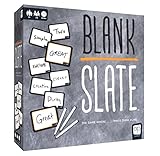
Overview: Blank Slate challenges players to predict collective thinking by writing single words to complete phrase prompts, aiming to match others’ unseen responses for points. Its dry-erase slates and cue cards foster lighthearted group synergy.
What Makes It Stand Out: The “_______ minds think alike” hook creates hilarious “aha!” moments as players discover shared assumptions. The double-sided cue cards (500 phrases total) and reusable slates enable endless rounds, while the scoreboard tracks progress intuitively.
Value for Money: With 250 cue cards and reusable components, it outlasts trivia games reliant on fixed questions. Its versatility for 3-8 players and minimal setup offer superior replay value per dollar compared to niche party games.
Strengths and Weaknesses:
Strengths: Encourages social bonding; effortless setup; highly replayable; slates eliminate paper waste; perfect for mixed-age groups.
Weaknesses: Humor relies heavily on group dynamics; less engaging for analytical players; slates require constant erasing.
Bottom Line: A brilliantly simple, laughter-filled game that excels at connecting people. Ideal for families and gatherings—buy it for reliably joyful, low-prep nights.
3. I should have known that! - A Trivia Game About Things You Oughta Know, Green
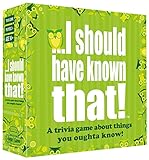
Overview: This compact trivia game tests practical knowledge with questions spanning everyday facts, pop culture, and common sense. Designed for ages 14+, it targets players who enjoy lighthearted challenges about “obvious” topics they might overlook.
What Makes It Stand Out: Its niche focus on deceptively simple “you should know this” questions creates relatable, humbling fun. The small 6x6-inch box enhances portability, while Poland-made production suggests thoughtful craftsmanship for a niche audience.
Value for Money: Limited features (no card counts specified) make value assessment tricky. However, its unique angle justifies a mid-range price for trivia fans seeking fresh, non-academic questions that spark “I should have known that!” moments.
Strengths and Weaknesses:
Strengths: Novel trivia concept; highly portable; sparks engaging conversations; accessible for casual players.
Weaknesses: Unclear replayability without card quantities; lacks thematic depth; minimal component details raise durability questions.
Bottom Line: A charming niche trivia game best for casual players who enjoy self-deprecating humor. Recommended if you prioritize portability and relatable questions over expansive content.
4. It’s Bananas! The Monkey Tail Game – Funny Family & Party Game for Kids & Adults | Hilarious Gift for Birthday, Christmas, Bachelorette, Thanksgiving, White Elephant

Overview: It’s Bananas is a physical comedy game where players mimic absurd monkey-themed actions (like “thrusting” or squatting) to earn cards, generating uncontrollable laughter through sheer silliness.
What Makes It Stand Out: Viral TikTok fame (250M+ views) and celeb endorsements attest to its laugh-out-loud appeal. The carbon-neutral production and eco-conscious packaging differentiate it in a crowded market, while multi-generational play suits kids and adults equally.
Value for Money: High entertainment per dollar given its party-starter potential. The minimal components (cards only) are offset by massive replay value and viral social proof—cheaper than group therapy for generating genuine joy.
Strengths and Weaknesses:
Strengths: Unmatched laughter potential; eco-friendly; simple for all ages; ideal for large groups; media-validated fun.
Weaknesses: Pure physical comedy—no strategy; limited appeal for shy players; repetitive after extended play.
Bottom Line: A must-buy for laugh-seeking households. If you want guaranteed giggles at gatherings, this carbon-neutral comedy machine earns every penny.
5. What Do You Meme?Edition by Relatable, Now with Refreshed Content, Easter Family Games for Kids and Adults, Easter Basket Gift, The TikTok Viral Sensation, Includes 300 Caption Cards, 108 Photo Cards

Overview: This family-friendly meme game tasks players with matching caption cards to photo cards to create the funniest combinations. Designed for ages 8+, it’s a sanitized take on the viral adult version, perfect for Easter baskets or family nights.
What Makes It Stand Out: The “refreshed content” ensures age-appropriate humor, while 408 total cards (300 captions + 108 photos) provide vast creative combinations. TikTok virality and rotating-judge mechanic encourage personalized, dynamic gameplay.
Value for Money: Exceptional card volume justifies its price, eclipsing smaller card games. As a reusable Easter basket stuffer or travel game, it delivers sustained value through endless meme-making—far outperforming single-use toys.
Strengths and Weaknesses:
Strengths: Massive card variety; easy “judge picks winner” rules; ideal for tech-free group bonding; TikTok-tested appeal.
Weaknesses: Humor can feel forced for non-meme fans; younger kids may miss references; requires 3+ players to shine.
Bottom Line: The definitive family meme game—wholesome, creative, and endlessly replayable. A top-tier pick for Easter gifts or inclusive game nights.
6. USAOPOLY Flip 7, The Ultimate Blend of Press Your Luck & Strategy, Fast-Paced Addictive Card Game,Quick to Learn & Easy to Teach,Perfect for Game Nights, 3+ Players, Ages 8 & Up, 20 Minutes Play Time

Overview: Flip 7 is a fast-paced press-your-luck card game where players strategically reveal cards to accumulate points without drawing duplicates. Designed for 3+ players aged 8 and up, it delivers quick 20-minute rounds ideal for game nights, focusing on risk assessment and tactical decisions. What Makes It Stand Out: Its unique numbered deck—featuring decreasing quantities of cards (twelve 12s down to one 1)—creates inherent tension. Special action cards like “Flip Three” and “Second Chance” inject unpredictability, turning simple number matching into a dynamic test of nerve and strategy that keeps players engaged. Value for Money: Priced competitively for a niche strategy game, Flip 7 offers exceptional replayability through its variable deck composition and quick setup. It outperforms similar-priced luck-based games by emphasizing skill, making it a smarter investment than pure chance titles like older bingo variants. Strengths and Weaknesses: Strengths: Highly addictive risk-reward loop; intuitive rules; excellent replay value; compact and portable. Weaknesses: Heavy reliance on luck can frustrate strategic players; limited player interaction beyond turn-taking; point-tracking may feel tedious for younger kids. Bottom Line: Flip 7 excels as a thrilling, accessible press-your-luck game that balances simplicity with strategic depth. Despite minor luck dependency, its innovative deck design and fast pace make it a standout recommendation for families and casual gamers seeking quick, engaging rounds.
7. Do You Really Know Your Family? A Fun Family Game Filled with Conversation Starters and Challenges - Great for Kids, Teens and Adults
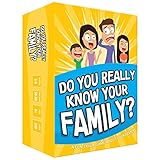
Overview: This conversation-driven card game prompts families to answer personal questions and complete lighthearted challenges, fostering connection through shared laughter and storytelling. Aimed at ages 8+, it requires zero setup and focuses purely on interpersonal interaction during game nights. What Makes It Stand Out: Unlike trivia-based games, it centers on knowing family members through tailored prompts (“What’s Mom’s most embarrassing habit?”), encouraging genuine insight. Silly challenges (“Do your best impression of Uncle Bob”) create spontaneous, memorable moments that transcend typical Q&A formats. Value for Money: An affordable investment for meaningful family bonding, it replaces screen time with active communication. While pricier than basic trivia decks, its unique focus on personalized interaction offers superior long-term value compared to generic alternatives like generic “Would You Rather” sets. Strengths and Weaknesses: Strengths: Sparks authentic conversations; effortless to learn; inclusive for mixed ages; builds emotional connection. Weaknesses: Limited replayability as questions repeat; less structured for competitive players; effectiveness depends on family openness (shy members may disengage). Bottom Line: A heartwarming tool for strengthening family bonds through humor and vulnerability. Despite modest replay limits, its ability to generate genuine connection makes it highly recommended for households seeking screen-free, laughter-filled nights.
8. CMYK Wavelength: The Mind Reading Party Game

Overview: Wavelength is a cooperative party game where teams interpret abstract spectrums (e.g., “Hot to Cold”) using cryptic clues. Players guess where a clue lands on a hidden continuum, blending psychology with playful deduction for 2–12+ participants in 30-minute sessions. What Makes It Stand Out: Its innovative spectrum mechanic creates “aha!” moments as teams align their thinking, fostering a near-telepathic connection. Critical acclaim (Polygon, NYT Wirecutter) and plug-and-play simplicity—set up in 5 seconds—make it a standout for diverse groups, from corporate offsites to family gatherings. Value for Money: Priced moderately for high-quality components, it delivers immense replayability through infinite spectrum combinations. It justifies its cost by replacing multiple niche party games, outperforming alternatives like Codenames in fostering collaborative energy. Strengths and Weaknesses: Strengths: Brilliant spectrum concept; scales perfectly for large groups; zero setup; encourages creative communication. Weaknesses: Less engaging for analytical players who prefer clear rules; spectrum interpretations can feel subjective; minimal strategy depth for hardcore gamers. Bottom Line: A masterclass in social deduction that transforms group dynamics with minimal effort. Its universal appeal and effortless setup make it an essential, highly recommended addition to any party game collection.
9. Taco Cat Goat Cheese Pizza Wildly Entertaining Card Game for Family and Group Game Night | Easy to Learn and Play with 10-15 Minute Rounds | Fun for Kids, Teens, Adults, and Families | 2-8 Players

Overview: This slap-based card game tasks players with matching spoken words (“Taco,” “Cat,” etc.) to played cards, triggering frantic pile-slapping when matches occur. Designed for 2–8 players aged 7+, it delivers 10–15 minute bursts of high-energy fun suitable for travel or game nights. What Makes It Stand Out: The hypnotic chant-and-slap mechanic creates infectious chaos, while action cards amplify unpredictability. Its universal accessibility—equally thrilling for kids and adults—cements it as a go-to for mixed-age groups, outpacing classics like Slapjack with polished pacing. Value for Money: An exceptional value given its durability, portability, and broad appeal. It surpasses similarly priced games (e.g., Uno) in replayability per dollar, as quick rounds encourage repeated plays without fatigue, justifying its status as a top stocking stuffer. Strengths and Weaknesses: Strengths: Instant setup; inclusive for all ages; sharpens reflexes and focus; highly portable. Weaknesses: Can become overwhelming with >6 players; repetitive after extended sessions; physical slapping may not suit all environments (e.g., quiet spaces). Bottom Line: A near-perfect party game that guarantees laughter and engagement in minimal time. Despite slight chaos at high player counts, its simplicity and energy make it a must-buy for families and casual gamers.
10. Ransom Notes - The Ridiculous Word Magnet Party Game, 3+ Players

Overview: Players craft absurd responses to outrageous prompts (e.g., “Confess to stealing the office coffee creamer”) using randomized word magnets. This creative party game accommodates 3–6+ players in 30–90 minute sessions, thriving on improvisational comedy. What Makes It Stand Out: The tactile magnet mechanic and wildly inventive prompts spark unparalleled humor, as players scramble limited vocabulary to form coherent (or hilariously incoherent) sentences. Infinite combinations from 840 magnets and 250 prompts ensure freshness. Value for Money: Justifies its cost with premium components and massive replay potential. While pricier than card-only games, the physical magnets enhance engagement, offering more lasting value than disposable joke decks like Cards Against Humanity expansions. Strengths and Weaknesses: Strengths: Unleashes creativity; instantly involves shy players; magnet quality feels substantial; wildly re-playable. Weaknesses: ~30% of prompts are adult-themed (requires pre-screening for families); magnet organization can be messy; limited strategic depth. Bottom Line: A brilliantly inventive game that transforms wordplay into uproarious group fun. Despite needing prompt curation for families, its creativity and re-playability earn a strong recommendation for adult game nights.
Understanding Your Unique Family Game Night Needs
Before diving into mechanics or themes, the most crucial step is a deep dive into who you’re playing with and why you’re gathering. This foundational understanding prevents disappointment and sets the stage for genuine fun.
Assessing Age Range and Developmental Stages
The gap between a 5-year-old and a 70-year-old is vast, and game mechanics must bridge it thoughtfully. Consider cognitive abilities: younger children thrive on simple cause-and-effect, luck-based elements, and quick turns, while older players often appreciate strategy and nuanced decisions. Physical dexterity matters too—games requiring fine motor skills or rapid hand-eye coordination can frustrate younger or less agile players. Look for adaptable rules that allow scaling complexity; some games offer “family mode” or modular rulesets specifically designed to grow with your crew. The goal isn’t identical play, but parallel engagement where everyone feels capable and included.
Determining Ideal Player Count and Group Dynamics
Don’t assume a game labeled “for 2-6 players” works equally well at both extremes. A game that shines with four competitive adults might fall flat with just two people or become chaotic with six. Consider your typical gathering size. Also, observe your group’s social energy: are they naturally competitive, collaborative, silly, or prefer quiet focus? A highly confrontational game might overwhelm a gentle group, while a purely cooperative one could bore thrill-seekers. Match the game’s social “temperature” to your family’s natural vibe for smoother, more enjoyable interactions.
Key Game Mechanics That Drive Family Fun
The engine under the hood—the core mechanics—dictates the flow, pace, and type of engagement. Choosing mechanics that resonate with your group is paramount for sustained enjoyment.
Luck vs. Skill Balance: Finding the Sweet Spot
Pure luck games (like simple dice rolls) ensure young children aren’t constantly defeated, preventing frustration. However, too much luck can make older kids and adults feel powerless, reducing investment. Pure skill games often lead to the same person winning repeatedly, discouraging others. The magic happens in the middle: games incorporating meaningful choices alongside manageable luck elements. Think “push your luck” mechanics where players decide when to stop rolling dice, or set collection where luck draws cards but skill organizes them. This balance keeps outcomes uncertain enough for kids to win sometimes, while giving adults avenues to influence their success.
Turn Structure: Keeping Everyone Engaged
Long waits between turns are the arch-nemesis of short attention spans, especially for kids. Games with simultaneous play (where everyone acts at once), very quick individual turns, or active player roles that involve others during their turn are golden. Avoid games where players are completely inactive for extended periods. Mechanics like “take that” cards can keep non-active players invested in the action, while cooperative games naturally foster group participation throughout. The smoother the turn flow, the less likely you are to hear “Is it my turn yet?”
Theme and Narrative: More Than Just Decoration
A compelling theme isn’t just window dressing; it provides context that aids understanding and fuels imagination. A space adventure theme makes abstract resource management feel like building a starship. A silly monster theme turns simple matching into a hilarious rescue mission. Crucially, the theme should resonate across ages—avoid overly complex lore that confuses kids or juvenile themes that bore teens/adults. Universally appealing concepts (adventure, cooking, animals, community building) often work best. A strong narrative hook can transform abstract rules into an immersive story everyone wants to be part of.
Practical Considerations for Real-World Play
Beyond the fun factor, logistical realities make or break repeated play. Ignoring these can turn a promising game into a dusty shelf ornament.
Setup and Cleanup Time: The Reality Check
In the hustle of family life, a game requiring 15 minutes to set up intricate boards and pieces is unlikely to see frequent play. Prioritize games with setup under 5 minutes and intuitive component organization. Look for trays, compartmentalized boxes, or clear iconography that speeds assembly. Similarly, cleanup should be straightforward—ideally under 2 minutes. Games where pieces are uniform (like standard dice or cards) or have obvious storage spots win here. If getting the game out feels like a chore, it won’t happen often.
Physical Space and Component Durability
Be brutally honest about your play space. Do you have a large table, or are you playing on the floor? Games with sprawling boards or requiring significant arm movement need room. Consider component size: tiny tokens are a nightmare with toddlers or on uneven surfaces. Durability is non-negotiable for family use. Thicker cardboard, wooden pieces, and laminated cards withstand enthusiastic handling and accidental spills far better than flimsy materials. Rounded corners on boards prevent snags, and secure box lids prevent component avalanches during storage.
Budget and Long-Term Value Assessment
Family game budgets vary widely, but focus on value over sheer cost. A slightly more expensive game that gets played weekly for years offers far better value than a cheap one played once. Consider replayability: Do variable setups, modular boards, or multiple winning strategies mean no two games are identical? Can the game scale up or down for different group sizes? Does it have expansions (though avoid immediate reliance on them)? Games fostering genuine connection often become beloved staples, justifying a higher initial investment compared to a novelty item with limited appeal.
Inclusivity and Accessibility for All Players
Truly great family games create space for everyone to participate meaningfully, regardless of individual challenges.
Accommodating Different Abilities and Learning Styles
Look for games offering multiple paths to engagement. Visual learners benefit from clear icons and color-coding, while auditory learners might enjoy games with sound cues or storytelling elements. Include options for players with fine motor challenges—larger components, dice towers, or rules allowing helpers to manipulate pieces. For players with sensory sensitivities, avoid games reliant on loud noises, flashing lights, or overwhelming physical contact. Cooperative games inherently reduce pressure on individuals, while adjustable difficulty settings (like “easy mode” rules) ensure no one feels consistently left behind.
Managing Competitive Tension and Fostering Positive Interaction
Healthy competition is fun; toxic rivalry kills the vibe. Games with built-in “catch-up” mechanics (where trailing players get small advantages) or indirect competition (where players compete against the game system, not directly against each other) reduce frustration. Cooperative games eliminate player-vs-player conflict entirely, focusing the group against a common challenge. Emphasize games that encourage positive interaction: giving helpful hints in co-ops, light-hearted “take that” with humorous consequences, or shared storytelling moments. The goal is spirited play, not bruised egos.
The Digital Dilemma: Physical vs. Screen-Based Games
While apps and video games offer convenience, physical tabletop games provide unique benefits crucial for family bonding.
The Irreplaceable Value of Tangible Interaction
Handling physical components—shaking dice, drawing cards, moving pieces—creates a multisensory experience that screens can’t replicate. This tactile engagement boosts memory retention and spatial reasoning, especially in children. Crucially, physical games force participants to be present in the same physical space, making eye contact, reading body language, and sharing immediate reactions. This fosters deeper social connection and communication skills that screen-based interactions often lack. The absence of notifications and infinite scrolling creates a dedicated, distraction-free zone for genuine interaction.
When Digital Enhancements Truly Add Value
Acknowledging that technology has its place, some hybrid games use apps sparingly to enhance, not replace, the physical experience. Examples include apps that handle complex scoring, provide variable setups, or add atmospheric soundtracks—without becoming the primary focus. The key is that the core gameplay remains firmly rooted in physical interaction around the table. Avoid games where the screen is the game board; these often replicate the isolating nature of individual device use, defeating the purpose of a shared family activity.
Beyond Entertainment: Hidden Educational and Developmental Benefits
Great family games are stealthy learning tools, nurturing skills in a context of pure enjoyment.
Cognitive Skills Developed Through Play
Strategic planning emerges in games requiring resource management or route optimization. Pattern recognition is honed through set collection and sequencing challenges. Probability and risk assessment come into play with dice rolls and “push your luck” mechanics. Even simple turn-taking reinforces sequencing and patience. The beauty is that players absorb these concepts through engaging, low-pressure scenarios, making learning feel like an organic part of the fun rather than a lesson.
Social and Emotional Learning in Action
Games are microcosms of social interaction. Players practice clear communication when explaining rules or negotiating trades. They learn emotional regulation when facing setbacks (a bad roll, a lost point) and experience delayed gratification while waiting for their turn. Cooperative games explicitly teach teamwork, shared problem-solving, and perspective-taking (“How can I help my teammate succeed?”). Navigating both winning and losing gracefully within the safe boundaries of a game provides invaluable lessons for real-world interactions.
Maximizing Enjoyment: Tips for Hosting a Successful Game Night
Choosing the right game is half the battle; facilitating the experience ensures it lands perfectly.
Setting the Stage for Success
Create a dedicated, comfortable play environment. Ensure good lighting on the table, minimize background distractions (mute TVs!), and have snacks/drinks within easy reach to avoid constant getting up. Briefly explain the spirit of the game before diving into rules: “This is all about silly guesses and laughing together, winning isn’t the main point!” Frame it as collaborative fun from the start. Start with a very quick, ultra-simple warm-up game to get everyone in the playful mood before tackling something more complex.
Facilitating Play and Managing Energy Levels
Appoint a gentle “rules referee” (often rotates) to keep things moving without stifling fun. Be prepared to simplify rules on the fly for younger players—“For now, Grandma, you can just focus on matching colors; we’ll add the special actions next time.” Watch energy levels closely; if kids are getting restless, shorten rounds or switch to a faster-paced activity. Most importantly, model good sportsmanship: laugh at your own mistakes, celebrate others’ successes genuinely, and keep the focus on shared enjoyment, not just the scoreboard.
Making Your Investment Last: Storage and Maintenance
Protecting your game collection ensures those joyful moments can be repeated for years.
Smart Storage Solutions for Longevity
Store games upright like books to prevent box warping. Keep them in a cool, dry place away from direct sunlight, which fades components. For games played frequently, consider adding aftermarket organizers (like foam inserts or custom trays) to protect cards and pieces and speed setup. For less durable games, clear plastic bags inside the box can corral small bits. Never store games in attics or basements with extreme temperature or humidity fluctuations—they’re death sentences for cardboard and paper.
Simple Maintenance for Peak Performance
After each play, quickly check for stray bits before packing up. Wipe down boards and cards with a dry microfiber cloth if they get sticky; avoid liquids. If cards get bent, flatten them under a heavy book. Replace lost dice easily with standard replacements (most are standard sizes). For more serious damage (torn cards, broken pieces), many publishers offer replacement parts—don’t hesitate to contact them. A little care goes a long way in preserving the physical integrity and playability of your favorites.
Frequently Asked Questions
How do I choose a game when ages range from 5 to 70?
Focus on mechanics with adjustable difficulty, strong themes that appeal universally (adventure, animals), simultaneous play to minimize downtime, and a healthy luck/skill balance. Cooperative games often excel here as they reduce direct competition across ages.
What if someone in the family hates losing?
Prioritize cooperative games where the group wins or loses together, or games with indirect competition and strong “catch-up” mechanics. Emphasize the fun of playing itself over winning, and consider implementing a “no scoreboard” rule for purely social games.
Are expensive games always better for families?
Not necessarily. Value lies in replayability, durability, and how well it suits your group. A moderately priced game played constantly offers better value than a costly one gathering dust. Focus on mechanics and fit over price tag.
How can I get teens who prefer screens interested?
Involve them in the selection process—ask what themes or mechanics they might like. Choose games with strategic depth, engaging themes relevant to them, or high-quality components. Start with shorter, faster-paced games; avoid anything that feels childish. Frame it as social time with friends (invite their friends!).
What’s the ideal game length for mixed-age groups?
Aim for 20-45 minutes for younger kids mixed with adults. Games with variable length (play until someone reaches X points) allow flexibility. Always have a clear endpoint; open-ended games often lead to fading interest. Shorter, high-energy games are often more satisfying than dragging out a long one.
How do I handle arguments over rules during play?
Designate a rotating “head referee” beforehand, ideally someone calm and knowledgeable. Agree that the ruling for this game is final to keep play moving—debate specific interpretations afterward. Keep a notepad to jot down disputes for later research. Simplify rules on the fly if arguments become frequent.
Are there good family games that don’t require reading?
Absolutely! Look for games relying heavily on symbols, colors, icons, and visual cues. Many tile-laying, pattern-matching, dexterity, and cooperative games use minimal text. Games like “Dobble” (Spot It!) or “King of Tokyo” (using iconography) are great examples where reading isn’t essential.
How can I make game night appealing to non-competitive family members?
Emphasize cooperative games where everyone works together. Choose games with low player interaction (minimal “take that”) and high theme immersion. Focus on the social aspect—serve favorite snacks, play background music, make it about chatting and laughing together as much as the game itself.
What should I do if a game we bought isn’t working for our family?
Don’t force it! It’s okay to abandon a game mid-session if frustration is high. Analyze why it failed (too complex? too long? wrong theme?) to inform future choices. Consider selling or trading it and using the funds toward something better suited. Not every game is for every group.
How often should we have family game night to keep it special but not burdensome?
Consistency matters more than frequency. Aim for a realistic, sustainable rhythm—perhaps bi-weekly or monthly. Make it a predictable,期待 event (“Game Night is every second Saturday!”). Quality and enjoyment are key; one fantastic hour is better than forcing a tedious two-hour session that nobody looks forward to.