Table of Contents
Imagine gathering around the table after dinner, not for another screen-lit session, but for an evening where every clue matters, every question holds weight, and the thrill of solving a puzzle brings your family closer together. Deduction games offer this magic – transforming ordinary game nights into captivating journeys of logic, observation, and collaborative reasoning. They’re not just about winning; they’re about the shared “aha!” moments, the gentle teasing when someone makes a bold (and wrong!) accusation, and the quiet pride when a younger player pieces together a critical detail everyone else missed. For families craving connection beyond passive entertainment, these mystery-driven adventures provide the perfect blend of challenge and camaraderie.
What makes deduction games uniquely powerful for family bonding? Unlike many board games, they actively engage critical thinking skills essential for real-world problem-solving, all wrapped in accessible, often whimsical themes. They teach patience as players gather information, encourage articulate communication when forming hypotheses, and foster empathy as participants try to understand others’ perspectives and potential motives. Whether you’re unraveling a fantastical heist in a dragon’s lair or solving a cozy village mystery, the core experience remains the same: working together, using logic and evidence, to uncover the truth. It’s mental exercise disguised as pure, shared fun – a recipe for creating lasting memories and building crucial cognitive muscles in players of all ages.
Top 10 Deduction Games
Detailed Product Reviews
1. Gamewright - Deduckto - A Quacking Deduction Game - Card Game for Kids Ages 8 and Up - Great for Family Game Night!

Overview: Deduckto is a lighthearted deduction card game where 2-4 players aged 8+ race to discover their secret suspect identity—determined by an animal, disguise, and location—using clever clue-giving and questioning. Designed for quick 15-minute sessions, it’s ideal for family game nights seeking accessible mental engagement.
What Makes It Stand Out: Its charm lies in the whimsical duck-themed art and streamlined deduction mechanics. Unlike complex strategy games, Deduckto uses intuitive questioning (e.g., “Am I wearing a hat?”) to eliminate possibilities, making logical reasoning feel effortless and fun for younger players. The variable suspect combinations ensure high replayability.
Value for Money: Priced moderately for a niche card game, it delivers exceptional value through durable components and near-infinite replayability. It outshines similarly priced kids’ games by blending education (logic development) with pure entertainment, avoiding the disposable nature of many children’s titles.
Strengths and Weaknesses: Strengths include easy setup, engaging theme for kids, rapid gameplay, and robust replay value. Weaknesses involve limited strategic depth for older players and potential repetitiveness in larger groups due to minimal player interaction beyond turns.
Bottom Line: An outstanding, affordable entry into deduction gaming for families; highly recommended for parents seeking screen-free, brain-boosting fun that kids genuinely enjoy repeating.
2. There’s Been A Murder - A Collaborative Card Game of Death and Deduction (Packaging May Vary) by Pressman, for Ages 14 and up

Overview: This cooperative social deduction game casts 3-8 players as detectives working together to identify the hidden Murderer card before it escapes. Players share clues via unique card effects, fostering intense communication and collective strategy in a 20-30 minute session tailored for teens and adults.
What Makes It Stand Out: Its fully collaborative nature—where everyone wins or loses together—sets it apart from competitive deduction games. The ever-changing card interactions and social pressure to interpret ambiguous clues create dynamic, high-stakes moments that reignite group engagement with every playthrough.
Value for Money: A strong investment for groups, offering deep social interaction at a budget-friendly price. It competes well against pricier party games by maximizing group cohesion and replayability without requiring additional purchases or apps.
Strengths and Weaknesses: Strengths are seamless teamwork focus, scalable player count, and high re-playability. Weaknesses include potential confusion for new players due to nuanced card effects and reliance on expressive group dynamics, which can falter with passive participants.
Bottom Line: A must-have for social gamers craving collaborative tension; perfect for game nights where shared victories matter more than cutthroat competition.
3. Fun Squared Games Prime Suspect – Logic Deduction Puzzle Game with 45 Case Cards | Single or Cooperative Play | Ages 8+ | Compact Travel Brain Teaser for Kids, Teens & Adults
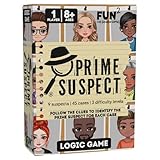
Overview: Prime Suspect is a portable logic puzzle game where players arrange 9 suspect tiles on a 3x3 grid using directional clues from 45 case cards. Solving reveals the center tile as the “Prime Suspect,” supporting solo or cooperative play for ages 8+ with three difficulty tiers.
What Makes It Stand Out: Its dual-mode flexibility (solo or team play) and progressive difficulty levels—from beginner to expert—cater to diverse skill sets. The compact travel design and durable tiles make it uniquely accessible for on-the-go critical thinking without screens.
Value for Money: Exceptional value given the 45 puzzles, durable components, and multi-age appeal. It surpasses comparable puzzle games by growing with players’ skills, eliminating the need for frequent replacements as logic abilities advance.
Strengths and Weaknesses: Strengths include educational depth (logic/reasoning), portability, and scalable challenge. Weaknesses are limited physical interaction compared to group board games and occasional ambiguity in advanced clues requiring adult guidance for younger kids.
Bottom Line: An indispensable, screen-free brain trainer for families and educators; highly recommended for fostering logic skills in a travel-friendly format.
4. Guess Who? Board Game with Classic Characters by Winning Moves Games USA, Classic Children’s Mystery Board Game of Deduction for 2 Players, Ages 6+ (1191)

Overview: This faithful revival of the 1980s classic pits two players in a head-to-head deduction duel, where each must identify their opponent’s hidden character through strategic yes/no questions about facial features, targeting children aged 6+.
What Makes It Stand Out: Nostalgia-driven authenticity is key—the original cast of characters and tactile plastic flip-mechanics preserve the timeless charm. Its simplicity lowers barriers for young children, transforming basic observation into an engaging mystery-solving ritual.
Value for Money: A worthwhile purchase for retro appeal and durability, though limited to two players. It justifies its cost as a perennial kids’ favorite that outlasts trend-driven alternatives, especially for parents introducing deduction concepts.
Strengths and Weaknesses: Strengths are intuitive gameplay, robust physical design, and excellent deduction skill-building. Weaknesses include outdated character diversity, two-player exclusivity, and potential repetitiveness after prolonged use.
Bottom Line: The definitive choice for foundational deduction practice with kids; ideal for nostalgic parents despite minor modern limitations.
5. I know… You Don’t Strategic Card Game for Family Game Night by Taco Cat Goat Cheese Pizza | Easy to Learn | Fast 10 Minute Rounds | Fun for Kids, Teens, and Adults | 3 - 7 Players

Overview: This fast-paced deduction game challenges 3-7 players (ages 10+) to crack a hidden rule governing card plays. Through observation and pattern recognition, players strategize via card plays, multi-card moves, or hand trades to decode the secret system in 10-minute rounds.
What Makes It Stand Out: Its innovative “hidden rule” mechanic—where players collaboratively deduce evolving patterns—creates fresh cognitive challenges every game. Five difficulty levels ensure accessibility for novices while offering depth for seasoned players, all wrapped in rapid, social gameplay.
Value for Money: Excellent for groups, providing immense replayability through adaptable rules and compact portability. It outperforms similar party games by merging strategic depth with brevity, making it a versatile staple for diverse gatherings.
Strengths and Weaknesses: Strengths are lightning-fast setup, scalable complexity, and strong group engagement. Weaknesses include occasional rule ambiguity for beginners and reduced impact with fewer than four players.
Bottom Line: A top-tier, brain-tickling addition to any game library; essential for groups craving quick, intelligent fun that evolves with every round.
6. Secret Hitler

Overview: Secret Hitler is a high-tension social deduction game for 5–10 players where hidden roles drive deception and political maneuvering. Set in pre-WWII Germany, liberals must identify fascist saboteurs while a secret Hitler player works covertly to seize power.
What Makes It Stand Out: The game’s wooden components, foil-inlaid boards, and secret envelopes create immersive physicality rare in party games. Its rapid pace (30 minutes) and emphasis on bluffing, alliances, and dramatic reveals foster intense, memorable interactions.
Value for Money: Priced moderately higher than entry-level deduction games, its premium components and proven replayability justify the cost. It outshines cheaper alternatives by avoiding reliance on apps or complex rules, delivering polished, theater-of-the-mind gameplay.
Strengths and Weaknesses:
Strengths: Exceptional component quality; seamless role integration; scales perfectly for large groups; encourages creative lying and deduction.
Weaknesses: Requires a minimum of 7 players for optimal balance; theme may discomfort some; limited strategic depth beyond social manipulation.
Bottom Line: A must-buy for social gamers seeking theatrical, high-stakes deception. Its premium build and flawless execution make it worth the investment for groups prioritizing immersive party experiences over mechanical complexity.
7. CGE Codenames Board Game (2nd Edition) The Top Secret Word Association Party Game for Friends & Family Game Nights, 4+ Players

Overview: Codenames reimagines word association as a thrilling team-based spy mission. Two groups compete to identify their hidden agents on a 5×5 word grid using only single-word clues from their spymaster, while avoiding the deadly assassin.
What Makes It Stand Out: Its genius lies in spymasters crafting clever, ambiguous clues that link multiple words, sparking collaborative “aha!” moments. The assassin mechanic injects urgency, and the 15-minute runtime ensures snappy, accessible fun for all ages.
Value for Money: An outstanding bargain for its replayability and universal appeal. At this price point, it outperforms niche strategy games by offering near-infinite combinations through its word grid, making it ideal for frequent family or office use.
Strengths and Weaknesses:
Strengths: Effortless rules; fosters creative thinking; scales perfectly for 4–8 players; compact and travel-friendly; zero setup time.
Weaknesses: Word lists can occasionally feel dated; uneven teams may frustrate competitive players; limited strategic depth beyond clue interpretation.
Bottom Line: The definitive party word game. Its blend of simplicity, tension, and replay value makes it indispensable for game nights—especially for groups valuing quick setup and inclusive, brain-teasing fun.
8. Asmodee Love Letter Card Game (2025 Refresh) - Deduction & Player Elimination Strategy Game for Kids & Adults, Ages 10+, 2-6 Players, 20 Minute Playtime

Overview: Love Letter is a minimalist deduction duel where players vie to deliver their affections to a princess through bluffing and calculated risks. With only 16 cards, each round lasts 15 minutes, making it a lightning-fast battle of wits.
What Makes It Stand Out: The 2025 Refresh shines with eco-friendly packaging and tactile acrylic tokens, while retaining its elegant core: hidden roles, player elimination, and high-stakes card play that rewards memory and psychology over luck.
Value for Money: Exceptional for its portability and replayability. At this price, it surpasses bulkier games by delivering countless quick sessions—ideal for travelers or as a gateway game—without compromising on strategic bite.
Strengths and Weaknesses:
Strengths: Ultra-portable; rules learned in 2 minutes; deep deduction in tiny package; eco-conscious redesign; perfect for mixed-age groups.
Weaknesses: Player elimination may frustrate casual players; limited strategy depth for hardcore gamers; card art feels dated despite refresh.
Bottom Line: A timeless, pocket-sized gem. The eco-upgrade cements its status as a must-have for game night newcomers and veterans alike seeking quick, clever clashes without commitment.
9. SAVANA Traitors Aboard - Award Winning Secret Identity Party Game - Fun, Bluffing and Betrayal | Easy to Learn, 15-Minute Round | Popular Games for 3-8 Players - Ages 10+

Overview: Traitors Aboard casts players as pirates racing to fill a treasure chest with gold—while mutineers secretly sabotage the mission. This 20-minute game blends deduction, alliance-building, and betrayal for 3–8 players.
What Makes It Stand Out: Its pirate theme and tangible “gold coin” tokens create playful immersion. Unlike pure deduction games, it emphasizes collaborative strategy with hidden enemies, driving lively debates and last-minute betrayals that spark laughter.
Value for Money: A superb entry-point for secret-identity games. Its low price, travel size, and family-friendly design offer more approachable fun than complex alternatives like Secret Hitler, especially for younger audiences.
Strengths and Weaknesses:
Strengths: Simple rules for all ages; highly portable; strong theme integration; encourages group discussion; minimal downtime.
Weaknesses: Gold tokens feel flimsy; mutineer victory can feel luck-dependent; shorter playtime reduces strategic depth.
Bottom Line: An engaging, accessible gateway to social deduction. Perfect for families or casual groups wanting light betrayal mechanics without heavy rules—just pure, giggly chaos.
10. Big Potato Snakes: A Slippery Social Deduction Game for Families and Adults | Perfect for Game Night

Overview: Snakes pits players against a hidden “Snake” saboteur who manipulates trivia answers, while the Mongoose of Truth piece grants one player unshakeable honesty. This 12+ game thrives on deception, trivia, and group persuasion in 15-minute rounds.
What Makes It Stand Out: The Mongoose mechanic—a player whose statements are always true—adds unique strategic layers absent in similar games. Combined with trivia flexibility (e.g., “your grandma knows Egypt facts”), it fuels hilarious, unpredictable debates.
Value for Money: Priced competitively, it delivers exceptional replay value through endless trivia combinations and the Mongoose’s shifting dynamics. It outshines pricier deduction games by prioritizing accessibility and group laughter over complexity.
Strengths and Weaknesses:
Strengths: Mongoose mechanic innovates deduction genre; trivia-free play option; fast-paced; award-winning designer pedigree; great for mixed groups.
Weaknesses: Trivia reliance may alienate non-enthusiasts; Snake’s power feels overwhelming; limited physical components beyond cards.
Bottom Line: A fresh, laugh-out-loud take on social deduction. Ideal for trivia lovers and families wanting bite-sized, strategic fun—though trivia skeptics might prefer purer deduction experiences.
Understanding Deduction Games: More Than Just Guessing
Deduction games stand apart from pure luck-based or trivia-heavy experiences. At their heart, they challenge players to use logical reasoning to eliminate possibilities and arrive at a single, correct solution based on limited information. It’s a process of structured thinking: observing clues, identifying patterns, testing hypotheses, and revising conclusions as new data emerges. This mirrors real-world investigative and problem-solving processes, making the gameplay intellectually stimulating without feeling like a chore.
The Core Mechanics of Logical Reasoning
The essence lies in information asymmetry and elimination. Players typically start with incomplete knowledge about a hidden setup (like a culprit, a hidden object, or a sequence of events). Through specific game actions – asking targeted questions, examining shared or private clues, making deductions based on others’ actions – they gradually narrow down the possibilities. It’s less about random guessing and more about building a logical framework where incorrect options are systematically ruled out, leaving the truth exposed.
Why Deduction Resonates with Families
For families, this structure is gold. It creates natural opportunities for discussion and collaboration. Older children can model logical steps for younger siblings (“If the candlestick wasn’t in the library, and the professor wasn’t near the conservatory, then…”). Parents can gently guide thinking without giving answers away. The shared goal of solving the mystery fosters teamwork, even in competitive variants, as players often need to interpret the same clues. The satisfaction comes from the process of figuring it out together, not just the final reveal.
Moving Beyond Simple Guesswork
True deduction games avoid solutions based on luck or obscure trivia. The answer should be reachable through the logical application of the information provided by the game mechanics. A well-designed family deduction game ensures that with careful attention and reasoned thought, players of the appropriate age can successfully solve the puzzle. This builds confidence in their analytical abilities and reinforces that persistence and clear thinking yield results.
Key Features to Consider When Choosing Family Deduction Games
Selecting the right deduction game is crucial for ensuring it’s enjoyable, accessible, and enriching for your unique family dynamic. It’s not just about the theme; it’s about matching the game’s structure to your players’ ages, attention spans, and developing cognitive skills. Skipping this step can lead to frustration for younger members or boredom for older, more experienced players.
Age Appropriateness and Cognitive Load
This is paramount. Carefully assess the manufacturer’s age recommendation, but look deeper. Consider the complexity of the logic required: Does it involve simple elimination (e.g., “Is it red or blue?”), multi-step reasoning (“If A is true, then B cannot be, so C must be…”), or tracking several interdependent variables? A game requiring players to hold three distinct categories of information in mind simultaneously might overwhelm a six-year-old but be perfect for a ten-year-old. Choose a game where the challenge stretches skills slightly but doesn’t cause consistent frustration.
Theme and Narrative Appeal
The theme is the hook that draws players in, especially children. Is your family captivated by pirates, space adventures, magical creatures, or cozy neighborhood mysteries? A compelling theme makes the deduction process feel meaningful and immersive. A game about solving a missing cookie mystery in a gingerbread house will resonate far more with young children than one simulating a complex political intrigue, even if the underlying mechanics are similar. Ensure the theme is engaging but not so complex or scary that it distracts from or hinders the deductive process for younger players.
Player Count and Group Dynamics
How many people typically play together? Some deduction games shine with 3-4 players but become unwieldy or slow with 6+. Others are specifically designed for larger family groups. Consider how the game handles player interaction. Does it encourage discussion and shared reasoning (great for teamwork), or is it primarily competitive with players working in isolation (which might leave younger kids feeling sidelined)? Cooperative deduction games, where everyone works against the game itself, are often excellent entry points for families as they minimize direct competition and foster collaboration.
Game Length and Pacing
Family attention spans vary. A deduction game that takes 90 minutes with complex setup might be ideal for dedicated game nights with older kids, but for including younger children or fitting into a busy schedule, shorter playtimes (20-45 minutes) are often better. Look for games with intuitive setup and smooth, engaging turns that maintain momentum. Games that drag during setup or have long periods of downtime between player actions can lose the interest of younger participants. Replayability is also key – games offering variable setups, multiple scenarios, or modular elements ensure the mystery feels fresh over multiple plays.
Building Essential Skills Through Play
The beauty of well-chosen deduction games lies in their ability to develop crucial cognitive and social skills under the guise of pure entertainment. These aren’t just games; they’re stealthy learning tools that engage children (and adults!) in fundamental mental processes vital for academic success and everyday life.
Sharpening Critical Thinking and Problem-Solving
Every deduction game is a series of interconnected problems to solve. Players must learn to break down the overall mystery into smaller, manageable questions. They practice forming hypotheses (“Maybe the culprit took the blue key?”), testing them against available evidence, and revising their thinking when new information contradicts their initial idea. This iterative process mirrors scientific reasoning and is foundational for tackling complex challenges in math, science, and even reading comprehension.
Enhancing Observation and Attention to Detail
Success often hinges on noticing subtle clues that others miss. Players learn to scan game boards, cards, or other players’ actions meticulously. Was that token placed slightly differently? Did another player hesitate before answering a specific question? This heightened observational skill translates directly to improved reading accuracy, better performance in science labs, and increased awareness in daily environments. Games often train players to distinguish between relevant details and deliberate red herrings.
Developing Communication and Reasoning Abilities
Articulating why you believe something is key in deduction. Players practice constructing logical arguments: “I think the artifact is in the cave because the map shows the path was blocked after the storm, and the explorer card says they were near the forest.” They learn to ask precise, targeted questions to gather the most useful information efficiently. This strengthens verbal reasoning, persuasive speaking, and the ability to listen critically to others’ deductions, fostering respectful debate and collaborative thinking.
Fostering Patience and Resilience
Deduction isn’t instantaneous. Players learn the value of waiting for the right moment to act, gathering sufficient evidence before making a bold claim, and accepting that initial hypotheses might be wrong. When a deduction fails, it’s a low-stakes opportunity to analyze why it failed and try a different approach. This builds perseverance, emotional regulation in the face of setbacks, and the understanding that mistakes are part of the learning process – invaluable life skills.
Gameplay Styles and Mechanics to Explore
Deduction games come in diverse formats, each offering a unique flavor of mystery-solving. Understanding these common styles helps you find the perfect fit for your family’s preferences, whether you crave intense competition, collaborative puzzle-solving, or something in between.
Cooperative Deduction: Solving Together
In these games, the entire family bands together against the game system itself. You share all information openly, discuss theories freely, and work as a team to crack the case before a game timer runs out or a catastrophe occurs. This style minimizes intra-family competition, making it ideal for younger children or groups who prefer unified goals. It strongly emphasizes communication, collective reasoning, and leveraging each player’s observations for the common good. The shared victory is immensely satisfying.
Competitive Deduction: The Art of the Bluff
Here, players work individually (or sometimes in teams) to be the first to solve the mystery. While logic is central, these games often introduce elements of deception, hidden information, and strategic questioning designed to mislead opponents. Players must not only deduce the truth but also interpret others’ actions and potentially sow confusion. This style appeals to families who enjoy light strategy and psychological elements, teaching reading social cues and strategic thinking, though it requires a slightly higher level of maturity to handle the competitive bluffing aspect gracefully.
Semi-Cooperative Tension: Ally and Adversary
A fascinating hybrid, semi-cooperative games create dynamic where players might share a common goal (solving the mystery) but have individual secondary objectives or hidden roles that could conflict. One player might secretly be working against the group! This generates incredible narrative tension and forces players to question alliances and motivations. It’s best suited for older children and teens who can handle the complexity of hidden roles and the potential for betrayal, offering deep strategic and social deduction layers.
Asymmetric Roles: Unique Perspectives
In some games, players take on distinct roles with different abilities, information access, or even win conditions. A “detective” might see more clues, while “suspects” might have hidden agendas. This asymmetry creates rich role-playing opportunities and ensures each player has a unique, vital contribution to make. It encourages players to think from different viewpoints and understand how perspective shapes interpretation of evidence, adding significant depth and replayability.
Hidden Movement and Trail Following
A thrilling sub-genre involves one player (or the game system) secretly moving a “culprit” or object around a map, leaving subtle trails or clues. Other players follow these trails, interpreting breadcrumbs like footprints, dropped items, or witness statements to predict the target’s location or next move. This style is highly visual and kinetic, great for kinesthetic learners, and emphasizes spatial reasoning and inference based on sequential evidence.
Ensuring an Enjoyable and Inclusive Experience
The goal is fun and connection for everyone at the table. Thoughtful setup and mindful facilitation can transform a potentially frustrating deduction attempt into a joyful, inclusive family memory. It’s about creating an environment where all players feel capable and valued participants in the mystery-solving process.
Setting the Stage for Success
Before diving in, take a moment to frame the experience positively. Emphasize that the focus is on the process of deduction – the questions asked, the clues noticed, the logical steps taken – not just who shouts the answer first. Establish ground rules: respectful listening, no mocking wrong guesses (“Great try! What made you think that?”), and celebrating “detective moments” where someone spots a crucial detail. This sets a supportive tone where younger or less experienced players feel safe to participate.
Adapting for Mixed Ages and Skill Levels
Don’t hesitate to modify the game slightly for inclusivity. For younger players, an adult or older sibling can be their “deduction partner,” helping them formulate questions or interpret clues without taking over. You might simplify the initial setup by revealing one obvious clue to get them started, or allow them to make “practice accusations” that don’t count towards winning but help them learn the flow. The aim is scaffolding – providing just enough support to let them experience success through their own reasoning.
Facilitating the Deduction Process
An engaged adult (or older teen) often acts as a gentle guide, especially with younger players. Instead of giving answers, ask open-ended questions: “What clues have we seen about the blue room?” or “If the necklace wasn’t taken before lunch, what does that tell us about who had access?” Help players connect disparate clues (“You said the gardener was muddy, and the footprint by the window was muddy too – could those be related?”). This models deductive thinking without doing the work for them.
Managing Frustration and Celebrating Effort
Deduction can be challenging! If a player seems stuck or frustrated, suggest taking a short break or shifting focus to a different aspect of the puzzle. Explicitly praise effort and logical steps, not just correct answers: “I love how carefully you checked all the alibis!” or “That was a really smart question you asked.” Normalize being wrong as part of the process: “Ah, interesting theory! Let’s see what clue might help us test that idea.” Keeping the mood light and encouraging ensures the mystery remains fun, not a source of stress.
Frequently Asked Questions
Frequently Asked Questions
What age is appropriate to start introducing deduction games to children?
Most children begin grasping basic deduction concepts around age 6-7, starting with very simple elimination games (e.g., “Guess Who?” with fewer characters). Look for games explicitly designed for ages 5-6 that use visual clues and minimal text. The key is simplicity – focus on one or two clear categories of information to deduce.
How can I tell if a deduction game is too hard for my child?
Signs include consistent frustration, inability to understand the core question being asked (“Who did it?”), making random guesses with no attempt to use clues, or disengaging completely. If setup or rules explanation takes longer than actual gameplay, it’s likely too complex. Start simpler and build up.
Are cooperative deduction games better for families than competitive ones?
It depends on your family dynamics. Cooperative games eliminate direct competition, making them excellent for younger groups, mixed ages, or families prioritizing teamwork. Competitive games can be great for older kids who enjoy strategy and light rivalry, but require players mature enough to handle bluffing without taking it personally. Many families enjoy both styles.
How long should a family deduction game session last?
Aim for 20-45 minutes for younger children (under 10) or first-time players. Older children and teens can often handle 45-75 minute sessions. Crucially, stop while everyone is still having fun – ending on a high note ensures they’ll want to play again. Shorter, frequent games are more effective than rare, marathon sessions.
My child keeps making random guesses instead of using clues. How can I encourage logical thinking?
Gently redirect: “That’s a possibility! What clue makes you think that?” or “Let’s look back at the notebook – what do we know for sure about the blue room?” Model the process aloud when it’s your turn. Praise specific logical steps: “Great job remembering the butler’s alibi – that really helps rule him out!”
Can deduction games help shy or reluctant participants engage more?
Absolutely. Assign specific, manageable roles: “You’re our clue tracker – can you watch for all the red cards?” or “You’re the question master – what’s one thing we should ask the witness?” Cooperative games are particularly good, as they reduce pressure on any single player. Start with games where players contribute privately (e.g., writing down suspicions) before sharing.
What’s the biggest mistake families make when playing deduction games?
Rushing the deduction process or focusing solely on the winner. The real value is in the discussion, the shared reasoning, and the “aha” moments. Forcing the pace or letting one dominant player take over stifles the learning and enjoyment for others. Prioritize the collaborative thinking journey over the destination.
How do I handle it when a younger child accidentally reveals a critical clue or solution?
Stay calm and positive! “Oops, good catch noticing that! Since we know it now, how does that change what we think happened?” Treat it as new information for everyone to process, not a mistake. For future games, gently remind players to keep their private clues private before starting. Avoid shaming.
Do these games require strong reading skills?
Not necessarily. Many modern deduction games use highly visual components – symbols, colors, icons, and simple illustrations – minimizing text reliance. Look for games labeled “language-independent” or with picture-based clues. For text-heavy games, an adult can read clues aloud, turning it into a shared listening and comprehension activity.
How often should we play deduction games to see skill development?
Consistency matters more than frequency. Even playing one short deduction game weekly provides valuable mental exercise. The key is active engagement during play – discussing clues, explaining reasoning, and reflecting on the process. Quality of interaction trumps quantity of games played.
See Also
- 10 Expert-Recommended Deduction Board Games for Mystery Lovers in 2026
- 10 Essential Deduction Board Games Every Mystery Fan Needs in 2026
- 10 Top-Rated Deduction Games for Families According to Experts in 2026
- The 10 Most Revolutionary Deduction Board Games of 2026
- How to Choose the 10 Best Deduction Strategy Games for Game Night in 2026