Table of Contents
Ever feel like your vocabulary is stuck on autopilot? Like you’re scrolling through the same mental dictionary entries day after day, craving that spark of linguistic discovery? For language enthusiasts, the thrill isn’t just in using words, but in playing with them – twisting meanings, uncovering hidden connections, and feeling that satisfying click when the perfect term lands. Word-based board games offer a uniquely immersive playground for this passion, transforming abstract language skills into tangible, social, and deeply engaging experiences. Forget rote memorization; these games make expanding your lexicon feel less like homework and more like an exhilarating treasure hunt where every session unlocks new cognitive pathways.
As we move further into the 2020s, the landscape for word games is evolving rapidly. Players now seek more than just simple anagram challenges; they crave depth, strategic nuance, and experiences that genuinely nourish their love for language in meaningful ways. The best modern word games aren’t just about winning points – they’re about fostering connections, building confidence in expression, and providing a dynamic space where language learning happens organically through laughter, competition, and shared creativity. Whether you’re a seasoned polyglot or simply someone who delights in the power of a well-chosen phrase, understanding what makes these games truly transformative is key to finding your next favorite pastime.
Top 10 Word Board Games
Detailed Product Reviews
1. USAOPOLY The Original TAPPLE, The Fast-Paced Family Board Game,Choose a Category & Race Against The Timer to be The Last Player,Learning Word Game for Ages 8 & Up, 2-8 Players, 15-20 Minute Play Time

Overview: TAPPLE is a high-energy, category-based word game designed to inject excitement into family game nights. Players race against a built-in timer, shouting out words starting with a specific letter within a chosen category, pressing the corresponding tab to lock in their answer before time runs out. Its compact wheel design houses all components for easy portability. What Makes It Stand Out: The integrated timer and physical “tapping” mechanism create immediate, palpable tension unmatched by turn-based word games. Its speed (15-20 minute playtime) and capacity for 2-8 players make it ideal for large groups or parties, while the 144 diverse categories ensure significant replayability without requiring deep vocabulary. Value for Money: Priced competitively for a specialty word game, TAPPLE delivers exceptional value through its unique timer-driven gameplay and durable construction. It outshines cheaper alternatives by offering a genuinely different, adrenaline-fueled experience focused on quick thinking rather than extensive vocabulary, justifying its cost for families seeking dynamic entertainment. Strengths and Weaknesses: Strengths include rapid setup, inclusive play for varied ages/skill levels, strong portability, and high replay value. Weaknesses involve potential stress for younger players under time pressure, limited strategic depth compared to Scrabble, and the timer mechanism occasionally malfunctioning with vigorous play. Bottom Line: TAPPLE is a standout party game that transforms word play into a thrilling race. Highly recommended for families and groups wanting fast-paced, accessible fun that accommodates many players without lengthy sessions.
2. Hasbro Gaming Scrabble Board Game, Classic Word Games for Kids Ages 8 and Up, Fun Family Game for 2-4 Players, The Classic Crossword Game
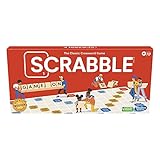
Overview: Scrabble remains the quintessential crossword board game, challenging players to build high-scoring words using letter tiles on a premium-squared grid. This classic edition features wooden tiles and racks, offering a tactile, traditional experience focused on vocabulary, strategy, and spatial reasoning for 2-4 players. What Makes It Stand Out: The enduring appeal lies in its perfect blend of linguistic skill and strategic depth. Premium wooden components enhance durability and feel, while the textured board prevents tile slippage. The scoring system, incorporating letter values and bonus squares, creates endless opportunities for clever plays and comebacks, cementing its status as the word game benchmark. Value for Money: While slightly pricier than basic editions, the quality wooden components significantly enhance longevity and play experience, making it a worthwhile investment. It offers immense replayability and educational value, justifying its cost as a timeless family heirloom compared to fleeting digital alternatives. Strengths and Weaknesses: Strengths are its unmatched strategic depth, educational benefits, high-quality materials, and broad generational appeal. Weaknesses include potentially slow pace for young children, scoring complexity for beginners, and limited player count (max 4). Bottom Line: This classic Scrabble edition is an essential purchase for any family game shelf. Its enduring challenge, quality build, and ability to foster language skills make it a perennial favorite and a highly recommended core word game.
3. Winning Moves Yahtzee Words Games USA, Family Word Game Version for 2 or More Players, Ages 8+

Overview: Yahtzee Words revitalizes the classic dice game by replacing numbers with letters, challenging players to form words from seven letter dice. Using a familiar Yahtzee scoresheet structure, it tasks players with achieving specific word combinations like “All Vowels” or the elusive seven-letter “Yahtzee” over thirteen rounds. What Makes It Stand Out: The ingenious fusion of Yahtzee’s probability-driven dice rolling with word formation creates a uniquely accessible hybrid. Its split scoresheet (Upper/Lower sections) provides clear goals, while targeting specific word types (2-6 letters, consonant/vowel sets) broadens appeal beyond pure vocabulary strength, making it less intimidating than Scrabble. Value for Money: Offering a fresh twist on two classics at a modest price point, Yahtzee Words delivers excellent value. It leverages the widespread familiarity of Yahtzee rules, reducing the learning curve significantly compared to other word games, making it a smart buy for families wanting novelty without complexity. Strengths and Weaknesses: Strengths include quick learning, fast gameplay, broad accessibility for varying word skills, and strong replayability through dice randomness. Weaknesses involve occasional frustration from poor letter rolls limiting word options and less strategic depth than pure word-building games. Bottom Line: Yahtzee Words is a highly engaging and accessible gem, perfect for families seeking a fun, less vocabulary-dependent word game. Its clever mechanics and familiar framework earn a strong recommendation for casual and mixed-skill groups.
4. Spin Master Games, Upwords, Classic Word Game with Stackable Letter Tiles, Family Board Game, Crossword Activity, 1-4 Players, for Ages 8 & Up
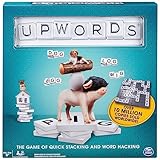
Overview: Upwords reinvents crossword gameplay by allowing players to stack letter tiles vertically on the board to form new words, dramatically altering scoring and strategy. Starting with seven tiles each, players build or modify words across a rotating lazy susan board, aiming to maximize points through strategic stacking and tile placement. What Makes It Stand Out: The revolutionary stacking mechanic is the core innovation, enabling players to creatively transform existing words and score points on every level. The rotating board ensures smooth turns, while the requirement to use all seven tiles for a bonus adds significant strategic depth and potential for high-scoring comebacks absent in traditional crossword games. Value for Money: Priced fairly for its unique mechanics and durable components (board, tiles, racks), Upwords offers distinct value by providing a fundamentally different, more dynamic word game experience. It justifies its cost through high replayability and the ability to engage players who find Scrabble too rigid. Strengths and Weaknesses: Strengths are the innovative stacking gameplay, inclusive design for varying skill levels, rotating board convenience, and exciting potential for big plays. Weaknesses include tiles potentially becoming unstable when stacked high and a slightly steeper initial learning curve than simpler word games. Bottom Line: Upwords is a brilliant evolution of the word game genre, fostering creativity and strategic thinking. Highly recommended for families and word game enthusiasts seeking a fresh, interactive, and visually engaging alternative to Scrabble.
5. USAOPOLY BLANK SLATE, Where Great Minds Think Alike, Fun Family-Friendly Board Game, Word Association Party Game, Easy to Learn, Fun to Play Family Game Night, 3-8 Players, Ages 8+
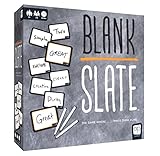
Overview: Blank Slate is a hilarious party game of word association and prediction where players write down what they think others will guess for incomplete phrases (e.g., “_______ minds think alike”). The goal is to match another player’s secret word without communicating, scoring points when unique matches occur. What Makes It Stand Out: Its brilliance lies in the simple, social deduction twist on word association. The dry-erase slates enable quick, private responses, and the core mechanic of predicting the group’s most common answer creates constant laughter and surprising insights into groupthink, making it exceptionally engaging for larger groups (3-8 players). Value for Money: Offering robust party game mechanics with high-quality slates and numerous cue cards at a standard price point, Blank Slate provides outstanding value for group gatherings. It outperforms many party games by requiring zero setup time and delivering consistent, inclusive fun without complex rules, maximizing entertainment per dollar. Strengths and Weaknesses: Strengths include effortless setup/learning, hilarious group dynamics, perfect scalability for parties, and strong replayability. Weaknesses involve limited strategic depth (pure social fun) and potentially repetitive gameplay over very long sessions for some players. Bottom Line: Blank Slate is a must-have for lively game nights, excelling as an icebreaker and laugh generator. Its ease of play and unique social prediction mechanic make it a top recommendation for anyone hosting groups seeking guaranteed fun.
6. CGE Codenames Board Game (2nd Edition) The Top Secret Word Association Party Game for Friends & Family Game Nights, 4+ Players

Overview:
CGE Codenames is a thrilling word-association party game where two teams compete to identify their hidden agents on a 5×5 grid. Guided by spymasters who give single-word clues linked to multiple cards, players must deduce correct words while avoiding the opposing team’s agents, bystanders, or the deadly assassin.
What Makes It Stand Out:
The assassin mechanic creates intense, high-stakes moments—revealing it ends the game instantly. Spymasters must craft clever, one-word clues that connect multiple agents without ambiguity, fostering creative thinking and teamwork. The flexible guessing rule (allowing one extra guess beyond the clue number) adds strategic depth and risk-taking opportunities.
Value for Money:
Priced competitively for a premium party game, its near-infinite replayability (thanks to modular grids and varied clue strategies) outshines cheaper alternatives. While simpler word games exist, Codenames’ unique blend of deduction, tension, and accessibility justifies its cost for regular game nights.
Strengths and Weaknesses:
Strengths: Exceptional replay value; easy to learn but challenging to master; scales perfectly for 4+ players; fosters communication and critical thinking.
Weaknesses: Can frustrate overly analytical players; spymaster role imbalance if one team dominates clue-giving; limited solo play options.
Bottom Line:
An essential, brilliantly designed party game that delivers consistent, engaging fun. Its strategic depth and nail-biting tension make it a standout choice for groups seeking a fresh, high-quality word game experience. Highly recommended.
7. Ransom Notes - The Ridiculous Word Magnet Party Game, 3+ Players

Overview:
Ransom Notes is a laugh-out-loud party game where players use magnetic word tiles to craft absurd responses to outrageous prompts, like “Tell someone you’ve clogged their toilet at a party.” With 840 magnets and 250 prompt cards, it thrives on improvisation and comedic creativity.
What Makes It Stand Out:
The physical word magnets enable tactile, chaotic fun—players scramble to form the funniest or most nonsensical sentences from a shared pool. The game’s genius lies in its simplicity: prompts are outrageously specific, and the limited word selection forces hilarious compromises. Its “instant play” design (learn in under a minute) breaks the ice effortlessly.
Value for Money:
The high magnet count and prompt variety offer exceptional replayability, justifying the price. While some prompts require filtering for family play (removing 15–30% for PG settings), the sheer volume ensures longevity. Cheaper alternatives lack its physical charm and consistent humor.
Strengths and Weaknesses:
Strengths: Effortlessly inclusive for shy players; magnets encourage tactile engagement; nearly endless combinations; perfect for quick, laughter-filled rounds.
Weaknesses: Mature prompts may require pre-screening; magnets can scatter during play; less strategic depth for competitive gamers.
Bottom Line:
A hilarious, accessible party staple that guarantees giggles. Its simplicity and re-playability make it ideal for casual gatherings, though families should curate prompts. An excellent gift for creative or humor-loving groups.
8. Shenanigrams! – The Mega-Mischievous Word Game! A Super Fun & Fast Family Party Game for Kids, Teens & Adults - Great for Travel, Couples & Family Board Games Night

Overview:
Shenanigrams! is a fast-paced word game where players build and steal words using letter tiles on a shared grid. Designed for 2–6 players (ages 8+), it combines spelling challenges with mischievous strategy as competitors tag words and steal them by altering letters.
What Makes It Stand Out:
The “stealing” mechanic—allowing players to hijack opponents’ words by adding, inserting, or replacing letters—creates dynamic, interactive gameplay. Its compact travel size and educational value (boosting spelling/vocabulary) are enhanced by multiple 2024 awards, including “Game of the Year” from Creative Child Magazine.
Value for Money:
Priced accessibly for its award-winning design and portability, it outperforms bulkier word games. The dual focus on education and entertainment offers strong value for families, though solo play isn’t supported. Cheaper travel games often lack its strategic depth.
Strengths and Weaknesses:
Strengths: Award-winning educational fun; highly portable; fast setup and play (20–30 mins); engaging for mixed-age groups; stealing mechanic adds excitement.
Weaknesses: Limited replayability after mastering core strategy; tile quality may feel lightweight; not ideal for hardcore word gamers seeking complexity.
Bottom Line:
A delightful, award-winning choice for families and travelers seeking quick, educational fun. Its playful stealing mechanic and portability make it a top pick for game nights—just prioritize it for casual rather than competitive play.
9. Winning Moves Big Boggle with 5x5 Grid and 25 Letter Cubes Games USA, Thought Provoking Word Game Bigger Than The Original, for 2 or More Players, Ages 8+ (1147)

Overview:
Big Boggle reinvents the classic word-search game with a larger 5×5 grid and 25 letter cubes, giving players three minutes to find as many four+ letter words as possible. Its expanded grid encourages longer, more complex words compared to the original 4×4 version.
What Makes It Stand Out:
The unique scoring system—where duplicate words earn zero points—drives players to hunt for obscure terms, adding intense strategy. The bigger grid significantly increases word possibilities, while the tense 3-minute timer creates frantic, engaging rounds ideal for competitive groups.
Value for Money:
As a durable, standalone physical game, it offers excellent replayability at a modest price. While digital alternatives exist, Big Boggle’s tangible cubes and timer provide a superior social experience. It’s a worthwhile upgrade from the smaller version for dedicated word-game fans.
Strengths and Weaknesses:
Strengths: High replayability; encourages vocabulary growth; simple rules; competitive scoring creates excitement; sturdy components.
Weaknesses: Timer pressure may frustrate casual players; limited solo appeal; duplicate-word penalty can feel punishing.
Bottom Line:
A must-have for word-game enthusiasts seeking fast-paced, competitive fun. The expanded grid and unique scoring revitalize the classic formula, making it a smarter investment than the original for group play. Highly recommended.
10. Monopoly Scrabble Game, Play in Under ONE Hour, Score Your Scrabble Word - Move Your Token, by Winning Moves Games USA, Mash-Up of 2 of The World’s Greatest Games, 2 to 4 Players Ages 8+ (1250)

Overview:
This innovative hybrid merges Monopoly’s property-collecting with Scrabble’s word-building. Players create words on a central board using letter tiles; scoring a word moves their token along Monopoly’s outer track, while covering premium squares claims color-group properties.
What Makes It Stand Out:
Replacing dice rolls with Scrabble scores is genius—it accelerates gameplay dramatically (under one hour) while integrating both classics seamlessly. The “Premium square” mechanic ties word placement to property acquisition, creating clever strategic layers absent in either standalone game.
Value for Money:
Priced fairly for a fresh take on two iconic games, it eliminates Monopoly’s notorious length without sacrificing strategy. Budget alternatives exist, but none offer this level of cohesive innovation. The streamlined experience justifies the cost for fans of either franchise.
Strengths and Weaknesses:
Strengths: Dramatically shorter playtime; brilliant integration of both games’ mechanics; maintains strategic depth; ideal for mixed-skill groups.
Weaknesses: Scrabble purists may miss crossword challenges; Monopoly lovers could miss dice randomness; limited tile pool restricts word options.
Bottom Line:
A triumph of game design that fixes Monopoly’s pacing while honoring Scrabble’s spirit. Perfect for families wanting strategic, time-efficient fun—highly recommended for fans of either classic seeking a revitalized experience.
Why Word Games Remain Essential for Language Development
The enduring appeal of word-centric board games lies in their unique ability to bridge fun and fundamental cognitive growth. Engaging with language in a playful, low-pressure environment significantly lowers the anxiety often associated with formal learning, allowing players to experiment and take risks with vocabulary and structure they might otherwise avoid. This safe space for trial and error is crucial for developing fluency and confidence. Furthermore, the social dynamics inherent in these games – negotiating meanings, debating word validity, or crafting persuasive arguments within the game’s context – directly translate to improved real-world communication skills, active listening, and the ability to articulate thoughts clearly under (friendly) pressure.
Beyond immediate vocabulary expansion, these games subtly train critical thinking and pattern recognition. Deciphering clues, identifying linguistic structures, or strategizing word placements based on scoring mechanics requires players to analyze language at multiple levels simultaneously. This multi-faceted cognitive workout strengthens neural pathways associated with memory, problem-solving, and even creative writing. The repetitive yet varied exposure to language patterns within engaging gameplay contexts cements understanding far more effectively than isolated study, making the learning process both stickier and infinitely more enjoyable.
The Cognitive Workout Hidden in Every Turn
Each move in a sophisticated word game presents a mini cognitive challenge. Players constantly engage executive functions: planning ahead (what tiles to keep, potential high-scoring spots), working memory (holding letter combinations in mind while scanning the board), and cognitive flexibility (adapting strategy when the board state changes unexpectedly). This constant mental juggling isn’t just about finding words; it’s about training the brain to process information efficiently, switch between tasks, and make strategic decisions under constraints – skills that benefit far beyond the game table, enhancing overall mental agility and focus in daily life.
Building Communication Confidence Through Play
The social interaction inherent in multiplayer word games provides a powerful incubator for communication confidence. Explaining your word choice, defending a play against challenge, or even gracefully accepting a disputed word fosters skills in clear articulation, persuasive reasoning, and respectful debate. For learners, this low-stakes social negotiation is invaluable practice for real-world conversations where nuance and confidence matter. The shared laughter and camaraderie that often accompany these games further reduce the fear of making mistakes, creating an environment where language exploration feels safe and rewarding, ultimately translating to greater willingness to engage verbally in other settings.
Key Features to Evaluate When Choosing Your Next Word Game
Selecting the right word game goes far beyond just “fun.” It requires considering how well the mechanics align with your specific linguistic goals and social context. Is the primary aim pure vocabulary expansion, strategic depth, collaborative storytelling, or perhaps reinforcing grammatical structures? Different games prioritize different aspects of language. Equally important is assessing the game’s complexity curve – does it offer enough strategic depth to remain engaging over multiple plays, or does it risk becoming repetitive? The ideal game should provide a satisfying challenge that grows with the player’s skill, ensuring long-term replayability and continued learning.
Another crucial factor is the game’s adaptability to your group dynamics. Consider the typical number of players, their language proficiency levels, and preferred play styles (competitive vs. cooperative). Some games shine with two intense competitors, while others truly come alive with larger, more boisterous groups. Pay close attention to the game’s pacing and downtime between turns; lengthy pauses can frustrate players seeking a fast-paced experience. The physical components also matter – durable tiles, a clear board layout, and readable text contribute significantly to the overall enjoyment and reduce friction during play, especially for groups with varied visual acuity or dexterity.
Vocabulary Depth and Range
Examine how the game sources its vocabulary. Does it draw from a broad dictionary, encouraging exploration of obscure or advanced terms, or does it focus on more common, practical language? Consider if the game incorporates thematic word sets (e.g., scientific terms, historical vocabulary, specific dialects) that might align with your interests. Crucially, evaluate how the game handles word validity – is there a clear, accessible reference, or does it rely on group consensus, which can lead to disputes? A game that pushes players slightly beyond their comfort zone, introducing just manageable challenges, is often the most effective for growth without causing frustration.
Strategic Mechanics Beyond Simple Word Formation
Look beyond the basic “make a word” mechanic. Does the game incorporate spatial reasoning (placing tiles to maximize scoring intersections), resource management (limited letter draws, special action tiles), set collection, or area control? Games with layered strategic elements keep experienced players engaged long after mastering basic word-finding. Consider how player interaction is facilitated – are there direct challenges, cooperative elements, or indirect competition through board control? Mechanics that require anticipating opponents’ moves or adapting strategy dynamically add significant depth and replay value, transforming the game from a vocabulary test into a rich strategic experience.
Replayability and Evolving Challenge
A hallmark of a truly great word game is its ability to feel fresh session after session. Assess the randomness factors (like tile draws) and how they interact with player skill – too much luck can overshadow strategy, while too little randomness can make outcomes predictable. Does the game offer variable setups, different objectives per session, or modular components that alter the playing field? Look for games with a clear “skill ceiling” that players can work towards, perhaps through mastering advanced tactics or understanding nuanced scoring combinations. Games that incorporate narrative elements or evolving scenarios can also significantly boost long-term engagement and replayability.
Understanding Different Gameplay Styles and Mechanics
Word board games utilize a diverse array of mechanics to engage players with language, each offering a distinct experience. Tile-drafting and placement games, where players draw letter tiles and strategically position them on a shared or personal board to form words and score points, remain incredibly popular for their tactile satisfaction and spatial puzzle elements. Narrative-driven word games, however, take a different approach, using language prompts, story cards, or collaborative sentence-building to spark creativity and focus on the expressive, contextual power of words rather than pure lexical knowledge. Recognizing these core styles helps pinpoint which type of linguistic engagement will resonate most with your preferences.
Other mechanics include deduction-based word games where players give clues to guess specific terms, often emphasizing precision of language and understanding semantic fields. Pattern recognition games challenge players to identify linguistic structures, prefixes, suffixes, or word families quickly. Cooperative word games foster teamwork as players combine their linguistic skills to solve shared challenges against the game itself, reducing competitive pressure and emphasizing collective problem-solving. Understanding these fundamental mechanical approaches allows you to seek out experiences that align with whether you crave intense competition, collaborative creation, or cerebral deduction.
Tile-Based Builders: The Classics Reimagined
These games form the backbone of the modern word game renaissance. Players manipulate physical letter tiles, arranging them on a board to create interconnected words. Modern iterations often innovate by introducing unique board layouts (hexagonal grids, 3D structures), special tiles with bonus effects (wildcards, multipliers, action triggers), or dynamic board elements that change as the game progresses. The tactile nature of handling tiles and the spatial puzzle of maximizing connections provide a deeply satisfying, almost meditative, core experience that continues to captivate players, proving that the fundamental joy of building words from scratch remains timeless.
Narrative and Creative Expression Engines
Moving beyond point-scoring, these games prioritize storytelling and linguistic creativity. Players might use word prompts to build collaborative narratives, craft persuasive arguments within a themed scenario, or construct sentences that fulfill specific emotional or descriptive criteria. Mechanics often involve voting on the best contribution, weaving individual phrases into a larger story, or using language to achieve character goals within a fictional setting. These games excel at developing expressive writing skills, understanding connotation and nuance, and fostering the ability to use language persuasively and imaginatively, making them ideal for writers, educators, and those who love the artistry of language.
Deduction and Clue-Giving Challenges
Games in this category test players’ ability to understand and manipulate semantic relationships. One player (or team) might provide limited clues for others to deduce a specific word or phrase, requiring precision in language choice and deep understanding of how words connect conceptually. Variations include identifying a secret word through yes/no questions, narrowing down possibilities based on category clues, or interpreting abstract hints. These mechanics sharpen critical thinking, vocabulary depth (knowing precise definitions and associations), and the ability to communicate complex ideas concisely – skills directly applicable to effective communication and comprehension in any language-rich environment.
The Social and Educational Powerhouse of Group Play
The true magic of word games often unfolds in the space between players. The shared table becomes a dynamic classroom where language is negotiated, debated, and celebrated in real-time. Explaining why “quixotic” perfectly describes a character’s action, or passionately defending the use of an archaic term within a specific context, fosters a deeper understanding than any solitary study session. This collaborative dissection of language builds not only vocabulary but also critical reasoning and the ability to articulate nuanced arguments – essential skills for academic and professional success. The laughter that erupts over a brilliantly obscure play or a hilarious misinterpretation creates positive emotional associations with language exploration, reinforcing the desire to keep learning.
Furthermore, group play inherently teaches vital social-emotional skills. Players learn patience during others’ turns, sportsmanship in victory and defeat, and the art of constructive disagreement – all while immersed in linguistic engagement. For younger players or language learners, observing more experienced players’ strategies and vocabulary provides invaluable implicit learning. The diverse perspectives around the table expose everyone to different ways of thinking about and using language, broadening cultural and linguistic awareness. This social dimension transforms word games from mere cognitive exercises into powerful tools for building empathy, communication bridges, and a genuine communal appreciation for the richness of language.
Fostering Inclusive Language Communities
Well-designed word games can be remarkably inclusive, accommodating players with varying language proficiencies and learning styles. Cooperative mechanics ensure everyone contributes meaningfully, regardless of vocabulary size. Games with adjustable difficulty levels or rule variants allow mixed-skill groups to play together harmoniously. The shared focus on the game itself reduces performance anxiety for learners, as the goal becomes collaborative success or strategic play rather than individual linguistic perfection. This creates a supportive environment where asking “What does that word mean?” is encouraged, fostering a culture of curiosity and mutual aid that strengthens both language skills and social bonds within the group.
Beyond the Game: Transferring Skills to Real Life
The skills honed around the word game table don’t stay confined to the board. The strategic thinking required for optimal tile placement translates to better planning and decision-making. The quick thinking needed during clue-giving or rapid word formation sharpens mental agility for everyday conversations. The expanded vocabulary and deeper understanding of word roots, prefixes, and suffixes directly enhance reading comprehension and writing clarity. Perhaps most significantly, the confidence gained from successfully navigating complex linguistic challenges in a playful setting empowers players to communicate more effectively and take more risks in real-world academic, professional, and social interactions, proving that the benefits of these games extend far beyond the final score.
Looking Ahead: The Future of Word Games in 2026 and Beyond
The trajectory for word games points towards increasingly sophisticated integration of linguistic depth and innovative mechanics. We’re seeing a move beyond simple dictionary reliance towards games that explore etymology, semantic networks, and even generative language elements. Expect more titles that subtly teach linguistic concepts like morphology or syntax through engaging gameplay, making the learning process almost invisible. Sustainability is also becoming a major factor, with designers prioritizing eco-friendly materials for components and minimalist, durable packaging, reflecting players’ growing environmental consciousness without compromising the tactile joy of physical games.
Digital augmentation, used thoughtfully, presents exciting possibilities. Imagine companion apps that provide subtle hints for obscure words without breaking immersion, offer historical context for terms used, or dynamically adjust difficulty based on player skill – all while preserving the core social, face-to-face experience of the physical board. However, the heart of the best word games will remain firmly in the physical realm: the shared space, the tangible manipulation of components, and the unmediated social interaction that fosters genuine connection and linguistic play. The future belongs to games that leverage technology to enhance, not replace, these irreplaceable human elements.
Embracing Linguistic Diversity and Inclusion
The next wave of word games is actively broadening its scope. Designers are increasingly mindful of creating experiences that resonate across different language backgrounds and dialects, moving beyond a single standardized lexicon. Games exploring code-switching, regional variations, or even bilingual mechanics are emerging, celebrating the richness of global language expression. There’s also a stronger focus on accessibility – ensuring rules are clear for neurodiverse players, components are easy to handle, and gameplay accommodates various cognitive styles. This push towards inclusivity ensures that the joy and cognitive benefits of word games become accessible to a much wider audience, enriching the community and the games themselves.
The Enduring Appeal of Tactile, Social Connection
Despite technological advancements, the fundamental appeal of physically handling letter tiles, leaning over a shared board, and reading the reactions on fellow players’ faces remains unmatched. In an increasingly digital world, the demand for authentic, screen-free social interaction is driving a resurgence in the value placed on these tangible experiences. The future of word games lies in doubling down on this strength – designing elegant physical components, fostering meaningful face-to-face engagement, and creating mechanics that thrive on the unpredictable energy of human interaction. This commitment to real-world connection ensures that word games will continue to be a vital, vibrant part of language lovers’ lives for years to come.
Frequently Asked Questions
What’s the best word game for absolute beginners with limited vocabulary?
Focus on games with simple core mechanics, clear visual aids, adjustable difficulty (like shorter word minimums), and cooperative elements that reduce pressure. Look for titles emphasizing common words and providing immediate, positive reinforcement for participation, even with short words.
Can word games genuinely help with learning a new language?
Yes, particularly for reinforcing vocabulary, understanding word structure (prefixes/suffixes), and improving spelling. Games focusing on thematic vocabulary or simple sentence construction are most effective for beginners, while more advanced players benefit from games emphasizing nuance and context. Consistency and engagement are key.
Are there good word games designed specifically for solo play?
Absolutely. Many modern word games include robust solo modes, often involving puzzle-like challenges against a timer or a simulated opponent system. These modes are excellent for focused vocabulary building, practicing speed, or working on specific linguistic weaknesses without social pressure.
How do I choose between competitive and cooperative word games?
Consider your group’s dynamic and goals. Competitive games often drive strategic depth and intense engagement but can frustrate less experienced players. Cooperative games foster teamwork, reduce anxiety for learners, and emphasize collective problem-solving. Many groups enjoy having both types in their collection for different moods.
What features make a word game suitable for family play with mixed ages?
Look for games with scalable rules (simpler versions for kids), minimal reading requirements for younger players, short playtimes to maintain attention spans, and mechanics that allow players of different skill levels to contribute meaningfully (e.g., cooperative elements or team play). Visual components can also aid younger participants.
Do complex word games require constant dictionary use, slowing down play?
Well-designed complex games minimize this. They often use clear, integrated validity rules (e.g., specific word lists, category restrictions) or incorporate challenge mechanics that become part of the strategic fun. Games relying solely on a standard dictionary can slow down; seek those with defined linguistic boundaries within the game system itself.
How important is component quality in a word game?
Very important for longevity and enjoyment. Durable, thick tiles with clear, readable lettering and a stable board prevent frustration. Cheap, flimsy components can warp, become hard to read, or feel unpleasant to handle, significantly detracting from the experience, especially during repeated plays.
Can word games help with professional writing or communication skills?
Definitely. They enhance vocabulary precision, understanding of connotation, sentence structure awareness (in narrative-focused games), and the ability to think quickly and articulate ideas clearly under constraints – all directly transferable to professional writing, presentations, and negotiations.
Are there word games that focus on specific aspects like grammar or spelling?
Yes, though they are less common than vocabulary-focused games. Some target spelling patterns through phonics-based mechanics, while others incorporate grammatical elements like verb conjugation, part-of-speech identification, or sentence diagramming within their core gameplay loop, often in educational contexts.
How can I tell if a word game has enough depth for regular players?
Look beyond the basic rules. Does it offer layered strategies? Are there meaningful decisions on nearly every turn? Does mastery reveal advanced tactics? Check reviews for mentions of “replayability,” “strategic depth,” and whether experienced players continue to find it challenging after multiple sessions. Games with variable setups often fare better here.
See Also
- The 10 Ultimate Best Word Board Games for Language Lovers in 2026
- 10 Expert-Recommended Word Trivia Games for Language Lovers in 2026
- 10 Must-Have Word Building Games for Language Lovers in 2026
- The 10 Ultimate Best Word Board Games for Language Nerds in 2026
- 10 Best Word Trivia Games for Language Lovers That Don’t Sacrifice Quality in 2026