Table of Contents
Homeschooling math doesn’t have to mean tears at the kitchen table or battles over worksheets. In fact, the most powerful learning often happens when kids are laughing, strategizing, and rolling dice with anticipation. As we move through 2026, homeschooling parents are discovering what classroom teachers have known for decades: dice games transform abstract mathematical concepts into hands-on, memorable experiences that stick with children long after the game ends.
The beauty of math dice games lies in their deceptive simplicity. A handful of dice can generate thousands of practice problems without a single worksheet, adapt instantly to different skill levels, and turn repetitive drills into engaging family time. Whether you’re teaching a kindergartner to count or helping a middle schooler master probability, the right dice games can become the cornerstone of your math curriculum. This guide explores everything you need to know about selecting, implementing, and maximizing these powerful learning tools in your homeschool environment.
Top 10 Math Dice Games
Detailed Product Reviews
1. ThinkFun Math Dice Junior Game - Engaging Math Skills Builder | Perfect for Kids Aged 6+ | Aids in Mental Agility | Toy of The Year Nominee

Overview: ThinkFun Math Dice Junior Game transforms mundane arithmetic practice into an engaging, fast-paced challenge for children ages six and up. This compact learning tool uses two twelve-sided target dice and three six-sided scoring dice to generate equations, helping kids practice addition and subtraction through playful competition. As a Toy of the Year nominee from a brand trusted by over 50 million customers, it delivers educational value in a deceptively simple package that fits in a backpack.
What Makes It Stand Out: The game’s brilliance lies in its “stealth learning” approach—children sharpen mental math agility without feeling like they’re doing homework. The clear instruction manual ensures immediate playability, while the portable design makes it ideal for travel, classrooms, or family game nights. Unlike digital apps, this tangible game builds focus and reduces screen time while delivering comparable skill development.
Value for Money: Priced around $8-10, this represents exceptional value compared to math workbooks or tutoring sessions. The durable dice withstand years of use, offering infinite problem combinations that grow with your child’s abilities. It’s a one-time investment that replaces disposable worksheets with reusable, interactive learning.
Strengths and Weaknesses: Strengths include quick setup, scalable difficulty, teacher endorsement, and genuine fun factor that keeps kids engaged. The compact Game-Go bag prevents component loss. Weaknesses are minor: advanced mathematicians may outgrow it quickly, and the small dice pose a choking hazard for younger siblings. Some children might find the competitive pressure frustrating initially.
Bottom Line: A must-have educational tool that successfully balances learning with entertainment. Perfect for parents and teachers seeking to build foundational math confidence through low-stakes, high-engagement gameplay.
2. ThinkFun Math Dice

Overview: ThinkFun Math Dice is the original mental math game that sharpens numerical fluency through rapid-fire equation building. Players roll two twelve-sided target dice to establish a goal number, then use three six-sided scoring dice to create equations using addition, subtraction, multiplication, or division. Designed for ages 8 to adult, this minimalist game delivers maximum cognitive challenge in a pocket-sized format that encourages quick thinking.
What Makes It Stand Out: The game’s open-ended structure allows endless difficulty scaling—from simple addition for younger players to complex multi-step equations for math enthusiasts. The included Game-Go Bag makes it exceptionally portable for restaurants, road trips, or classroom centers. ThinkFun’s reputation for brain-building puzzles ensures the gameplay remains fresh and engaging through years of use without batteries or screens.
Value for Money: At approximately $7-9, it’s one of the most cost-effective educational tools available. The unlimited replay potential and ability to accommodate multiple skill levels simultaneously make it superior to single-use workbooks. One set serves an entire family or classroom for years, adapting as skills advance.
Strengths and Weaknesses: Key strengths include rapid gameplay (under 5 minutes per round), no setup required, and the way it builds processing speed under pressure. The practice tables help track progress. However, it demands solid mental math fundamentals, making it frustrating for true beginners. The minimalist component list means losing one die renders the game unplayable.
Bottom Line: An outstanding choice for students ready to move beyond basic facts into flexible number manipulation. Highly recommended for families prioritizing screen-free skill building.
3. ThinkFun My First Math Dice - Engaging Counting Game for Kids | Enhances Math & Number Skills | Fun Learning Activity for Ages 3+
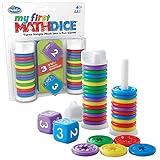
Overview: ThinkFun My First Math Dice introduces toddlers ages three and up to foundational number concepts through tactile, visual gameplay. The set includes two large dice, two chip towers, thirty colorful counter chips, and a storage bag, creating a multi-sensory learning experience. Unlike flashcards, this game builds early math skills through pattern recognition, one-to-one correspondence, and hands-on counting activities that hold young attention spans.
What Makes It Stand Out: The chip towers provide a concrete, visual representation of quantities that helps young learners grasp abstract number concepts. The design deliberately cultivates patience and focus—skills often overlooked in preschool products. The high-quality instruction manual offers multiple game variations that grow with your child, extending the product’s lifespan beyond typical toddler toys.
Value for Money: Retailing around $12-15, it’s pricier than basic dice sets but justifiable through its thoughtful, age-specific design. The durable components survive rough toddler handling, and the multi-game format provides months of educational entertainment. It effectively replaces several single-skill preschool toys.
Strengths and Weaknesses: Strengths include perfectly sized components for small hands, non-toxic materials, and the progression from simple matching to early addition. It successfully bridges the gap between play and structured learning. Weaknesses: children quickly progress to more complex games, limiting long-term use. The small chips require supervision for children under three, and the game lacks the fast-paced excitement older kids crave.
Bottom Line: An ideal first math game that respects early developmental stages. Worth the investment for parents committed to building strong numeracy foundations through purposeful play.
4. University Games, Scholastic Math Match Travel Dice Game, Mathematics Reinforcement Game for Kids, for 2 or More Players Ages 5 and Up

Overview: University Games’ Scholastic Math Match combines dice and cards in a travel-friendly format endorsed by the world’s largest children’s book publisher. Designed for ages 5-12, this versatile game reinforces all four arithmetic operations through solo or competitive play. The compact tin contains dice, cards, and instructions, making it a comprehensive learning system for families on the move who need curriculum-aligned practice.
What Makes It Stand Out: The Scholastic partnership lends immediate educational credibility, ensuring alignment with curriculum standards. The dual gameplay modes—solo practice and competitive challenge—accommodate different learning preferences and moods. Its travel-ready design with secure storage prevents component loss better than bag-based alternatives and withstands heavy use.
Value for Money: Priced at $12-15, you’re paying a modest premium for the Scholastic brand and multi-format gameplay. The ability to serve children across a seven-year age span delivers strong family value, effectively replacing several single-age educational toys and adapting to different skill levels.
Strengths and Weaknesses: Major strengths include the inclusive age range, clear progression of difficulty, and the card-dice combination that adds strategic depth. The beginner-friendly design builds confidence. However, the card components wear faster than dice, and the smaller dice can be difficult for younger children to read. The gameplay pace is slower than pure dice games, which may lose some kids’ attention.
Bottom Line: A reliable, curriculum-aligned choice for families seeking flexible, travel-ready math practice. The Scholastic backing makes it particularly appealing for homeschoolers and educators.
5. 50 Pieces Dice Set, 14mm Bulk 6 Sided Colored Dices for Board Games, Math Learning,Classroom

Overview: This 50-piece dice set delivers exactly what it promises: a bulk collection of colorful, standard six-sided dice for versatile use. Each 14mm acrylic die features rounded edges and vibrant translucent colors—five dice each in ten shades including black, blue, purple, red, and yellow. The included storage box keeps the set organized for classroom, gaming, or math practice applications where quantity matters.
What Makes It Stand Out: The sheer quantity enables creative educational applications beyond any single game. Teachers can distribute dice to entire classrooms for probability lessons, mental math drills, or custom game creation. The color variety allows for coding activities—assigning different values or operations to each color—transforming simple dice into a multi-functional teaching tool that sparks game design creativity.
Value for Money: At $8-10 for 50 dice, the per-unit cost is remarkably low, making this exponentially cheaper than replacing dice from commercial games. For educators and families who frequently lose components, it’s an economical insurance policy that also unlocks unlimited game-design possibilities and group activities.
Strengths and Weaknesses: Strengths include exceptional durability, child-safe rounded edges, vibrant readability, and the storage solution. The set adapts to countless math concepts from basic counting to advanced probability. The primary weakness is that it’s not a standalone game—users must create or find activities. Color distribution is fixed, limiting certain game designs. The acrylic material lacks the heft of premium gaming dice.
Bottom Line: An essential resource for teachers and creative families, but not a ready-to-play solution. Pair it with activity guides for maximum educational impact.
6. ThinkFun Math Dice Chase - The Fun Game of Mathematical Hot Potato, Invented by a Math Teacher

Overview: ThinkFun Math Dice Chase transforms mental math into a high-energy group activity reminiscent of musical chairs. Designed by an elementary school teacher specifically for classroom use, this game accommodates 4-6 players who race against the clock to solve multiplication problems before passing the dice. The package includes four 12-sided dice (two blue, two purple) and a storage bag, creating a portable solution for math practice that feels more like a party game than homework.
What Makes It Stand Out: The “hot potato” mechanic adds adrenaline to arithmetic, forcing players to calculate under pressure—a skill that translates to real-world quick thinking. The GEI Seal of Approval validates its educational efficacy, while the teacher-invented pedigree ensures the mechanics actually work in group learning environments. Unlike solitary math drills, this builds social skills alongside numerical fluency, making it uniquely suited for collaborative learning.
Value for Money: Priced competitively with other specialty dice games, Math Dice Chase delivers exceptional value for educators and homeschooling groups. The durable dice withstand heavy classroom use, and the minimal components mean nothing gets lost easily. Compared to electronic math games or workbooks, this offers endless replayability at a fraction of the cost per session.
Strengths and Weaknesses: Strengths include rapid gameplay that maintains engagement, validated educational design, and portability for travel or outdoor learning. Weaknesses are the mandatory 4+ player requirement—making it unsuitable for solo practice—and the potential to overwhelm math-anxious children with its timed pressure. The focus solely on multiplication may limit long-term curriculum integration.
Bottom Line: Ideal for teachers and cooperative learning pods, Math Dice Chase excels at making math practice a social, energetic event. It’s less suited for individual study but unbeatable for group skill-building sessions.
7. Nicecho Shut The Box Dice Game,2-4 Player Family Wooden Board Table Math Games for Adults and Kids, 8 Dices Classics Games for Classroom,Home,Party or Pub

Overview: Nicecho’s Shut The Box revives the classic pub game as a family-friendly educational tool, blending wooden craftsmanship with mathematical fundamentals. This 8.74-inch square board accommodates 2-4 players using eight colorful dice to flip numbered tiles through strategic addition. The solid pinewood construction with a felt-lined playing surface prioritizes durability and noise reduction, making it appropriate for classrooms, homes, or travel.
What Makes It Stand Out: The premium build quality distinguishes it from cardboard alternatives, while the acrylic silk-screen dice ensure longevity. Its versatility spans pure entertainment to stealth education—children practice addition and subtraction without realizing they’re learning. The portable size and self-contained design make it an excellent restaurant or vacation game that requires no batteries or screens.
Value for Money: Mid-range pricing reflects the wooden construction quality rather than cheap plastic alternatives. For families seeking multi-generational appeal, it replaces several single-purpose games. The durability ensures years of use, making it cheaper per-play than disposable activity books or app subscriptions.
Strengths and Weaknesses: Strengths include the tactile wooden aesthetic, quiet felt surface, simple rules for all ages, and genuine educational value for basic arithmetic. Weaknesses involve the 4-player maximum limiting larger groups and the relatively simple math (addition/subtraction only) making it less challenging for teens. The small dice could pose a choking hazard for very young children despite the family-friendly marketing.
Bottom Line: A handsome, well-crafted game that successfully balances fun and foundational math practice. Perfect for families with elementary-aged children who appreciate screen-free, quality game nights with subtle educational benefits.
8. Semper Smart Games PlaySmart Dice Math-Tac-Toe Math Game: Get Sharp on Mental Math with a Fun New Twist on a Timeless Classic! Multiple Skill-leveled Math Bingo Made Fun for 8 and up!

Overview: Math-Tac-Toe reinvents the familiar three-in-a-row concept by embedding mental math challenges into each move. Using Semper Smart’s proprietary dice system, 2-6 players perform calculations to claim board spaces, with two distinct game modes offering variety. The three-tiered skill system—green cards for addition/subtraction, blue for multiplication, and red for advanced prime number calculations—allows simultaneous play across age groups from 8 through adult.
What Makes It Stand Out: The patent-pending PlaySmart Dice system specifically targets difficult number combinations that traditional dice miss, accelerating mastery of challenging math facts. The strategic layer transcends rote calculation—players must evaluate multiple move options, introducing genuine tactical depth rare in educational games. This dual focus on computation and strategy creates a more sophisticated learning experience.
Value for Money: Positioned as a premium educational game, the price reflects the specialized dice engineering and multi-level card system. For families with multiple children, it eliminates buying separate games for different skill levels. The reusable components offer better long-term value than consumable workbooks.
Strengths and Weaknesses: Strengths include the adaptable difficulty system, high-quality components, strategic gameplay that maintains interest, and efficient targeting of challenging math facts. Weaknesses involve a steeper learning curve for younger players despite the “8 and up” rating, and the requirement for at least two players limits solo practice options. The strategic element might frustrate children who just need straightforward drill practice.
Bottom Line: An excellent choice for families seeking a game that evolves with their children’s skills. The strategic component makes it genuinely enjoyable for adults while effectively building math fluency, though it’s best for kids ready for game-based complexity.
9. Math Dice Game for Kids, Teens, and Adults | Math Skill Game | Fun Educational Activity | Mental Math Game for Family Entertainment, Teachers and Learning | Engaging Brain Exercise for All Ages

Overview: This comprehensive math dice system offers a progressive learning pathway through three distinct challenge levels—Math Quest (ages 4-7), Math Explorer (7+), and Extra Challenge (teens/adults). The complete set includes two green target dice, one orange 12-sided die, a yellow symbol die, three scoring dice, and a storage bag. Designed for versatility, it functions equally well in classroom stations, homeschooling curricula, or family game nights.
What Makes It Stand Out: The age-stratified challenges create a rare game that genuinely grows with a child from preschool through high school. The inclusion of operation symbols (addition, subtraction, multiplication, division) on a dedicated die allows players to customize difficulty spontaneously. Teachers particularly value its adaptability for differentiated instruction within mixed-ability classrooms.
Value for Money: The extensive component set and multi-year usability justify the moderate price point. Rather than purchasing separate games for different ages, families invest once in a system that adapts. For educators, it replaces multiple single-skill manipulatives, offering strong budget efficiency.
Strengths and Weaknesses: Strengths include the progressive difficulty system, durable colorful dice, comprehensive instruction booklet, and suitability for solo or group play. Weaknesses involve the numerous small pieces requiring careful organization, and the generic branding makes it hard to distinguish from competitors. The youngest level may still challenge lower end of the 4-7 range without adult support.
Bottom Line: A remarkably versatile math tool that delivers exceptional longevity. Perfect for parents wanting one game to span childhood years or teachers needing flexible classroom resources, though piece management requires diligence.
10. PlaySmart Dice Deluxe: Sharpen Math Skills at Home, in School and On The Go with Uniquely Numbered Math Dice and 11 Fun Math Games That Help Kids Master Mental Math.

Overview: PlaySmart Dice Deluxe represents the flagship product in Semper Smart’s award-winning line, bundling their patent-pending dice system with 11 distinct games in a single portable package. Designed for learners 6 and up, it targets the most challenging math fact combinations through carefully weighted number distributions. The deluxe set includes multiple dice variations and instruction booklets for games ranging from simple matching to complex strategic challenges, all optimized for short, effective practice sessions.
What Makes It Stand Out: The scientific approach to number distribution makes this vastly more efficient than standard dice for mastering difficult facts like 7x8 or 9x6. The 11-game variety prevents the boredom that sinks single-mechanic educational tools, while the “minutes a day” design fits modern schedules. The system specifically addresses the cognitive science of math fact retrieval, not just repetition.
Value for Money: As a premium product, the initial investment exceeds basic dice sets but undercuts comprehensive math tutoring programs. For families committed to building strong mental math foundations, the cost-per-skill-mastered is exceptional. The portability eliminates need for separate travel games, consolidating value.
Strengths and Weaknesses: Strengths include research-based dice engineering, remarkable game variety, true portability, efficiency in targeting difficult facts, and scalability from ages 6 through adult. Weaknesses involve the higher price point deterring casual buyers, and the complexity of 11 games might overwhelm users wanting simple instructions. Some games require additional components not included in the base set.
Bottom Line: The ultimate serious math skill builder for families prioritizing educational efficacy over entertainment flash. While overkill for occasional users, it’s unparalleled for systematic mental math mastery and justifies its premium price through scientific design and comprehensive content.
Why Math Dice Games Are Transforming Homeschool Education
The Psychology of Play-Based Learning
Children’s brains are wired to learn through play. When kids engage with dice games, they’re not just memorizing facts—they’re building neural pathways through experimentation, failure, and success. The immediate feedback loop of rolling, calculating, and seeing results creates stronger memory retention than passive learning. In your homeschool setting, this means concepts that once took weeks to master can sometimes solidify in just a few game sessions.
From Abstract to Concrete: Making Numbers Tangible
Dice provide a physical representation of numbers that worksheets simply cannot match. When a child rolls a 4 and a 6, then physically counts the pips or combines them, they’re experiencing addition rather than just seeing symbols on paper. This multisensory approach is particularly powerful for kinesthetic learners who struggle with traditional math instruction. The tactile sensation of rolling dice, the visual pattern recognition, and the auditory element of calling out results engage multiple learning channels simultaneously.
Building Math Confidence Through Low-Stakes Practice
One failed worksheet can shatter a child’s math confidence for weeks. Dice games create a low-pressure environment where mistakes are simply part of the game. A wrong answer means losing a turn or rolling again—not a red mark on a page. This psychological shift is crucial for anxious learners. In 2026’s homeschooling landscape, where social-emotional learning is prioritized alongside academics, dice games offer a safe space to take mathematical risks and build genuine confidence.
Essential Math Skills Developed Through Dice Games
Foundational Number Sense and Counting
Even the simplest dice games build subitizing—the ability to instantly recognize small quantities without counting. This skill forms the foundation of all future math learning. Games that require matching, ordering, and comparing dice values help young learners understand number relationships intuitively. For early elementary homeschoolers, this translates to faster mental math and stronger place value understanding later on.
Addition and Subtraction Fluency
Dice games generate endless, randomized practice problems that feel nothing like drills. When children roll two dice and need the sum to move their game piece, they’re practicing addition facts dozens of times per session. Subtraction games that involve finding differences between rolls build mental flexibility. The key difference from flashcards? The practice is contextual and purposeful within the game’s narrative.
Multiplication and Division Mastery
Multiplication dice games often involve rolling multiple dice and combining values in various ways. This builds the conceptual understanding that multiplication is repeated addition while cementing facts through repetition. Division games that require partitioning dice totals into equal groups make the inverse relationship between multiplication and division visually obvious. For upper elementary homeschoolers, these games bridge the gap between concrete and abstract thinking.
Fraction, Decimal, and Percentage Understanding
Specialized dice with fractions or decimals printed on faces allow older elementary and middle school students to practice operations with rational numbers in a concrete way. Games that require comparing, ordering, or calculating with these values build intuition that transfers directly to algebraic thinking. In 2026’s STEM-focused educational climate, this early comfort with non-whole numbers gives homeschoolers a significant advantage.
Critical Thinking and Strategy Development
The best math dice games aren’t just about calculation—they require strategic decision-making. Should you roll again and risk losing points? Which combination of dice should you use to reach your goal? These decisions build mathematical reasoning, probability intuition, and logical thinking. Your homeschooler learns that math isn’t just about getting the right answer, but about making smart numerical decisions.
Types of Math Dice Games to Consider
Classic Roll-and-Calculate Games
These straightforward games involve rolling dice and performing operations to achieve a target number. They’re ideal for building fluency because they’re fast-paced and easy to learn. Look for versions that allow you to adjust the target number or operation difficulty. The simplicity makes them perfect for daily warm-ups or filling short time gaps in your homeschool schedule.
Cooperative Problem-Solving Games
In these games, players work together against the game itself, rolling dice to overcome challenges or reach a collective goal. This format eliminates competition anxiety and encourages siblings to explain their reasoning to each other. Cooperative games are particularly valuable in multi-age homeschool settings where older children can mentor younger ones while reinforcing their own skills.
Competitive Strategy Games
These games combine calculation with tactical decision-making, where players roll dice then choose how to apply the results strategically. They teach that math is a tool for achieving goals, not just an end in itself. When selecting competitive games for your homeschool, prioritize those where skill matters more than luck, ensuring that mathematical thinking drives success.
Story-Driven Math Adventures
Narrative-based dice games embed math problems within an engaging story context. Players might roll dice to battle dragons, explore space, or run a business. This format is magic for reluctant learners who don’t see themselves as “math people.” The story provides motivation to tackle calculations that would otherwise feel tedious. In 2026’s game market, these are increasingly sophisticated while remaining educationally sound.
Customizable Modular Game Systems
Some dice game systems allow you to swap out rules, difficulty cards, or dice types to create endless variations. These are excellent investments for homeschooling families because they grow with your children. A single system might serve your family from kindergarten through middle school by simply changing the modules. When evaluating these, check how many variations are included and whether you can create your own rules.
Key Features to Evaluate Before Investing
Age and Skill Level Appropriateness
A game that’s too easy breeds boredom; too difficult creates frustration. Look for games with clear age ranges but also flexible difficulty settings. The best options include variant rules that let you scale complexity up or down without buying new materials. Consider your child’s current math level, not just their grade level, when making selections.
Adaptability for Multiple Learners
Most homeschool families teach children of different ages simultaneously. Evaluate whether a game allows for handicapping systems, where older children have more challenging targets while younger ones play with simpler rules in the same round. This feature maximizes your investment and simplifies your teaching time.
Portability and Storage Considerations
Dice games should be easy to pull out for a quick lesson and simple to clean up. Bulky boxes with dozens of pieces often end up unused. Prioritize games that store compactly or can be contained in a small bag. This makes them perfect for learning on the go—whether that’s a doctor’s waiting room, a sibling’s sports practice, or family travel.
Quality and Durability of Components
Homeschool materials face heavy use. Check that dice are made from quality materials that won’t chip or fade. Printed dice should have etched or molded numbers rather than stickers that peel off. While wooden dice feel nice, high-impact plastic often survives drops onto hardwood floors better. Consider your family’s usage patterns and choose accordingly.
Replay Value and Longevity
The best dice games feel fresh after dozens of plays. Games with random elements, multiple strategies, or expansion options offer better long-term value. Before purchasing, ask yourself: Will my child still find this interesting after mastering the basic skill? Can we modify it as they advance? A game that answers yes to both questions earns its place in your homeschool budget.
Implementing Dice Games in Your Homeschool Routine
Scheduling Math Game Time Effectively
Consistency matters more than duration. A 15-minute daily dice game session produces better retention than an occasional hour-long marathon. Many homeschooling parents find success using dice games as morning warm-ups, transition activities between subjects, or Friday “fun math” rewards. The key is making it a predictable, anticipated part of your rhythm rather than an occasional treat.
Balancing Games With Traditional Instruction
Dice games supplement, not replace, systematic math instruction. Use them to practice and reinforce concepts you’ve taught through your core curriculum. After introducing a new operation, spend a week playing related dice games before moving to worksheet practice. This sequence—teach, play, practice—cements understanding while making the subsequent traditional work less intimidating.
Creating a Math-Friendly Game Space
Designate a specific area for math games, even if it’s just a small basket on a shelf. Keep dice in small containers to prevent loss, and consider using a dice tray to contain rolls and reduce noise. Having a dedicated space signals that these games are important learning tools, not just toys, and makes starting a session frictionless.
Involving Siblings of Different Ages
Multi-age gameplay requires thoughtful facilitation. Assign older children as “game guides” who help explain rules and verify calculations. This peer teaching reinforces their own learning while building leadership skills. For competitive games, use handicapping systems or have older players take on additional challenges, like calculating their score using mental math while younger siblings can use manipulatives.
Customizing and Creating Your Own Dice Games
Simple DIY Game Design Principles
Creating custom dice games requires no special expertise—just clear learning objectives. Start with the skill you want to practice, then add a simple goal and one or two rules. For example, to practice adding to 10, players roll a die and state what number they need to reach 10. The first to correctly answer five times wins. Test your game with your children and refine based on what engages them.
Adapting Commercial Games for Your Needs
Most published dice games include variant rules—use them as starting points for your own modifications. Change the target numbers, require players to explain their reasoning aloud, or add a storytelling element. If a game uses standard dice, try replacing them with specialized dice (fraction dice, 10-sided dice, etc.) to practice different skills using the same game board and rules.
Using Different Dice Types (D4, D6, D8, D10, D12, D20)
Standard six-sided dice are just the beginning. Polyhedral dice (like those used in role-playing games) open entirely new mathematical possibilities. Ten-sided dice are perfect for place value practice and percentages. Twelve-sided dice work beautifully for multiplication facts up to 12. Twenty-sided dice challenge advanced learners with larger numbers. A mixed set costs less than a typical workbook and provides infinite variation.
Integrating Games With Curriculum Standards
Mapping Games to Learning Objectives
Keep a simple log of which games practice which skills. When your state requires documentation, this shows intentional instruction. Most math curricula list specific competencies—create a cross-reference showing how each dice game addresses these objectives. This transforms “just playing games” into evidence of structured learning for portfolio reviews or standardized test preparation.
Documenting Progress for Portfolio Reviews
Photograph your children playing, save score sheets where they track their own calculations, or have them write brief reflections on strategies they discovered. These artifacts demonstrate both mathematical growth and critical thinking development. In 2026’s homeschool evaluation landscape, which increasingly values authentic assessment over testing, this documentation is powerful evidence of learning.
Using Games as Assessment Tools
Watch how your child approaches a dice game to assess their true understanding. Do they count every pip, or can they subitize? Do they use efficient strategies or brute-force counting? Can they explain their reasoning to a sibling? These observations provide richer assessment data than worksheets because you see their thinking process in real-time, not just their final answer.
Troubleshooting Common Challenges
When Games Become Too Competitive
Competition can motivate some children but paralyze others. If you notice anxiety or poor sportsmanship, shift to cooperative variants or have players compete against their own previous scores rather than each other. Establish a “learning mindset” where the goal is improvement, not winning. Model this by celebrating smart strategies, not just victories.
Managing Short Attention Spans
If your child loses interest mid-game, the game is likely too long or too complex. Break games into micro-rounds of 5-10 minutes. Use a visual timer so they know when the session ends. Allow standing, fidgeting, or even rolling while sitting on an exercise ball. The math learning happens regardless of posture—engagement is the real goal.
Addressing Math Anxiety Through Gameplay
For truly math-anxious children, remove all time pressure initially. Let them use calculators or math fact charts while playing, focusing first on game enjoyment. Gradually reduce supports as confidence builds. Frame mistakes as “data collection” for improving strategy. The game context provides emotional distance from “being bad at math,” allowing their true abilities to emerge.
Frequently Asked Questions
How many dice games should I purchase for a complete homeschool math program?
Focus on quality over quantity. Three to five versatile games that cover different skill areas provide more value than a dozen single-purpose options. Start with one foundational game for your child’s current level, then add one advanced game and one cooperative game. This gives you variety without overwhelming your budget or storage space.
Can dice games really replace math worksheets entirely?
While dice games are powerful practice tools, they work best as part of a balanced approach. Use games for skill practice and conceptual reinforcement, but include some traditional problem-solving to build stamina and exposure to varied question formats. The ideal ratio is roughly 60% game-based practice to 40% traditional work, adjusting based on your child’s learning style.
What age should I start using math dice games?
Children as young as three can play simple dice games with dot patterns for counting and matching. By age five, most children can handle basic addition games. The key is starting with games where the math is embedded in the action rather than explicitly called out. Never force a child to play—wait until they show interest in rolling dice or board games, then introduce math elements gradually.
How do I keep dice games from feeling like “stealth learning” that kids resist?
Be transparent about the learning goals. Say “This game will help you get faster at adding” rather than hiding the educational purpose. Let children choose which games to play and when. Involve them in creating house rules or modifications. When they own the experience, they embrace the learning rather than feeling manipulated.
Are expensive dice game systems worth the investment for homeschooling?
High-quality modular systems often cost less over time than buying multiple separate games, especially for families with several children. Evaluate cost-per-use rather than sticker price. A $50 system that serves your family for five years across multiple grade levels costs less than $10 annually. Compare that to workbooks that last one semester.
How can I use dice games to teach multiple children at different levels simultaneously?
Choose games with natural handicapping systems or create your own. Give older children more challenging targets, require them to use mental math while younger siblings use manipulatives, or have them serve as “game masters” who verify answers. Cooperative games where everyone works toward a common goal also work beautifully for mixed-age play.
What if my child just guesses randomly instead of calculating during games?
This usually indicates the game is too difficult or too slow-paced. Reduce the number range, allow calculation aids, or shorten the game. Alternatively, add a rule requiring players to explain their reasoning before moving. If guessing persists, observe whether they’re actually subitizing or using mental math shortcuts you haven’t recognized—their “random” guess might be sophisticated pattern recognition.
Can dice games help with standardized test preparation?
Absolutely. Timed dice games build the rapid recall many tests require. Games requiring multi-step problem-solving mirror the reasoning sections of standardized tests. More importantly, the confidence and number sense developed through gameplay reduces test anxiety. Document game play as part of your test prep portfolio to show holistic preparation.
How do I store and organize multiple dice games efficiently?
Use small craft boxes or zip-top bags to contain each game’s components, then store these in a larger bin. Label everything clearly. Keep a “quick play” basket with your three most-used games accessible for daily use. Store specialty dice in a segmented container so you can easily grab the types you need for custom games. This system makes setup and cleanup fast, increasing actual usage.
What should I do if my child prefers video games to dice games?
Bridge the gap by emphasizing the game mechanics dice games share with video games: leveling up, earning points, unlocking achievements, and strategic decision-making. Let your child design a dice game with a video game theme. Some families create “battle passes” where completing dice game challenges unlocks screen time. The tactile, social nature of dice games offers developmental benefits that screens can’t replicate, so find ways to make them feel equally engaging and modern.
See Also
- The 10 Ultimate Best Math Dice Games for Homeschooling Families in 2026
- 10 Game-Changing Strategy Dice Games That Will Test Your Brain in 2026
- 10 Game-Changing Dice Games for Unpredictable Fun in 2026
- 10 Game-Changing Dice Board Games for Board Game Night Veterans in 2026
- 10 Expert-Recommended Dice Games for Teaching Math to Kids in 2026