Table of Contents
Imagine a world where screen time takes a backseat, replaced by shuffling sounds, focused giggles, and the satisfying slap of a card hitting the table. For parents and educators seeking engaging, screen-free activities that genuinely build essential cognitive skills, card games offer a surprisingly powerful solution. These compact decks of opportunity aren’t just for passing time; they’re portable brain gyms perfectly sized for little hands and growing minds. In an era saturated with digital distractions, harnessing the simple magic of playing cards provides a tangible, interactive way to strengthen the very foundations kids need for academic success and everyday life: sharp memory and sustained focus.
Why card games? Unlike passive entertainment, they demand active participation. Children must remember rules, track sequences, recognize patterns, and make decisions – all while navigating the playful tension of friendly competition or cooperative play. This constant mental engagement is precisely what builds neural pathways associated with working memory, concentration, and strategic thinking. Forget expensive gadgets; the most effective tools for nurturing these crucial skills might already be hiding in your drawer or waiting for a trip to the local game store. Let’s explore how to choose the right card-based adventures to unlock these benefits for young learners.
Top 10 Card Games for Kids
Detailed Product Reviews
1. Regal Games Card Games for Kids - Go Fish, Crazy 8’s, Old Maid, Slap Jack, Garbage Monster, War - Simple & Fun Classic Family Table Games - Games May Vary (6 Set)

Overview: This 6-deck set delivers accessible, screen-free fun for young children, bundling timeless classics like Go Fish and Old Maid in a single portable package designed specifically for ages 4+.
What Makes It Stand Out: Its standout feature is the inclusion of six distinct, child-optimized games in one compact collection. The oversized cards (perfect for small hands), vibrant illustrations, and focus on skill-building—reinforcing colors, numbers, memory, and matching—make it uniquely suited for early learners. The portability for on-the-go play during travel or visits is a major plus.
Value for Money: Priced affordably for a multi-game set, it offers exceptional value compared to buying individual kids’ card decks. The durability and educational focus justify the cost, especially as a versatile gift (like Easter baskets or stocking stuffers) that replaces disposable toys with lasting engagement.
Strengths and Weaknesses:
Strengths: Huge variety in one box; extremely durable, large cards; excellent visual design for kids; strong educational benefits subtly integrated; highly portable.
Weaknesses: “Garbage Monster” rules may need clarification; card stock, while sturdy, isn’t laminated for heavy spills; limited replay depth for older children beyond age 8.
Bottom Line: An outstanding starter card game bundle for preschoolers and early elementary kids, blending education, entertainment, and portability. Highly recommended for parents seeking quality screen-free family time at a smart price.
2. USAOPOLY Flip 7, The Ultimate Blend of Press Your Luck & Strategy, Fast-Paced Addictive Card Game,Quick to Learn & Easy to Teach,Perfect for Game Nights, 3+ Players, Ages 8 & Up, 20 Minutes Play Time

Overview: Flip 7 is a thrilling, high-stakes card game where players draw numbered cards hoping to avoid duplicates, aiming to be the first to 200 points through calculated risk-taking and strategic luck.
What Makes It Stand Out: The game’s genius lies in its uniquely weighted deck (twelve 12s, eleven 11s, etc.) and dynamic action cards (Flip Three, Freeze, Second Chance). This creates intense “press your luck” tension as players chase higher scores while desperately avoiding busting from duplicate numbers, making every draw pulse-pounding.
Value for Money: At its price point, Flip 7 delivers remarkable replayability and excitement, easily rivaling more expensive board games. The quick 20-minute rounds and ease of teaching make it a superior investment for frequent game nights compared to complex strategy games with lengthy setups.
Strengths and Weaknesses:
Strengths: Exceptionally fast-paced and addictive; innovative deck mechanics heighten suspense; simple rules enable immediate play; action cards add strategic depth; perfect for 3-6 players.
Weaknesses: Heavy reliance on luck can frustrate strategy purists; scoring to 200 may feel arbitrary; limited longevity for players seeking deep tactical complexity.
Bottom Line: A must-have for game nights craving quick, high-energy fun. Its unique risk-reward loop and clever design make Flip 7 a superb value and a top recommendation for families and casual gamers aged 8+.
3. Taco Cat Goat Cheese Pizza Wildly Entertaining Card Game for Family and Group Game Night | Easy to Learn and Play with 10-15 Minute Rounds | Fun for Kids, Teens, Adults, and Families | 2-8 Players

Overview: Taco Cat Goat Cheese Pizza (TCGCP) is a raucous, slap-happy party game where players race to match spoken words with cards, creating instant chaos and laughter for groups of 2-8 players in short, intense rounds.
What Makes It Stand Out: The game’s magic is its perfect blend of simplicity and frenzy. Chanting the titular phrase while watching for matching cards (“Taco” card = slap pile!) triggers hilarious reflex-based scrambles. Its universal accessibility—from kids to adults—and 10-15 minute playtime make it ideal for breaking the ice or energizing any gathering.
Value for Money: This compact, travel-sized deck offers unparalleled entertainment density per dollar. It outperforms pricier party games by delivering consistent, high-energy fun with zero setup, making it a standout gift (like Easter baskets) for any social occasion.
Strengths and Weaknesses:
Strengths: Effortless to learn; wildly engaging for mixed-age groups; promotes quick thinking and reflexes; highly portable; generates non-stop laughter.
Weaknesses: Physical slapping can get rowdy (risk for young kids); replay value dips slightly after many plays; card durability may suffer from frequent slaps.
Bottom Line: An essential, budget-friendly addition to any game collection. TCGCP’s infectious energy and simplicity earn it a strong recommendation for families, parties, and anyone needing instant, screen-free fun.
4. Hasbro Gaming Guess Who? Card Game for Kids, 2 Player Guessing Game, Fun Summer Activities, Vacation Travel Essentials, Ages 5+

Overview: This compact card adaptation distills the beloved Guess Who? board game into a portable, two-player deduction challenge where kids race to identify each other’s mystery character through strategic yes/no questions.
What Makes It Stand Out: Its brilliance is in faithful simplification: retaining the core guessing mechanics of the classic board game while shrinking it into a pocket-sized deck. The travel-ready format, clear character illustrations, and focus on logical questioning make it an ideal on-the-go brain teaser for young children.
Value for Money: As a specialized travel game for ages 5+, it’s reasonably priced. While less versatile than multi-game sets, its durability and direct appeal to Guess Who? fans offer solid value as a stocking stuffer or vacation essential compared to generic card decks.
Strengths and Weaknesses:
Strengths: Perfectly captures the original game’s spirit; ultra-portable and spill-proof; teaches deductive reasoning; high-quality Hasbro components; excellent for car rides or waiting times.
Weaknesses: Strictly limited to two players; shorter replay value than open-ended games; less educational depth than skill-building card sets.
Bottom Line: A clever, well-executed travel companion for young Guess Who? enthusiasts. Recommended for parents needing focused, screen-free entertainment during trips, though less versatile for larger groups.
5. Upgraded Kids Card Games Pack, 6 Decks, Go Fish, Old Maid, Crazy Eights, Memory Match, Slap Jack, War, Playing Cards, Easter Basket Stuffers, Stocking Stuffers

Overview: This premium 6-deck collection elevates classic kids’ card games with thicker cards, educational themes (like sea life and occupations), and strategic “senior versions” featuring unique function cards for deeper gameplay.
What Makes It Stand Out: The standout upgrades are the 30% thicker, coated card stock and the inclusion of original “senior” rules adding strategy layers to games like Go Fish. Each deck’s thematic artwork (fruits, animals, jobs) subtly expands learning, while individual packaging enhances portability and gift appeal.
Value for Money: Priced slightly higher than budget sets, it justifies the cost through superior durability, thoughtful educational design, and extended replayability via advanced rules. It outperforms basic packs as a long-term investment and premium gift (e.g., classroom prizes).
Strengths and Weaknesses:
Strengths: Exceptional card quality and thickness; innovative senior rules boost cognitive challenge; beautifully cohesive thematic art; individually wrapped decks for easy gifting; strong skill development focus.
Weaknesses: Theming may not resonate equally with all kids; advanced rules require guidance for younger players; slightly bulkier than ultra-minimalist travel sets.
Bottom Line: The definitive upgraded card pack for discerning parents. Its blend of durability, education, and strategic depth makes it a top-tier recommendation for ages 4+, offering exceptional value over generic alternatives.
6. Dump The Skunk! Game | Family Card Game by Reiner Knizia | Ages 7 and Up | 2-6 Players | 20 Mins. | Easy to Learn Games for Kids, Teens, and Adults

Overview: Dump The Skunk! is a lighthearted, strategic card game by renowned designer Reiner Knizia, where players aim to avoid accumulating points by strategically discarding cards—especially the high-value skunk cards. Designed for 2-6 players aged 7+, it offers quick 20-minute rounds ideal for family game nights.
What Makes It Stand Out: Its clever twist on set collection—where discarding the “skunk” cards is critical—creates tension and quick decisions. The accessible rules (play a card, draw, or quit a round) make it easy to learn, while the skunk-themed art and 20-minute playtime ensure broad appeal. It successfully reimagines the mechanics of the award-nominated Don’t L.L.A.M.A! with a fresh, humorous theme.
Value for Money: Priced competitively for a Reiner Knizia-designed game, it delivers exceptional replayability for its cost. Compared to similar strategy-lite games, its compact size, portability, and inclusion of a universally engaging theme offer better family entertainment per dollar.
Strengths and Weaknesses: Strengths: Simple yet strategic depth; perfect for mixed-age groups; highly portable; quick setup. Weaknesses: Skunk theme may not resonate with all; limited long-term strategic complexity for hardcore gamers; relies on luck in smaller groups.
Bottom Line: An excellent, affordable choice for families seeking a fun, fast-paced game that bridges generations. Highly recommended for game nights or travel, especially for fans of light strategy.
7. Asmodee Spot It! Classic Card Game (2024 Refresh) - Eco-Blister Edition, 5-in-1 Visual Perception Game for Quick Reflexes and Family Fun, Ages 6+, 2-8 Players, 10 Minute Playtime

Overview: Spot It! Classic is a rapid visual perception game where players race to identify the one matching symbol between any two cards. This 2024 Eco-Blister Edition refresh maintains the core gameplay while adopting sustainable packaging, supporting 2-8 players in energetic 10-minute sessions.
What Makes It Stand Out: The inclusion of five distinct mini-games within one set maximizes replayability, challenging observation and reflexes differently each time. Its eco-conscious blister packaging reduces plastic waste without compromising durability, appealing to environmentally aware families. The universal symbol-based play transcends language barriers.
Value for Money: At its price point, the five-in-one gameplay offers extraordinary longevity compared to single-mechanic alternatives. The eco-upgrade adds ethical value without inflating cost, making it a smarter investment than older editions or competing matching games lacking versatility.
Strengths and Weaknesses: Strengths: Incredibly fast setup and play; scales perfectly for large groups; enhances cognitive skills; eco-friendly packaging; durable cards. Weaknesses: Minimal strategic depth; repetitive for older players after extended use; symbol recognition can frustrate very young children.
Bottom Line: A near-essential family game that excels in portability, inclusivity, and replay value. The eco-refresh solidifies its status as a top pick for parties, classrooms, or travel—highly recommended for ages 6+.
8. LotFancy Card Games for Kids, 6 Decks, Go Fish, Old Maid, Crazy Eights, Memory Match, Slap Jack, Animal Playing Cards, Easter Basket Stuffers, Stocking Stuffers, Birthday Gifts
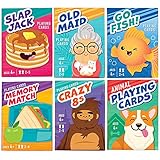
Overview: LotFancy’s 6-in-1 card bundle delivers six themed decks (Go Fish, Old Maid, etc.) with animal illustrations, targeting kids through colorful designs and educational elements. Each deck is individually boxed with instructions, making it ideal for gifting or varied play sessions.
What Makes It Stand Out: The sheer variety—six distinct games in one purchase—provides unmatched versatility for developing different skills (matching, memory, strategy). Sturdy, plastic-coated cards withstand rough handling, while the vibrant animal themes engage young players more effectively than standard decks.
Value for Money: Exceptional value as a multi-game starter kit. Buying these games individually would cost 2–3 times more. The durability and educational focus (teaching colors, animals, deduction) justify the price, especially for parents seeking screen-free activities.
Strengths and Weaknesses: Strengths: Excellent educational value; high durability; perfect for gifting; diverse skill development; compact storage. Weaknesses: Animal themes limit appeal for older kids; instructions lack depth for complex rules; not suitable for adults seeking strategic depth.
Bottom Line: A must-have for parents, teachers, or gift-givers wanting affordable, engaging games for children. Its versatility and resilience make it ideal for classrooms, travel, or holiday stockings—highly recommended for ages 4–10.
9. Hasbro Gaming 5 Alive Card Game, Fast-Paced Game for Kids and Families, Easy to Learn, 2 to 6 Players, Fun Summer Activities, Vacation Travel Essentials, Ages 8+

Overview: 5 Alive challenges players to keep a running card total under 21 while racing to discard cards. Players flip “Alive” cards when busting, with the last person standing after losing five lives winning. Designed for 2–6 players, it’s a portable choice for vacations or family nights.
What Makes It Stand Out: The high-stakes tension of the 21-point limit combined with wild “zap” cards creates unpredictable, laughter-filled rounds. Its blend of luck, risk-taking, and simple math makes it stand out from pure matching or set-collection games, offering thrilling moments ideal for energetic groups.
Value for Money: Solid for a dedicated travel game, though niche compared to classics like UNO. The included wild cards and life-tracking mechanic add replayability, but it may not justify higher prices if your family prefers strategy over luck-based play.
Strengths and Weaknesses: Strengths: Exciting, fast-paced gameplay; easy rules; great for large groups; portable tin; encourages quick math. Weaknesses: Heavy reliance on luck; limited strategic depth; repetitive after multiple plays; “busting” can frustrate younger players.
Bottom Line: A fun, adrenaline-pumping option for casual players seeking quick game nights. Best for families who enjoy luck-driven chaos over strategy—recommended for ages 8–12, but less compelling for teens/adults.
10. Mattel Games UNO Card Game in Travel & Storage Tin for Kid, Adult & Family Nights & Parties, Color Blind Accessible & Customizable Deck (Amazon Exclusive)

Overview: This Amazon-exclusive UNO edition features a color-blind accessible deck with symbol-coded cards and three blank Wild Cards for custom rules. Housed in a compact travel tin, it delivers classic matching gameplay where players race to discard cards while shouting “UNO!” at the one-card mark.
What Makes It Stand Out: The color-blind accessibility (using shapes/icons per color) is a groundbreaking, inclusive feature absent in standard editions. The customizable Wild Cards empower families to invent house rules, while the durable tin ensures portability—making it a thoughtful upgrade to the timeless formula.
Value for Money: Priced slightly above standard UNO, the accessibility features and tin justify the cost for inclusive gaming. Compared to other travel decks, its customization and universal design offer superior long-term value for diverse households.
Strengths and Weaknesses: Strengths: Truly inclusive design; highly portable; endless replay via custom rules; classic, reliable gameplay; sturdy tin. Weaknesses: Customization requires effort; symbols may confuse traditional players; minor rule tweaks won’t revive UNO fatigue for veterans.
Bottom Line: An essential upgrade for families prioritizing inclusivity and portability. The accessibility features and customization make it the definitive UNO edition—highly recommended for new buyers or those refreshing their collection.
Understanding the Cognitive Power of Simple Card Games
How Memory Skills Are Naturally Developed
Card games inherently challenge various memory types. Visual memory gets a workout when players need to recall the location of specific cards during matching games. Working memory is constantly engaged as children hold game rules, recent plays, or sequences in mind while planning their next move. Games involving hidden information, like remembering which cards opponents might hold, even introduce elements of strategic recall. This repeated, low-stakes practice strengthens memory circuits far more effectively than rote drills, embedding these skills through enjoyable repetition.
The Focus Factor in Play
Sustained attention isn’t a switch we flip on in children; it’s a muscle built through practice. Card games provide the ideal training ground. Players must maintain concentration to follow the flow of the game, anticipate turns, and resist distractions. The inherent structure – waiting for a turn, processing each play – teaches impulse control and the ability to focus on a single task for increasingly longer periods. The immediate feedback loop (a correct match, a successful strategy) reinforces the value of paying attention, making the development of focus feel like a rewarding achievement rather than a chore.
Beyond Memory and Focus: Additional Developmental Perks
The benefits extend far beyond the headline skills. Turn-taking fosters patience and social etiquette. Simple scoring mechanisms introduce early math concepts like counting and sequencing. Interpreting rules and adapting strategies builds critical thinking and problem-solving abilities. Cooperative card games specifically nurture communication, teamwork, and empathy as players work towards a shared goal. Even shuffling and dealing cards refine fine motor skills and hand-eye coordination, making card play a surprisingly holistic developmental activity.
Key Features to Prioritize When Choosing Card Games
Age-Appropriate Complexity Levels
Matching the game’s complexity to the child’s developmental stage is non-negotiable. For preschoolers (3-5 years), look for games with large, clear images, minimal rules (like simple matching), and very few cards in play at once to avoid overwhelming them. Early elementary (6-8 years) can handle slightly more complex mechanics like basic sequencing, simple set collection, or color/number matching with multiple attributes. Older children (9+) can manage games involving strategy, deduction, memory of multiple card types, or simple resource management. Starting too complex leads to frustration, while overly simplistic games quickly lose their appeal and challenge.
Visual Clarity and Card Durability
Small hands and developing eyesight demand cards that are easy to handle and see. Opt for decks with large, uncluttered illustrations or symbols. High-contrast colors and distinct shapes prevent confusion, especially for younger players or those with visual processing differences. Equally important is durability. Laminated cards or those made from thick, flexible stock withstand enthusiastic shuffling, the occasional spill, and the inevitable bend from curious fingers. Flimsy cards that warp or tear quickly diminish the play experience and become safety hazards.
Game Length and Pacing Dynamics
Young attention spans are finite. Prioritize games with short, predictable rounds (5-15 minutes for younger kids) that offer clear beginnings, middles, and satisfying ends. Games that drag on or have unpredictable endings due to constant card draws can lead to waning interest and frustration. Look for mechanics that maintain engagement: quick turns, visible progress towards a goal (like filling a row), or built-in elements that reset the action frequently. The pacing should feel energetic and manageable, not like a marathon.
Essential Game Mechanics for Targeted Skill Building
Matching and Pairing Mechanics
This foundational mechanic is a powerhouse for visual memory and pattern recognition. Games requiring players to find identical pairs (like classic Concentration) directly train the ability to recall the location of specific items after a delay. More advanced variations might involve matching cards based on categories (animals, colors, numbers) or attributes (size, shape), adding a layer of cognitive sorting that strengthens associative memory and categorical thinking – crucial skills for early literacy and math.
Sequencing and Ordering Challenges
Games that require players to arrange cards in a specific order (numerically, by color spectrum, or following a story sequence) actively develop working memory and logical reasoning. Holding the desired sequence in mind while manipulating individual cards is excellent mental exercise. This mechanic directly supports understanding number lines, alphabetical order, cause-and-effect relationships, and the step-by-step thinking required for problem-solving in math and science.
Pattern Recognition and Prediction
Identifying repeating sequences, color/number patterns, or predicting likely outcomes based on visible cards builds critical analytical skills. Games where players must complete a pattern or anticipate what card an opponent might play next engage the brain in active hypothesis testing. This skill is fundamental not only for advanced math and coding logic but also for reading comprehension (predicting story events) and understanding social cues.
Simple Set Collection and Resource Management
Games where players gather specific groups of cards (sets of three matching animals, four different fruits) require constant monitoring of the game state – remembering what sets are possible, what cards others might need, and what’s been played. This dynamic tracking strengthens working memory and introduces basic strategic planning. Even simple mechanics involving holding a hand of cards and deciding which to play when introduces foundational concepts of resource management and decision-making under constraints.
Practical Considerations for Real-World Play
Group Size Flexibility
Consider how the game functions with different numbers of players. Some games shine strictly as two-player duels, while others are designed for larger groups. Look for titles that offer adaptable rules or maintain engagement whether played with two friends or a whole classroom. Games that become chaotic or lose their core challenge with too few or too many players have limited utility in diverse settings like homes with siblings or varied classroom groupings.
Setup and Cleanup Simplicity
A game that takes longer to set up than to play is a barrier to frequent use, especially with eager young children. Prioritize decks requiring minimal setup – often just shuffling and dealing. Similarly, games where all components are uniform cards (no separate boards, tokens, or complex sorting) make cleanup effortless. Quick, fuss-free transitions between activities mean card play is more likely to become a spontaneous, integrated part of the day rather than a scheduled event that feels like work.
Portability and Storage Solutions
The compact nature of card games is a huge advantage, but only if they stay together! Look for decks that come in sturdy, easy-to-open-and-close tins or boxes that won’t get crushed in a backpack. Avoid games with tiny components that easily get lost. Consider if the deck size is manageable for small hands to shuffle and hold. Portability means the brain-boosting fun can happen anywhere – in waiting rooms, during travel, or at the kitchen table – maximizing opportunities for practice.
Rule Clarity and Learning Curve
The rules should be explainable in simple, concrete steps, ideally demonstrable within a minute or two. Avoid games reliant on abstract concepts young children can’t grasp. Well-designed children’s card games often use visual rule icons alongside minimal text. A gentle learning curve is key; the game should feel challenging but achievable after one or two practice rounds. If the rules explanation causes glazed eyes, the cognitive benefits will never be realized because the child disengages before play even begins.
Integrating Card Games into Daily Routines
Creating Consistent, Short Play Sessions
Consistency trumps marathon sessions. Aim for brief, regular playtimes (10-20 minutes) rather than infrequent long bouts. A quick card game before homework can act as a mental warm-up, focusing attention. A five-minute game while waiting for dinner leverages otherwise idle time productively. Building these micro-sessions into the existing routine makes skill-building feel natural and sustainable, avoiding the “homework” stigma that can come with dedicated “brain training” activities.
Balancing Competition and Cooperation
While healthy competition has its place, overemphasizing winning can overshadow the cognitive benefits and create anxiety. Introduce cooperative games where players work together against the game itself – this reduces pressure, encourages discussion of strategies (“What card should we play next?”), and keeps the focus on the shared process of problem-solving. For competitive games, emphasize effort, good play (“I saw you remembered where that card was!”), and learning from mistakes rather than just the winner.
Modeling Strategic Thinking Aloud
Don’t just play; narrate your thinking (appropriately for their age). “Hmm, I need a red card… I think I saw one go down two turns ago,” or “I have two cats, so I need one more to make a set.” This modeling gives children insight into the memory and planning processes you’re using, making the invisible cognitive work visible and teachable. It encourages them to start verbalizing their own strategies, deepening their understanding and self-awareness of their thought processes.
Navigating Common Challenges and Concerns
Managing Frustration During Learning Phases
It’s natural for children to get frustrated when learning new rules or facing setbacks. Acknowledge the feeling (“It’s tricky to remember all those cards, isn’t it?”), then refocus on the process. Suggest taking a short break, simplifying the rules temporarily, or switching to a purely cooperative mode for that session. Emphasize that making mistakes is how we learn and that remembering better each time is the real goal, not perfection on the first try.
Ensuring Fair Play Without Adult Refereeing
Games with clear, unambiguous rules and mechanics that make cheating difficult (like cards always being face-up) foster independence. Choose games where the outcome is visually verifiable by all players. For younger kids, start with very simple turn structures (“When I put a card down, then it’s your turn”). As they mature, discuss sportsmanship explicitly: “In our games, we play fairly because it’s more fun for everyone when we trust each other.”
Adapting Games for Diverse Learning Needs
The beauty of card games is their adaptability. For children with shorter attention spans, reduce the number of cards in play. For those needing more challenge, add memory constraints (e.g., “You can only look at your cards for 5 seconds”). Visual learners benefit from games with strong imagery, while auditory learners might enjoy games incorporating sounds or simple chants. Many core mechanics can be tweaked to meet individual needs without losing the cognitive benefits.
Frequently Asked Questions
How soon can toddlers start benefiting from simple card games?
Toddlers as young as 2.5-3 years can begin with very basic matching games using large, durable cards featuring clear, familiar images. Focus on short sessions (3-5 minutes), helping them find matches, and celebrating effort over speed. The primary goals at this stage are visual recognition, fine motor practice, and introducing turn-taking.
What’s a reasonable duration for a card game session with a 5-year-old?
For most 5-year-olds, 10-15 minutes is ideal. Watch for signs of fatigue like fidgeting, rushing moves, or frustration. It’s better to end on a high note while they’re still engaged than to push until they’re overwhelmed. You can often play multiple short rounds throughout the day.
Can card games genuinely help with conditions like ADHD?
Yes, appropriately chosen card games can be beneficial tools. Games requiring sustained attention on a concrete task, with clear structure and immediate feedback, provide valuable practice. Shorter games, cooperative play to reduce pressure, and incorporating movement breaks between rounds can make them particularly effective. Always consult with a specialist for personalized strategies.
How do I encourage my child to play without constantly needing me to referee?
Start with games featuring very clear, visual rules where the correct play is obvious (e.g., matching colors exactly). Play cooperatively first so the focus is on solving the game together. Gradually shift to competitive play only when they understand the rules well. Praise fair play explicitly. Simple games with minimal subjectivity reduce disputes.
Are digital card game apps as effective as physical cards for building memory?
Physical cards generally offer superior benefits for young children. Manipulating tangible objects provides crucial sensory and motor input that flat screens lack. Shuffling, dealing, and handling cards reinforces learning. Screens can be distracting with animations/sounds. While some quality apps exist, prioritize physical play for foundational skill development, especially under age 8.
What if my child gets upset when they lose?
Focus on process praise: “I love how you remembered where the blue cards were!” or “You tried a really smart strategy that time.” Normalize mistakes: “Everyone forgets sometimes; that’s how we get better at remembering.” Start with cooperative games where “winning” is shared. If frustration is intense, take a break and revisit later. Avoid forcing competitive play if it causes significant distress.
How can I tell if a card game is actually challenging their memory or just too easy?
Observe their play. If they win effortlessly every time without seeming to think, it’s likely too easy. Look for signs of engagement: Are they scanning the table thoughtfully? Do they hesitate, trying to recall? Do they express surprise when they forget? The sweet spot involves some struggle (but not frustration) and visible effort to remember or plan. Gradually increase complexity as they master current games.
Are there specific card mechanics to avoid for building focus in young children?
Avoid games reliant on long periods of waiting without engagement (e.g., complex games where players are inactive for many turns). Also steer clear of mechanics involving significant hidden information or complex bluffing for young children, as this can be confusing and anxiety-inducing rather than focus-building. Excessive randomness with little player control (e.g., pure chance draw games) offers minimal cognitive challenge.
Can these games be played effectively in a classroom setting with many students?
Absolutely. Choose games designed for larger groups or that can be easily played in small clusters (4-6 students per deck). Games with quick rounds and minimal setup are essential. Assign student “game masters” who have mastered the rules to help facilitate. Cooperative games work exceptionally well in classrooms, promoting teamwork alongside cognitive skills.
How do I store card games to prevent losing pieces and ensure longevity?
Invest in small, sturdy containers like metal tins or plastic boxes with secure lids – avoid ziplock bags long-term. Store decks upright like books. Teach children the routine: “Shuffle, play, count the cards back into the box.” For games with multiple card types, use rubber bands or small labeled bags inside the main box. Regularly check for missing cards and involve kids in the maintenance routine.
See Also
- 10 Tips for Finding the Perfect Card Games for Kids in 2026
- 10 Best Card Games for Kids After 6 Months of Testing in 2026
- How to Choose the 10 Best Kids Card Games for Learning and Laughter in 2026
- 10 Best Card Games for Kids That Make Learning Fun in 2026
- 10 Top-Rated Kids Card Games According to Parents in 2026